
Jaw and Chin Augmentation Surgery

Why the Lower Face Carries So Much Weight
A defined chin and jawline do a disproportionate amount of work in how a face reads — in profile especially, and increasingly on camera, where a weak chin flattens the whole lower third. It’s why chin augmentation is one of the most consistently satisfying facial procedures when it’s done for the right reason, and one of the most disappointing when it isn’t.
Augmentation works in one of two ways. Either a shaped implant is placed directly onto the bone through a small hidden incision, or the chin bone itself is cut and slid into a new position and fixed with tiny plates — a sliding genioplasty. Jaw angle implants can be added to widen and square the jaw where that’s the goal. All of it can be planned digitally, and for complex or asymmetric cases, implants can be custom-designed to your own CT scan.
What follows is the honest version: which operation suits which problem, when neither is the right answer, what it costs, and the risks that competitor pages tend to leave out.
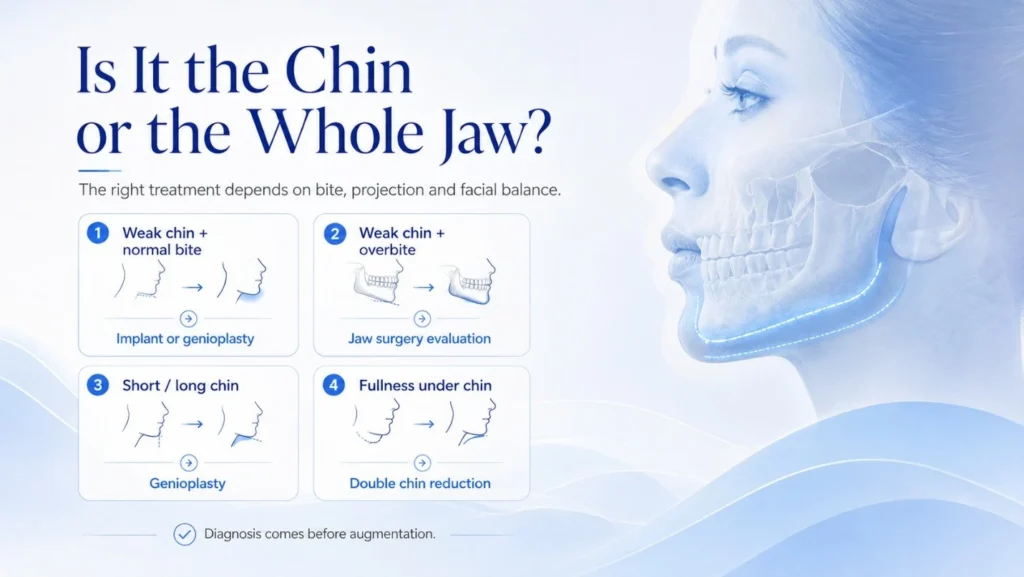
First Question: Is It Your Chin, or Your Whole Jaw?
This is where most disappointing results begin. A ‘weak chin’ can be a chin problem — or it can be the entire lower jaw sitting too far back, which is a different diagnosis with a different answer. Get this wrong and you buy an implant that camouflages a bite that stays wrong.
What you see | Likely cause | What actually corrects it |
| |
Chin sits back, but your teeth meet correctly | Isolated chin under-projection (microgenia) | Chin implant or genioplasty |
| |
Chin sits back AND your bite is off (overbite) | Mandibular retrusion — whole jaw | See orthognathic jaw surgery; implant is camouflage only |
| |
Chin is long or short vertically | Vertical chin excess or deficiency | Sliding genioplasty — an implant cannot change height |
| |
Chin points off-centre | Chin or mandibular asymmetry | Asymmetric genioplasty or custom implant |
| |
Jaw looks narrow from the front | Weak mandibular angles | Jaw angle implants |
| |
Jawline blurred by fullness under the chin | Submental fat | Double chin reduction — often combined |
| |
Lower face wide and square already | Masseter bulk | Masseter Botox — reduction, not augmentation |
| |
| The profile check worth doing before your consultation Photograph yourself from the side with your head level and teeth gently together. Drop an imaginary vertical line from the border of your lower lip. In balanced proportions the chin sits close to that line. If it falls well behind it, you have genuine chin under-projection — now check your bite: if your upper front teeth also sit well ahead of the lower ones, the whole jaw is likely retruded and you should be assessed for jaw surgery, not just an implant. If your bite is normal, an implant or genioplasty is likely the right conversation. This is an indication, not a diagnosis, but it tells you which questions to ask. | |||
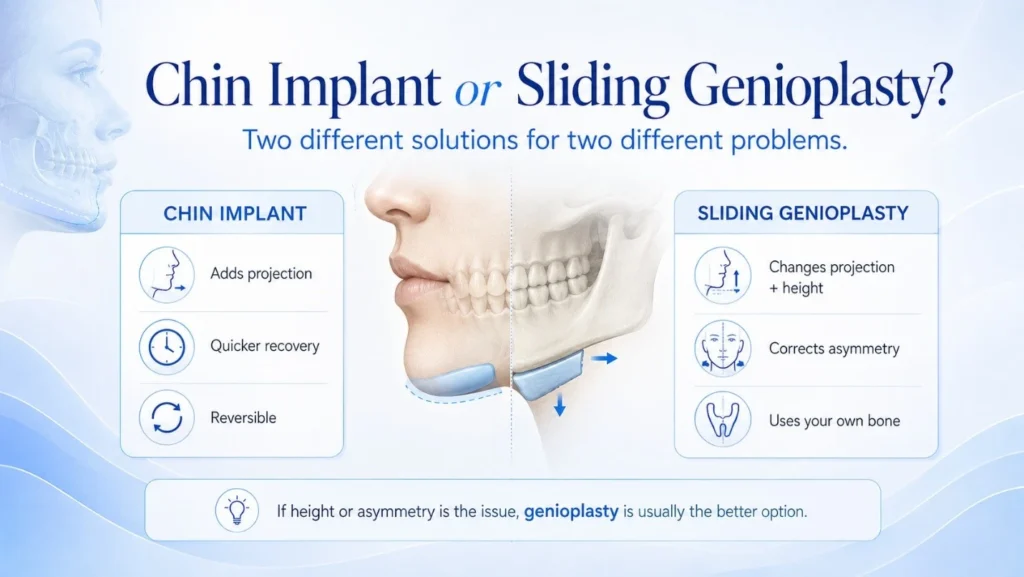
Chin Implant or Sliding Genioplasty? The Honest Comparison
This is the highest-value decision on the page, and most clinics present only whichever they prefer to perform. They do genuinely different things:
| Chin implant | Sliding genioplasty |
What it changes | Forward projection (and some width) | Projection, vertical height, asymmetry, and can also reduce |
Material | Silicone, porous polyethylene or custom PEEK | Your own bone, fixed with titanium plates |
Anaesthesia & time | Often local with sedation; 45–60 min | General anaesthesia; 60–120 min |
Recovery | Quicker — most back in a week | Longer — more swelling, soft diet |
Reversible? | Yes — implant can be removed | No — bone heals in the new position |
Key risks | Malposition, infection, bone resorption beneath | Nerve numbness, step-off, relapse |
Best for | Mild–moderate projection deficit, normal chin height | Vertical problems, asymmetry, larger movements, avoiding implants |
The two points most pages omit
- Bone resorption under chin implants is real. Pressure from an implant against the chin bone can cause gradual resorption of the bone beneath it. It’s frequently subtle and asymptomatic, occasionally significant, and it’s one of the strongest arguments for genioplasty in younger patients planning decades ahead. Ask any surgeon offering you an implant what they think about it — the answer tells you a lot.
- A deep crease below the lip won’t improve with an implant. If a prominent labiomental fold is part of what bothers you, adding projection alone can preserve or even accentuate it. Vertical lengthening — achievable only with genioplasty — is the reliable way to soften it.
Inside the Mouth or Under the Chin?
Both approaches are legitimate and the choice is genuinely clinical, not cosmetic preference:
Approach | Advantages | Trade-offs |
| |
Intraoral (inside lower lip) | No external scar at all | Higher infection risk with implants; the mentalis muscle origin is divided and must be reattached precisely |
| |
Submental (under-chin crease) | Better implant control and pocket precision; lower infection risk | A small scar — usually imperceptible in the natural crease |
| |
| Why the mentalis muscle matters more than patients realise The mentalis is the small muscle that supports the chin pad. Through an intraoral approach its origin has to be cut and then meticulously reattached; if that repair is inadequate, the chin soft tissue can sag over the implant — the deformity sometimes called ‘witch’s chin’. It’s uncommon in experienced hands and entirely avoidable with careful technique, but it’s the reason many surgeons prefer a submental approach for implants specifically. We’ll tell you which we’re recommending for you and why. | |||
Benefits of Jaw and Chin Augmentation
- A stronger profile. The most visible change, and the one people notice in photographs.
- A defined jawline and a cleaner chin-neck angle.
- Better facial balance. A projected chin balances the nose and lengthens the lower third proportionally.
- Correction of asymmetry with genioplasty or a custom implant designed to your scan.
- No visible scarring with the intraoral approach; a small hidden crease scar with the submental.
- Permanent structural change — unlike filler, which needs repeating.
- Reversibility with implants if you ever change your mind.
- Combines well. Frequently planned alongside double chin reduction, buccal fat removal, rhinoplasty or gender-affirming facial surgery.
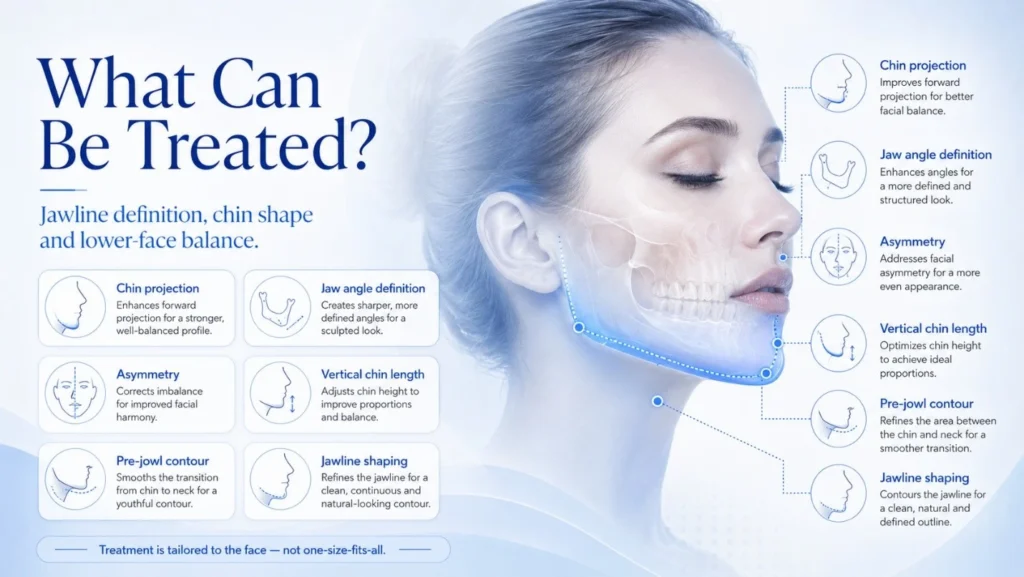
Areas Treated
- Chin — forward projection (the most common request).
- Chin — vertical height lengthening or shortening, via genioplasty.
- Chin width and shape — squarer or more tapered as suits the face.
- Mandibular angles — widening and squaring the back of the jaw.
- The jawline body — extended implants that blend chin to angle for a continuous contour.
- Pre-jowl area — filling the dip that develops in front of the jowl with age.
- Asymmetry correction across chin and jaw.
Concerns It Addresses
- Microgenia — a congenitally small or under-projected chin.
- A ‘weak’ profile where the chin sits behind the lip line.
- An undefined or narrow jawline.
- Vertical chin excess or deficiency — a chin that looks too long or too short.
- Chin or jaw asymmetry, congenital or post-traumatic.
- A deep labiomental crease below the lower lip.
- Age-related pre-jowl hollowing and loss of jaw definition.
- Gender-affirming contouring — as part of masculinization or feminization
When we’d steer you elsewhere If your bite is genuinely off, orthognathic surgery corrects the cause rather than disguising it. If the jawline is blurred mainly by fullness under the chin, submental liposuction may deliver more than any implant. If your lower face is already wide from masseter bulk, augmentation will make it wider — masseter Botox is the opposite and correct answer. And if skin laxity is the real issue, skin tightening addresses it. Augmenting the wrong problem is the most common reason people are unhappy with an otherwise well-performed operation. |

The Procedure, Step by Step
- Consultation, photographs and analysis. Profile assessment, bite check, and a decision on whether the problem is chin, jaw or soft tissue. Imaging where genioplasty or custom implants are planned.
- Optional filler trial. Where you’re undecided, chin or jawline filler can preview added projection reversibly before you commit to surgery.
- Implant selection or surgical planning. Size and shape chosen from anatomic ranges, or a patient-specific implant designed from your CT scan for complex and asymmetric cases; genioplasty movements planned digitally.
- Anaesthesia and access. Local with sedation or general, depending on the plan. Incision inside the lower lip or in the under-chin crease.
- Placement or osteotomy. The implant is positioned in a precisely-sized pocket on the bone and secured with screws where indicated; or the chin bone is cut, repositioned and fixed with titanium plates. Jaw angle implants are placed intraorally through separate pockets.
- Closure, support and home. Careful muscle repair, dissolvable sutures, supportive taping or a chin garment. Chin implant: 45–60 minutes; genioplasty or combined jaw and chin: 60–120 minutes. Day care in most cases.

Downtime & Recovery
Timeframe | What to expect |
Days 1–3 | Swelling and tightness; supportive tape or garment worn. Soft diet after intraoral work; mouth rinses after every meal. |
Days 4–7 | Swelling easing; most people return to desk work around day 5–7 after an implant, a little longer after genioplasty. |
Weeks 2–4 | Looking normal to others; chin may still feel firm or slightly numb. Normal diet resumes. |
Weeks 6–8 | Contour clearly settling; sensation returning; exercise resumed. |
Months 3–6 | Final result — soft tissue fully settled over the new framework. |
Aftercare
- Meticulous oral hygiene with prescribed rinses — with an implant near an intraoral incision, this genuinely protects against infection.
- Wear the supportive tape or garment exactly as instructed; it helps the soft tissue settle over the implant.
- Soft diet for about a week; avoid wide mouth opening and vigorous chewing early on.
- Sleep elevated for the first few nights, and avoid pressure or knocks to the chin.
- Report increasing pain, swelling or discharge immediately — early implant infection is far easier to treat than late.
- No contact sport for 6–8 weeks.
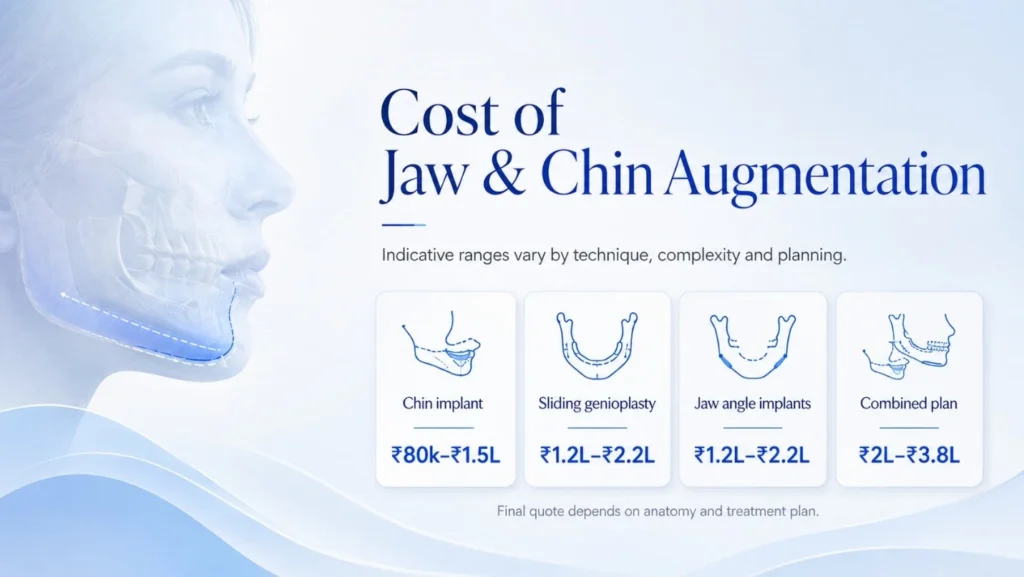
Cost of Jaw and Chin Augmentation Surgery
Cost depends on which procedure your anatomy actually calls for, whether one or both jaws-and-chin areas are treated, and whether a custom implant is used. These indicative ranges cover surgeon, anaesthesia, implant and follow-up. EMI options are available.
Procedure | Indicative cost (INR) |
| |
Chin implant (standard anatomic) | ₹80,000 – ₹1,50,000 |
| |
Sliding genioplasty | ₹1,20,000 – ₹2,20,000 |
| |
Jaw angle implants (pair) | ₹1,20,000 – ₹2,20,000 |
| |
Combined jaw + chin augmentation | ₹2,00,000 – ₹3,80,000 |
| |
Custom 3D-designed implant (per site) | + ₹50,000 – ₹1,50,000 |
| |
Chin / jawline filler (non-surgical trial) | ₹20,000 – ₹60,000 per session |
| |
Implant removal or exchange | Assessed case by case |
| |
| The filler-versus-implant maths, honestly Chin and jawline filler is genuinely useful — reversible, no downtime, and an excellent way to test whether more projection suits your face before committing. But run the numbers before you make it a long-term plan: at ₹20,000–₹60,000 every 12–18 months, the cost of maintaining a filler jawline passes the price of an implant within roughly three to four years, and keeps going. Use filler as a trial or for mild refinement; choose surgery if you know you want the change permanently. | ||
Results Timeline
When | What you’ll see |
Immediately | The new projection is there — but obscured by swelling. |
Weeks 2–4 | Swelling largely settled; the profile change becomes clear. |
Weeks 6–8 | Contour refining; firmness and numbness resolving. |
Months 3–6 | Final settled result. |
Long term | Permanent. Implants are stable but can be removed or exchanged; genioplasty bone heals in position. |
Comparing All the Options
Option | Best for | Permanent? | Downtime |
Chin implant | Projection deficit, normal chin height | Yes (removable) | 5–7 days |
Sliding genioplasty | Vertical change, asymmetry, larger movements | Yes | 7–14 days |
Jaw angle implants | Narrow jaw, weak angles | Yes (removable) | 7–10 days |
Trial, or mild refinement | No — 12–18 months | 1–2 days | |
Bite is genuinely off | Yes | 3–4 weeks | |
Jawline blurred by fat, not bone | Yes | 5–7 days |
Risks & Safety
Both operations are well established and satisfaction rates are high in appropriately selected patients. The honest risk list:
- Implant malposition or asymmetry — the commonest aesthetic complaint; minimised by precise pocket dissection and screw fixation.
- Infection — uncommon, but with an implant it can require removal to resolve; risk is higher via the intraoral route, which is why approach choice matters.
- Bone resorption beneath a chin implant — documented and usually subtle, but a genuine long-term consideration, especially in younger patients.
- Mental nerve injury — numbness of the lower lip and chin; usually temporary, occasionally longer-lasting after genioplasty.
- Chin pad ptosis (‘witch’s chin’) — from inadequate mentalis muscle repair via the intraoral approach; avoidable with careful technique.
- Step-off or palpable edge after genioplasty — managed with bone smoothing and graft material.
- Under- or over-correction — which is exactly why a filler trial is worth considering first if you’re unsure.

Why Dr. Arun Panda — Both Operations, and the Judgement to Choose
The advantage here isn’t performing chin implants — many clinics do. It’s being able to offer implants, genioplasty AND orthognathic surgery, and therefore having no incentive to fit your anatomy to whichever one is on the menu. Dr. Arun Panda is a Cranio-Maxillofacial and fellowship-trained Facial Plastic and Cosmetic Surgeon and founder of Trinity Aesthetics Academy. The mandible and chin are his primary surgical territory.
- The full ladder of options. Filler, implant, genioplasty and jaw surgery — so the recommendation follows your anatomy, not the inventory.
- Bite assessed before aesthetics. If your chin problem is really a jaw problem, you’ll be told — even though the implant would have been the easier sale.
- Custom implant planning from CT data for asymmetric and complex cases.
- Meticulous mentalis repair and considered approach selection — the technical details that separate a good chin result from a sagging one.
- Whole lower-face planning. Augmentation considered alongside submental contouring and buccal fat removal, since jawline definition is rarely about one thing.
In Vashi — and accessible from across India Bodyskulpt Aesthetics is in the heart of Vashi, Navi Mumbai, easily reached from Kharghar, Panvel, Belapur, Nerul, Airoli, Thane and across Mumbai. Jaw and chin augmentation is a planned, single-stage procedure, so patients regularly travel to us from other cities — video consultations are available beforehand, and consultation, surgery and review can be scheduled efficiently. EMI options available. |
Frequently Asked Questions
How much does jaw and chin augmentation surgery cost in India?
A standard chin implant runs approximately ₹80,000–₹1,50,000, sliding genioplasty ₹1,20,000–₹2,20,000, and a pair of jaw angle implants ₹1,20,000–₹2,20,000. A combined jaw and chin plan is typically ₹2,00,000–₹3,80,000, with custom 3D-designed implants adding ₹50,000–₹1,50,000 per site. Chin or jawline filler, useful as a trial, is ₹20,000–₹60,000 per session. EMI options are available.
Chin implant or sliding genioplasty — which is better?
Neither is universally better; they do different things. An implant adds forward projection and is quicker, less invasive and reversible — ideal when your chin height is normal and you need moderate projection. A sliding genioplasty repositions your own bone and is the only option that can change vertical chin height, correct asymmetry, or reduce a chin. Genioplasty also avoids the bone resorption that can occur beneath an implant, which matters more the younger you are.
Is my weak chin actually a jaw problem?
Often, yes. If your chin sits well behind a vertical line dropped from your lower lip AND your upper front teeth sit well ahead of your lower ones, the whole lower jaw is likely retruded rather than just the chin. In that case an implant camouflages the profile while leaving the bite uncorrected — orthognathic jaw surgery addresses the actual cause. If your bite is normal, chin augmentation alone is usually appropriate.
Will there be a visible scar?
Not with the intraoral approach, where the incision is inside the lower lip. With the submental approach a small incision sits in the natural crease under the chin and is usually imperceptible once healed. The submental route gives better implant control and carries a lower infection risk, so it’s often preferred for implants specifically — the choice is clinical rather than cosmetic.
Can a chin implant be removed later?
Yes. Implants can be removed or exchanged, which is one of their genuine advantages over bone surgery. Removal is another operation with its own risks, and soft tissue does not always return exactly as it was, so it shouldn’t be treated as a trial — but the option exists, unlike with genioplasty where the bone heals in its new position.
Do chin implants cause bone loss?
Some resorption of bone beneath a chin implant is documented and is usually subtle and asymptomatic, though occasionally more significant. It’s a legitimate reason to prefer sliding genioplasty in younger patients planning for decades ahead, and a reasonable question to ask any surgeon recommending an implant. Screw fixation and correct implant sizing and positioning reduce the risk.
What is the recovery time?
Most people return to desk work 5–7 days after a chin implant and 7–14 days after genioplasty. Swelling largely settles by weeks 2–4, firmness and numbness resolve over 6–8 weeks, and the final contour appears at 3–6 months. Soft diet and mouth rinses are needed for about a week after intraoral surgery.
Should I try fillers first?
It’s often sensible if you’re undecided. Chin or jawline filler previews the effect of added projection reversibly and with minimal downtime, letting you see whether the change suits your face. Just be aware of the maths: maintaining a filler jawline at ₹20,000–₹60,000 every 12–18 months exceeds the cost of an implant within about three to four years.
Book a Profile Assessment
Find out what your lower face actually needs — before anyone recommends an implant. Book with Dr. Arun Panda at Bodyskulpt Aesthetics, Sector 9, Vashi, Navi Mumbai. You’ll get a proper profile and bite assessment, a clear explanation of whether an implant, genioplasty, jaw surgery or something simpler suits you, the option of a reversible filler trial first, and an itemised quote. Video consultations available for patients travelling from other cities. Explore jaw surgery, double chin reduction, or book a consultation. Call / WhatsApp: 9152020907 / 9152020908 • drarunpanda.com • EMI available |
Authoritative references
For independent information, see the American Society of Plastic Surgeons on chin surgery, Cleveland Clinic on jaw implants and NCBI StatPearls on genioplasty.
Please reach out to us through the contact details below.
- Website: https://drarunpanda.com/
- Phone: +919152020907, +919152020908
- Address: Dr. Arun Panda, BodySkulpt Aesthetics, F1/A-4, Aditi Apartments, Sector 9, Vashi, Navi Mumbai – 400703
- Facebook: https://www.facebook.com/DrArunPanda
- Instagram: https://www.instagram.com/drarunpanda/
- Youtube: https://www.youtube.com/DrArunPanda
- LinkedIn: https://www.linkedin.com/in/drarunpanda
- Twitter: https://twitter.com/DrArunPanda1
- Email: facialaestheticsindia@gmail.com
- Google Directions: https://g.page/DrArunPanda?gm
