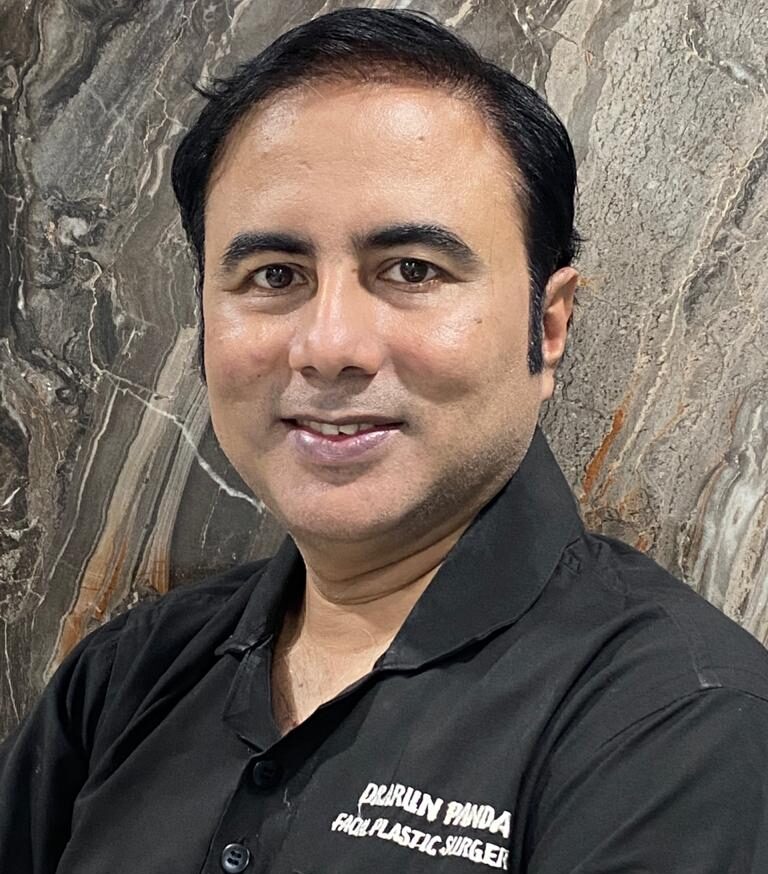
Hair Transplant in Navi Mumbai
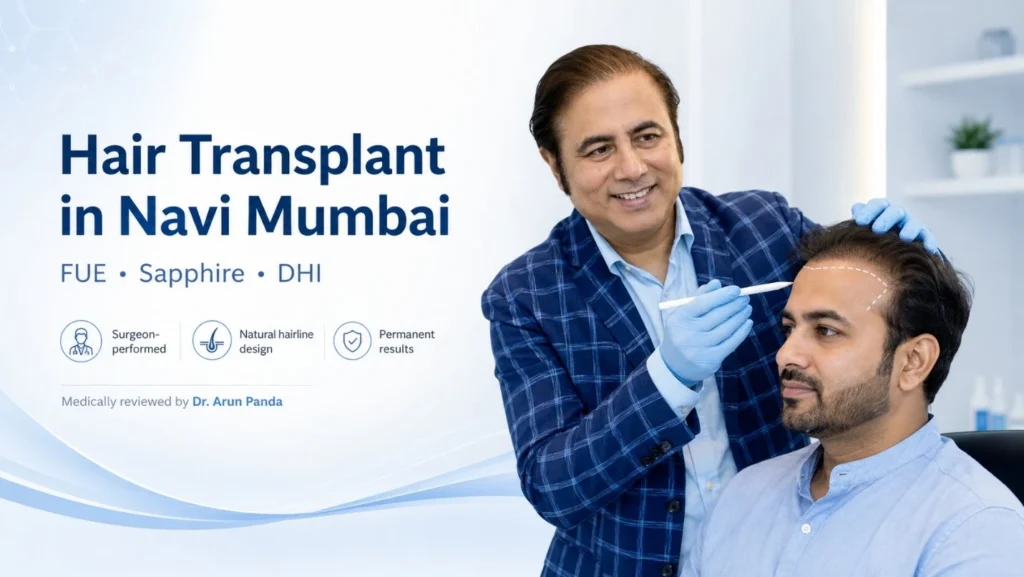
What a Hair Transplant Really Is and Isn’t
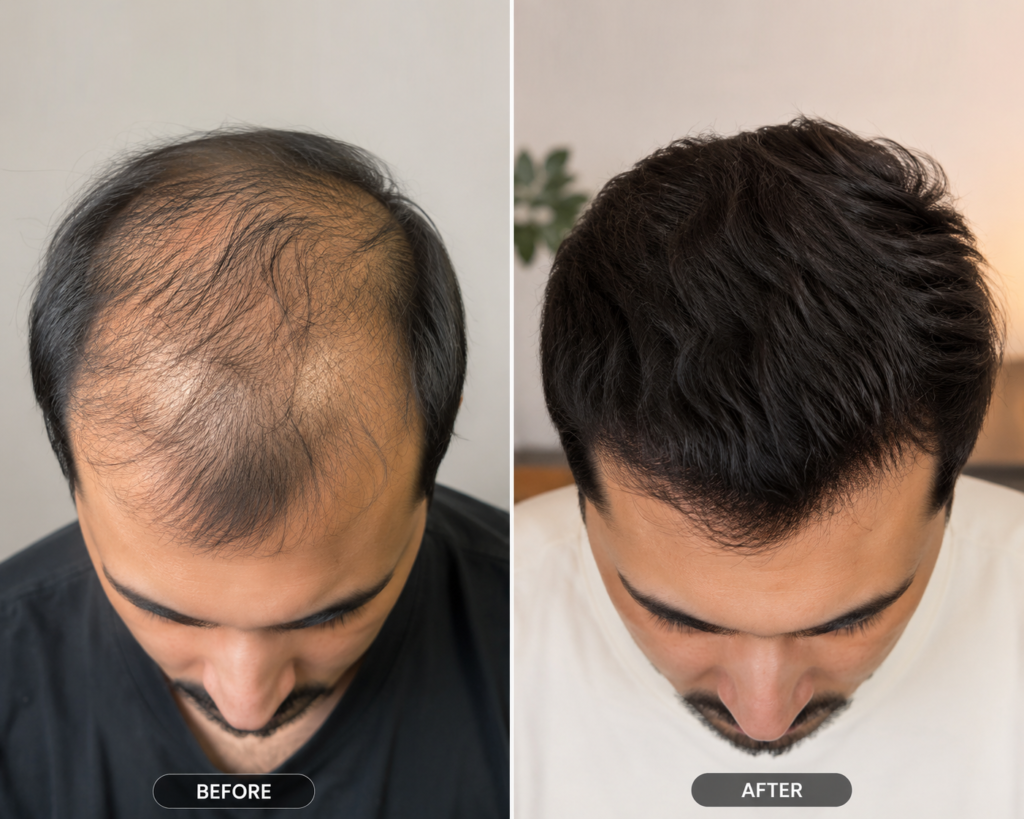
Male- and female-pattern hair loss happens because follicles across the top of the scalp are genetically sensitive to DHT, a by-product of testosterone — while the hair at the back and sides is genetically resistant and keeps growing for life. A hair transplant doesn’t create new hair; it redistributes that permanent hair into the areas that have thinned. Because the follicles carry their DHT-resistance with them, they keep growing in their new position permanently.
That’s the honest framing, and it carries two implications most clinics skip. First, your donor supply is finite — there are only so many permanent follicles to move, so they must be planned across your lifetime of hair loss, not spent freely on one dense hairline at 28. Second, a transplant does nothing to protect the native hair you still have. If your loss is still active and unmanaged, it will continue behind the transplant — which is why medical stabilisation comes first at any honest clinic.
The Question That Decides Everything: Who Actually Performs Your Surgery?
India has world-class hair transplant surgeons — and, alongside them, a large industry of centres where the ‘surgeon’ you meet at consultation never touches the instruments, and the entire procedure is done by technicians. The difference isn’t cosmetic: published comparisons put graft survival at 90–95% in surgeon-led clinics, falling sharply — sometimes to 50–70% — at technician-operated centres, where longer graft handling times, poor storage and imprecise site creation kill follicles before they ever grow. A cheap procedure where a third of your grafts die is not a saving; it’s the most expensive mistake in this field, paid for with donor hair you can never get back.
Five questions to ask any clinic including ours
- Who performs the extraction, the site creation, and the implantation — by name and qualification?
- How many procedures has that person — not the clinic — performed?
- What graft survival rate do you achieve, and how do you know?
- Will the surgeon design my hairline personally, and will I approve it before we start?
- What happens if something goes wrong — is a doctor present throughout?
Our answer, on the record At Bodyskulpt Aesthetics, Dr. Panda designs every hairline personally, performs and supervises the surgical steps, and is present throughout. He is also the founder of Trinity Aesthetics Academy, where he trains other doctors in hair transplantation — the techniques used here are the ones other practitioners come to learn. We’d rather compete on that than on the cheapest per-graft rate in the market. |
Before Surgery: Stabilise the Loss, or You’ll Chase It for Years
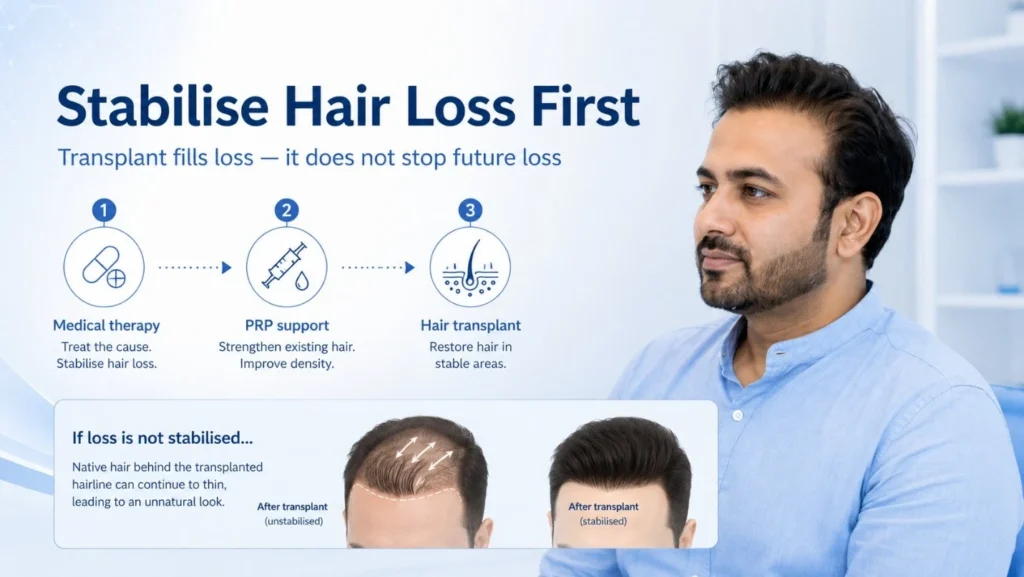
A transplant fills in what’s already lost. It does not slow what’s still going. A 30-year-old with active loss who transplants his hairline and takes no medical management can watch native hair recede behind the transplant over the following years — producing an island of transplanted hair and a fresh bald band behind it, then a second surgery, then a third.
The honest sequence is: assess and stabilise first — typically with medical therapy (finasteride and/or minoxidil, prescribed and monitored, with side-effects discussed openly) and, where useful, PRP hair treatment to support existing follicles — then transplant into a stable situation, with donor supply planned for anything the future may still bring. If a clinic quotes you graft numbers before asking what you’re doing about the hair you still have, that tells you what business they’re in.
How Many Grafts Do You Need? – By Stage of Hair Loss
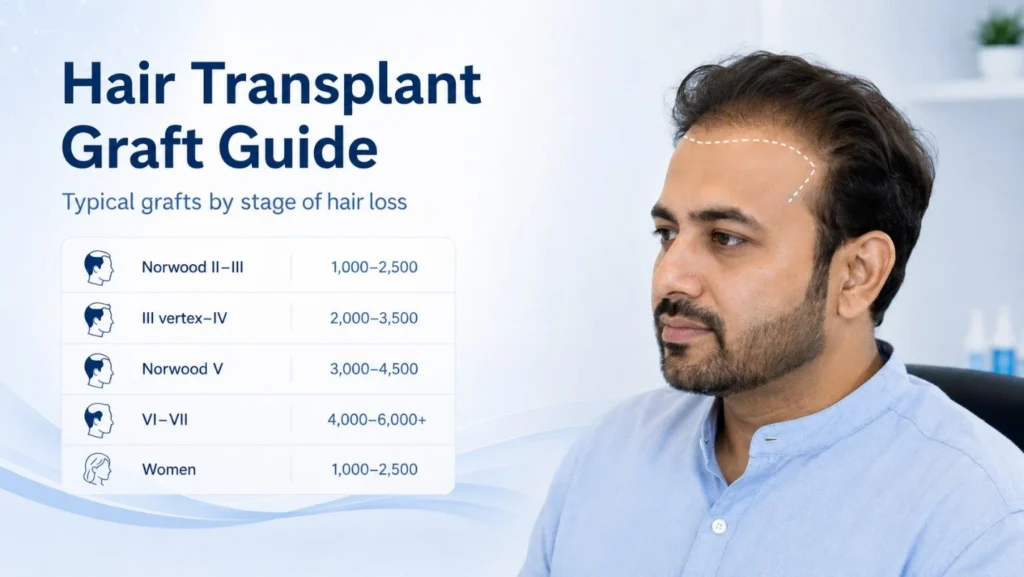
Graft numbers scale with your Norwood stage (the standard classification of male-pattern loss). These are honest indicative ranges — your exact number needs a scalp examination including donor-area assessment:
Stage of loss | What it looks like | Typical grafts |
Norwood II–III | Temple recession; early frontal thinning | 1,000 – 2,500 |
Norwood III vertex–IV | Recession plus a thinning crown | 2,000 – 3,500 |
Norwood V | Front and crown merging; bridge thinning | 3,000 – 4,500 |
Norwood VI–VII | Extensive baldness, horseshoe remaining | 4,000 – 6,000+ (often staged) |
Women (Ludwig I–II) | Diffuse central thinning, preserved hairline | 1,000 – 2,500 (selected cases) |
Hairline refinement only | Softening or lowering a stable hairline | 800 – 1,500 |
Two honesty notes: advanced stages (VI–VII) may exceed what scalp donor alone can supply — body hair can supplement, and expectations must be set for coverage rather than teenage density. And no ethical surgeon can quote your graft number over WhatsApp from a photo; donor density has to be examined.
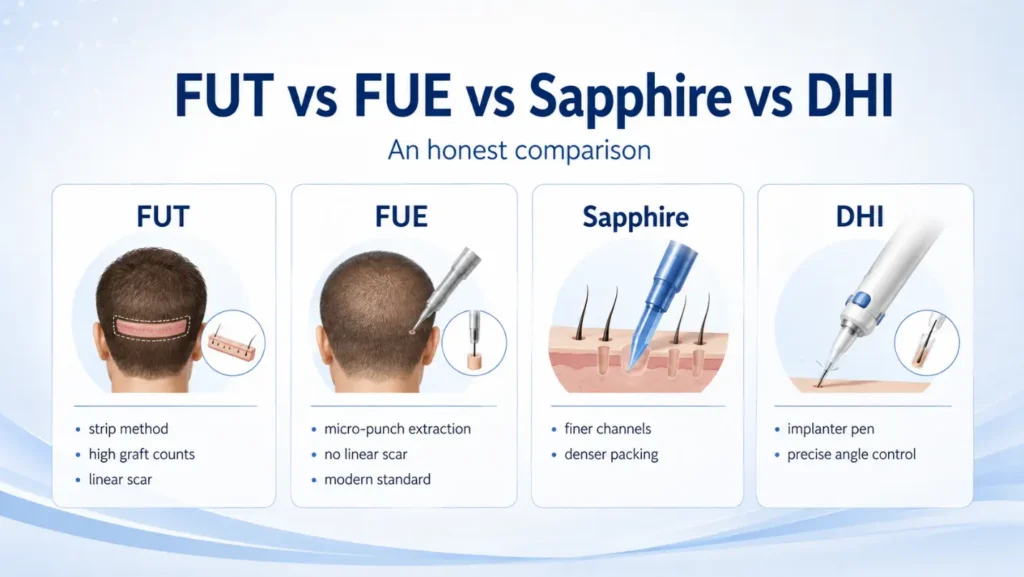
FUT vs FUE vs Sapphire vs DHI – an Honest Comparison
Technique | How it works | Scar | Best suited to | ||
FUT (strip) | A strip of donor scalp is removed and dissected into grafts | Linear scar (hidden by hair) | Very high graft counts; tight budgets | ||
FUE | Follicles extracted one by one with micro-punches | Tiny dots, invisible | The modern standard for most cases | ||
Sapphire FUE | FUE with sapphire-blade site creation | Tiny dots | Denser packing, finer channels | ||
DHI (implanter pen) | FUE extraction + direct implantation via Choi pen | Tiny dots | Hairline zones needing maximal angle control | ||
The machine doesn’t do the surgery Sapphire blades and implanter pens are genuinely useful instruments — and heavily marketed as if the equipment were the surgeon. It isn’t. Hairline design, angle and direction of each site, graft handling time and density judgement are human skills; a mediocre operator with a sapphire blade produces mediocre results with finer incisions. Choose the hands, then the instrument. We use FUE as standard, with Sapphire and DHI where they genuinely add control, and FUT only in select high-graft cases after discussing the scar honestly. | |||||
Who a Hair Transplant Helps and Who It Doesn’t
- Male-pattern baldness — receding hairline, thinning crown, or both; the classic indication.
- Women with pattern thinning — in carefully selected cases with stable, localised loss and good donor density; female hair loss needs particularly thorough diagnosis first.
- Hairline refinement — softening a harsh line or conservatively lowering a naturally high one.
- Scar camouflage — grafting into surgical, burn or accident scars on the scalp.
- Traction alopecia — loss from years of tight hairstyles, once the traction has stopped.
- Eyebrow restoration — over-plucked or scarred brows (a microblading alternative when real hair is wanted).
- Beard & moustache — see our dedicated beard hair transplant
When we’ll tell you no — or not yet Active, unstable loss in your early twenties (stabilise first; transplanting into a moving target wastes donor). Diffuse unpatterned thinning or suspected scarring alopecia / active alopecia areata (needs diagnosis and treatment, not surgery). Insufficient donor density for the coverage you want (we’ll show you the math rather than overpromise). Expectations of original teenage density (a transplant restores appearance and framing, not your 16-year-old head of hair). Uncontrolled diabetes, bleeding disorders or unmanaged scalp disease (medical work-up first). |
Benefits of a Hair Transplant
- Transplanted follicles are DHT-resistant and grow for life.
- Completely natural. It’s your own growing hair — cut it, style it, oil it, swim with it.
- A designed hairline. Age-appropriate framing that suits your face — the artistic half of the operation.
- No linear scar with FUE. Short haircuts remain possible.
- Single-day, walk-in walk-out. Local anaesthesia; home the same evening.
- One cost, lifelong result. Unlike systems, wigs and endless products.
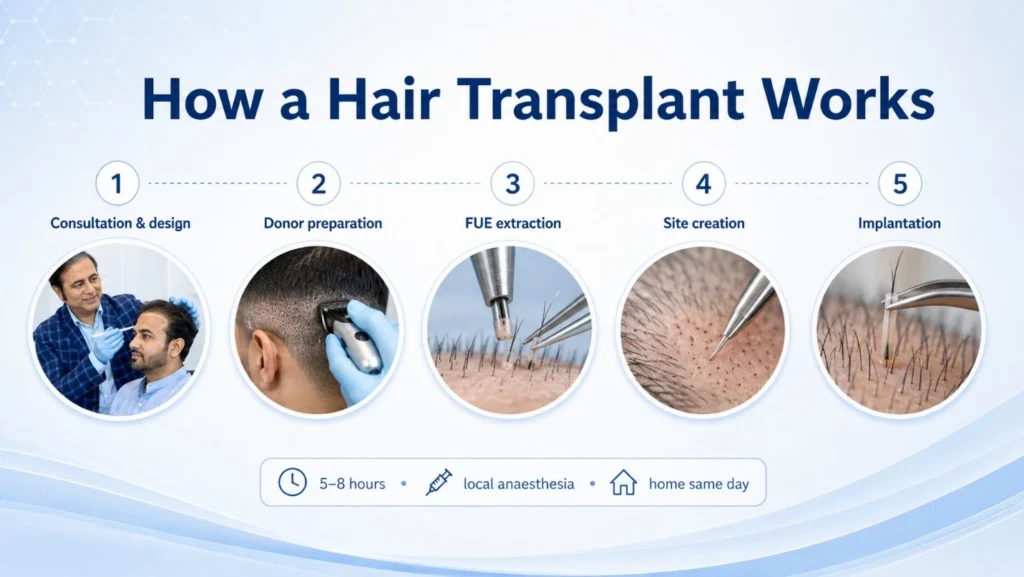
The Procedure, Step by Step
- Consultation & scalp examination. Pattern and stability of loss, donor density under magnification, medical history — and an honest conversation about stabilising treatment, graft numbers and lifetime donor planning.
- Hairline design. Drawn by Dr. Panda for your face shape and age, adjusted with you at the mirror, and only then agreed. This is where facial-surgery judgement matters most.
- Donor preparation & anaesthesia. The donor zone is trimmed and numbed; you’re awake and comfortable throughout, with breaks as needed.
- Follicular units are harvested with micro-punches and kept in chilled holding solution — handling time and storage are where graft survival is won.
- Recipient sites. Thousands of micro-incisions at natural angles and directions, denser at the frontal zone, softer single-hair units along the hairline edge.
- Implantation & home. Grafts placed one by one; a light dressing on the donor only; written aftercare, medication and follow-up plan. Total: 5–8 hours depending on graft count.
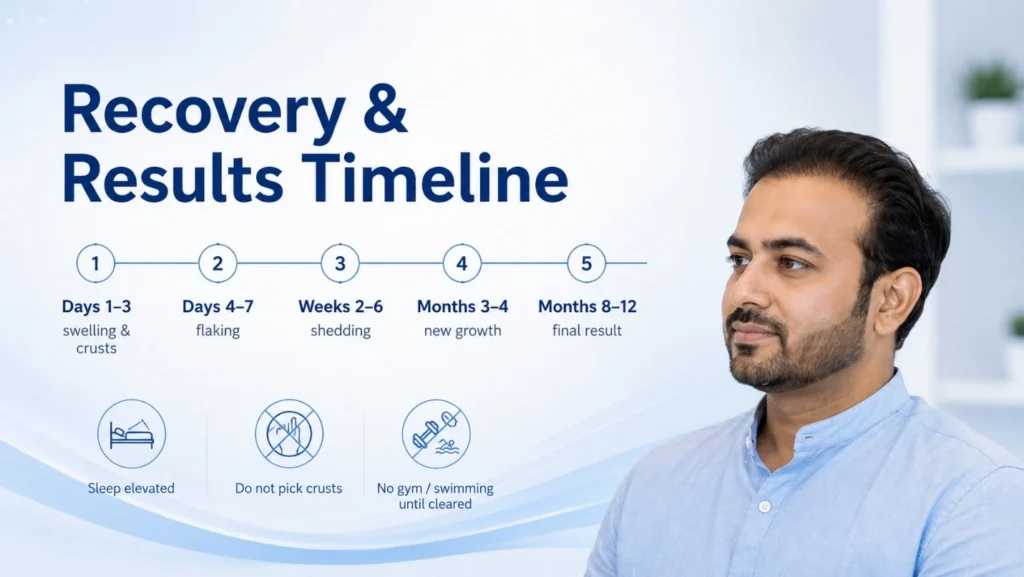
Downtime & Recovery
Timeframe | What to expect |
Days 1–3 | Mild swelling of forehead (can drift toward the brows); tiny crusts at each graft; donor area tender. |
Days 4–7 | Crusts flake with gentle washing as instructed; most people return to desk work around day 3–5. |
Days 10–14 | Scalp looks close to normal; haircut of surrounding hair possible. |
Weeks 2–6 | Transplanted hairs shed — normal ‘shock loss’; the roots stay. Don’t panic. |
Months 3–4 | New growth begins — fine at first, thickening steadily. |
Months 8–12 (to 18) | Full result matures; crown areas are typically the slowest. |
Aftercare essentials
- Wash exactly as instructed from the day you’re told — gentle pouring, no shower jet on grafts for the first days.
- Sleep elevated, on your back for the first several nights.
- No gym, swimming, helmets or caps until cleared; no sun on the scalp.
- Don’t pick crusts; don’t scratch. Itching means healing — use the prescribed spray.
- Continue your medical management — the transplant protects nothing; the medication protects the rest.
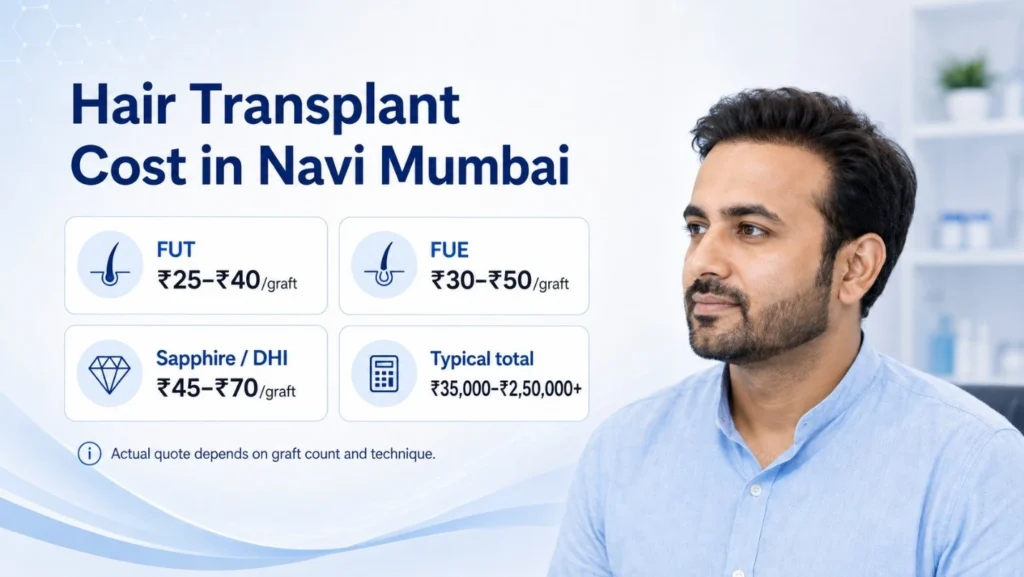
Cost of Hair Transplant in Navi Mumbai
Hair transplants are priced per graft, so the honest way to compare quotes is per graft × the grafts your stage needs — plus what’s included. Navi Mumbai rates for equivalent expertise typically sit below South Mumbai and Bandra. Indicative 2026 ranges:
Technique | Per graft | 2,000 grafts | 3,500 grafts |
FUT (strip) | ₹25 – ₹40 | ₹50,000 – ₹80,000 | ₹90,000 – ₹1,40,000 |
FUE (standard) | ₹30 – ₹50 | ₹60,000 – ₹1,00,000 | ₹1,05,000 – ₹1,75,000 |
Sapphire FUE / DHI | ₹45 – ₹70 | ₹90,000 – ₹1,40,000 | ₹1,60,000 – ₹2,45,000 |
Premium / robotic platforms | ₹60 – ₹180 | Quoted case by case | Quoted case by case |
What a fair quote includes: the procedure, anaesthesia, post-op medication, first follow-ups — and clarity on GST, PRP add-ons and any second-session pricing. For the full breakdown, hidden-cost checklist and EMI options, see our dedicated hair transplant cost guide for Navi Mumbai.
Why the ₹25-per-graft quote costs the most Below roughly ₹30 per graft, the economics only work with technician-performed surgery at speed — and speed is what kills grafts. If a third of your grafts don’t survive, your true cost per GROWING graft is higher than the premium clinic’s, and the donor hair those dead grafts came from is gone forever. Compare quotes on who operates and what survives, not on the sticker number. |
Results Timeline — the Honest Version
When | What’s happening |
Weeks 2–6 | Shedding phase — transplanted hairs fall out while roots stay. Expected, not failure. |
Months 3–4 | First new growth — fine, soft, sometimes patchy. Patience. |
Months 5–7 | Visible transformation begins; density builds month on month. |
Months 8–12 | Most of the final result visible; hair thickens and matures. |
Months 12–18 | Crown work and full maturation complete. Judge the result here, not at month 4. |
Hair Transplant vs the Alternatives
Option | What it does | Permanent? | Honest verdict |
Hair transplant | Relocates permanent follicles | Yes | The only way to regrow hair where follicles are gone |
Finasteride / minoxidil | Slows loss; can thicken existing hair | Only while used | Essential partner to surgery, not a rival |
Stimulates existing follicles | Needs maintenance | Good support for thinning; can’t fill bald skin | |
Scalp micropigmentation (SMP) | Tattooed illusion of stubble | Fades over years | Camouflage, not hair; useful for some |
Wigs / systems | External coverage | No | Immediate but lifelong cost and upkeep |
Is a Hair Transplant Safe?
In qualified hands, yes — it’s a day-care procedure under local anaesthesia on the most superficial layer of the scalp, using your own tissue. Expected effects: swelling, crusting, numbness patches and donor tenderness for days to weeks. Uncommon issues: folliculitis, temporary shock loss of native hair, and — almost entirely technique-dependent — poor growth, unnatural angles, visible punch scarring from oversized instruments, or donor over-harvesting. The pattern is consistent: the serious risks of this surgery are the risks of the wrong operator. We’ve written more in our guide, “Is a hair transplant safe?”.
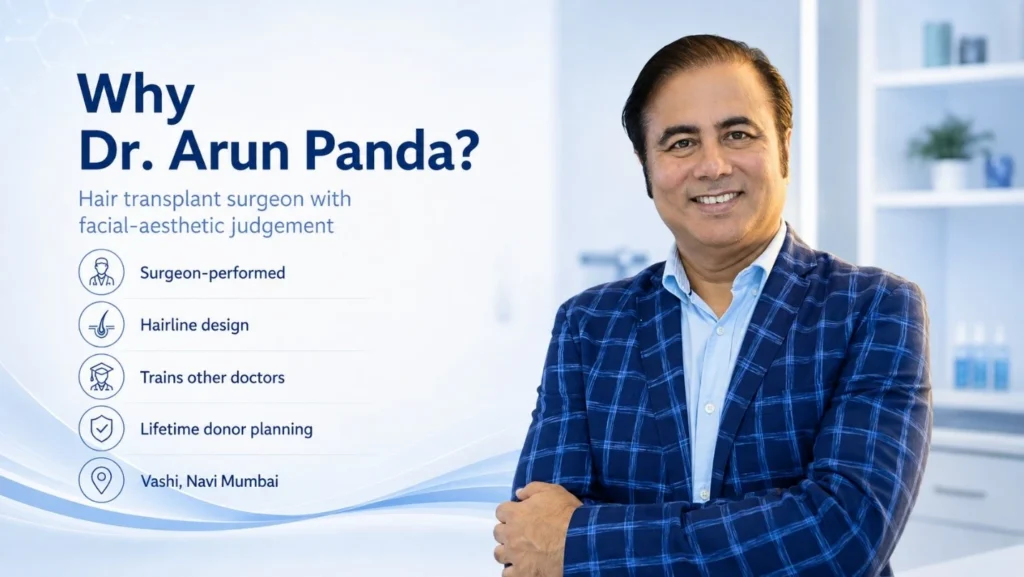
Why Dr. Arun Panda — the Hair Transplant Surgeon Other Doctors Train Under
Dr. Arun Panda is a Cranio-Maxillofacial and fellowship-trained Facial Plastic and Cosmetic Surgeon with 18+ years of surgical experience — and the founder of Trinity Aesthetics Academy, where practising doctors come to learn hair transplantation. If you’re searching for a hair transplant doctor or hair transplant surgeon in Navi Mumbai, that distinction — the surgeon who teaches the procedure versus clinics that market it — is the meaningful one.
- Surgeon-performed, start to finish. Design, surgical steps and supervision by Dr. Panda — answered on the record above.
- A facial surgeon’s hairline. Hairline design is facial aesthetics: proportion, symmetry, age-appropriateness. This is his home ground.
- Lifetime donor planning. Grafts budgeted across your future loss — including any later crown work or second session — so today’s hairline doesn’t bankrupt tomorrow’s options.
- Honest medicine first. Stabilising treatment and PRP where they serve you better than — or before — surgery.
- Full facial-hair capability. Scalp, beard and moustache, eyebrows and scar work under one roof.
Centrally located in Vashi — serving Navi Mumbai and Mumbai Bodyskulpt Aesthetics is in the heart of Vashi, easily reached from Kharghar, Panvel, Belapur, Nerul, Airoli, Thane and across Mumbai. EMI options available; out-of-town patients can be scheduled for consultation and surgery on consecutive days. |
Frequently Asked Questions
How much does a hair transplant cost in Navi Mumbai?
Per graft: roughly ₹25–₹40 for FUT, ₹30–₹50 for standard FUE and ₹45–₹70 for Sapphire FUE or DHI. Total cost depends on your graft count — typically ₹35,000–₹50,000 for small hairline cases up to ₹2,50,000+ for advanced staged work. A fair quote includes anaesthesia, medication and follow-ups; always confirm GST and any PRP add-ons. EMI options are available. See our dedicated cost guide for the full breakdown.
How many grafts will I need?
By stage: roughly 1,000–2,500 grafts for early recession (Norwood II–III), 2,000–3,500 with a thinning crown (III vertex–IV), 3,000–4,500 for Norwood V, and 4,000–6,000+ — often staged — for advanced loss. An exact number requires a scalp examination with donor assessment; no ethical surgeon quotes grafts from a WhatsApp photo.
Is a hair transplant permanent?
Yes — the transplanted follicles come from the DHT-resistant zone at the back and sides of the scalp and keep growing for life in their new position. But the transplant doesn’t protect your remaining native hair, which is why ongoing medical management matters alongside surgery.
Which is better — FUE, FUT, Sapphire or DHI?
FUE is the modern standard: no linear scar, faster healing. FUT still makes sense for very high graft counts on a budget, at the cost of a linear scar. Sapphire and DHI are refinements of FUE — finer site creation and tighter angle control — worth their premium in hairline zones. The operator matters far more than the instrument; a skilled surgeon with standard FUE beats a technician with a sapphire blade every time.
Who actually performs the surgery — does it matter?
It’s the single biggest factor in your result. Graft survival at surgeon-led clinics reaches 90–95%, and drops sharply at technician-operated centres due to handling time, storage and imprecise site creation. Ask by name who performs extraction, site creation and implantation — and be wary of any clinic where the doctor you meet at consultation disappears on surgery day.
What is the recovery time after a hair transplant?
Most people are back at desk work in 3–5 days. Crusts clear by day 10–14. Transplanted hairs shed at weeks 2–6 (normal shock loss), new growth starts around month 3–4, and the full result matures at 8–12 months — up to 18 for crown work.
Does a hair transplant stop hair loss?
No — and this is the most misunderstood fact in hair restoration. A transplant relocates permanent hair into bald areas; it does nothing to protect the native hair behind it. Without medical stabilisation (typically finasteride and/or minoxidil, sometimes with PRP), loss continues and you can end up chasing it with repeat surgeries. Stabilise first, transplant second.
Can women have hair transplants?
Yes, in carefully selected cases — typically stable, patterned thinning (Ludwig I–II) with good donor density. Female hair loss has more medical causes than male loss (thyroid, iron, hormonal), so thorough diagnosis comes first; surgery on an undiagnosed cause fails. Hairline lowering and eyebrow restoration are also options for women.
Is a hair transplant painful?
The procedure itself isn’t — local anaesthesia keeps you comfortable, and most patients watch films or nap. The anaesthetic injections sting briefly, and the donor area feels tender for some days afterwards, managed with simple medication.
Book a Scalp & Donor Assessment
An honest surgical opinion — from the surgeon other doctors train under. Book with Dr. Arun Panda at Bodyskulpt Aesthetics, Sector 9, Vashi, Navi Mumbai. You’ll get a proper scalp and donor examination, an honest view on stabilising treatment, your true graft number and a lifetime donor plan, a hairline designed for your face — and a clear itemised quote with EMI options. Read the cost guide, our beard transplant guide, or book a consultation. Call / WhatsApp: 9152020907 / 9152020908 • drarunpanda.com • EMI available |
Authoritative references
For independent information, see the International Society of Hair Restoration Surgery (ISHRS), the American Academy of Dermatology and peer-reviewed FUE literature.
Educational information only and not a substitute for an in-person surgical consultation. Graft numbers, costs and results vary between individuals and depend on donor supply, stage of loss and adherence to medical management.
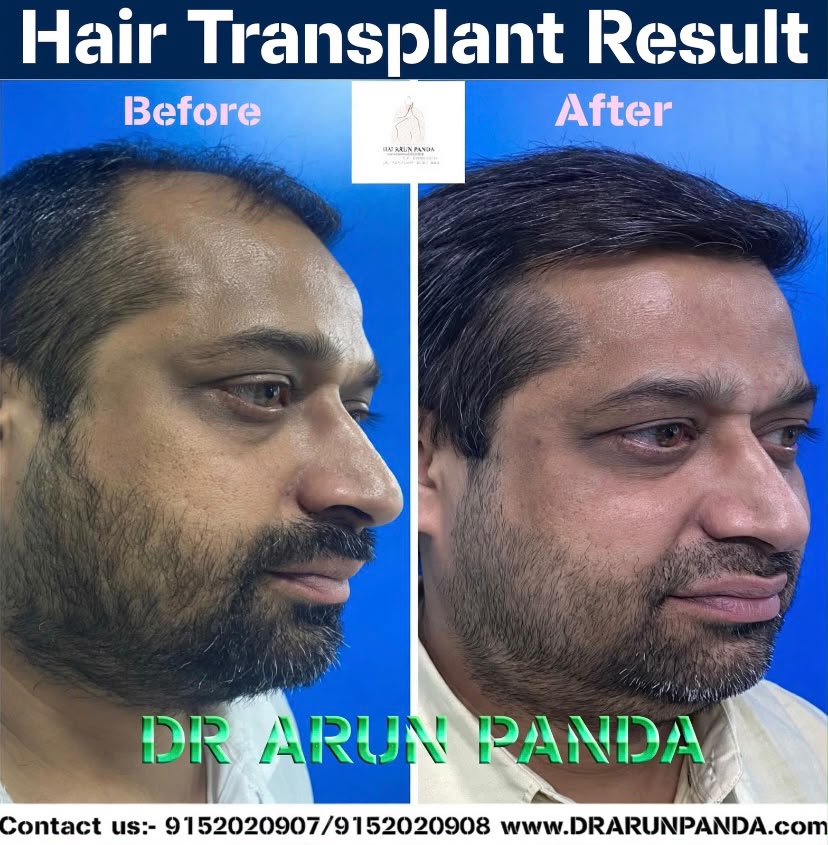
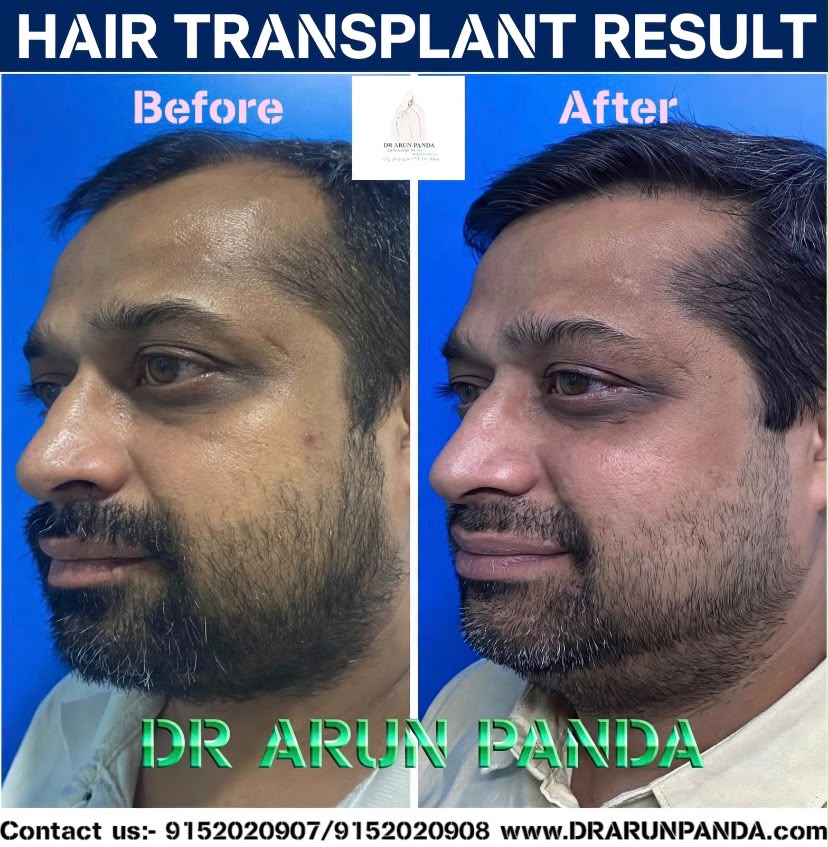
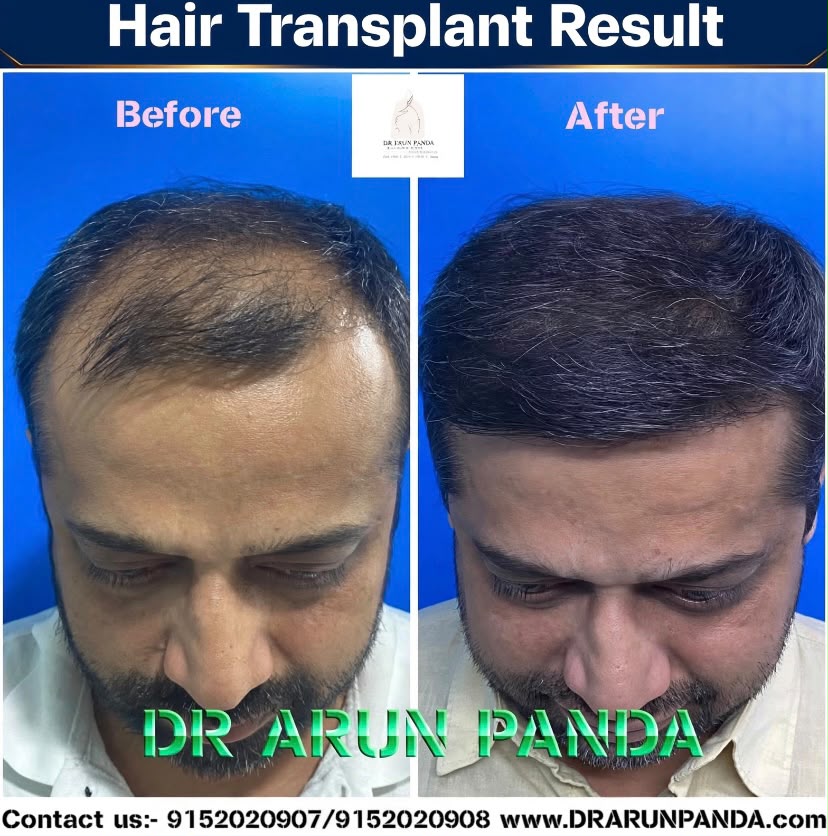
Please reach out to us through the contact details below.
- Website: https://drarunpanda.com/
- Phone: +919152020907, +919152020908
- Address: Dr. Arun Panda, BodySkulpt Aesthetics, F1/A-4, Aditi Apartments, Sector 9, Vashi, Navi Mumbai – 400703
- Facebook: https://www.facebook.com/DrArunPanda
- Instagram: https://www.instagram.com/drarunpanda/
- Youtube: https://www.youtube.com/DrArunPanda
- LinkedIn: https://www.linkedin.com/in/drarunpanda
- Twitter: https://twitter.com/DrArunPanda1
- Email: facialaestheticsindia@gmail.com
- Google Directions: https://g.page/DrArunPanda?gm



WHY CHOOSE US
CERTIFIED SPECIALISTS
OUR TEAM OF SPECIALISTS ARE CERTIFIED & EXPERIENCED SPECIALISTS & SURGEONS FOR A GUARANTEED SUCCESS AND MAXIMUM RESULT
CENTRALIZED LOCATION
The center is in Navi Mumbai and is easy to reach with the nearby bus stop, railway station, and taxi stand.
TEAM APPROACH
Specialists collaborate during surgery or communicate to achieve optimal outcomes when necessary.
ADVANCED TECHNOLOGY
WE UTILIZE ULTRA MODERN AND HIGHLY EFFECTIVE TECHNOLOGY FOR FACIAL PLASTIC SURGERIES AND COSMETIC TREATMENTS
AFFORDABLE
OUR TREATMENTS AND PROCEDURES ARE TOTALLY AFFORDABLE AND WITHIN THE REACH OF COMMON MAN. WE BELIEVE IN QUALITY, SAFETY, AND ECONOMICAL TREATMENTS.
REPUTATION & EXPERIENCE
Dr. Arun is a talented surgeon in Mumbai. He focuses on facial surgery and has 18 years of experience.


EASY EMI OPTION
CENTRALLY LOCATED IN THE HEART OF NAVI MUMBAI AT VASHI
CUSTOMISED TREATMENT PLAN
WHY CHOOSE US FOR YOUR
HAIR RESTORATION
Near 100% Survival Rate of Grafts
NO VISIBLE MARKS OR SCARS
NO PAIN & MINIMUM DOWNTIME
HIGH DENSITY RESULTS & MAXIMUM RESULTS
NATURAL LOOKING HAIR
ASSURED RESULTS WITH MAXIMUM COMFORT
