Jaw and Chin Augmentation Surgery
When Braces Aren’t Enough
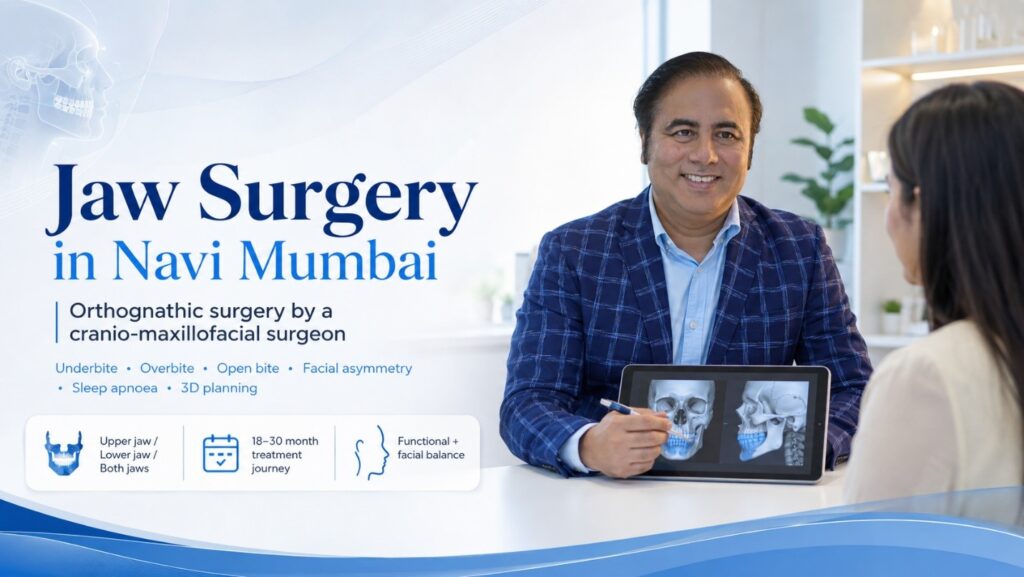
Braces move teeth. They move them through bone, quite precisely, and for most bite problems that’s sufficient. But if your teeth don’t meet because the jaws themselves are the wrong size or in the wrong position relative to each other, no amount of orthodontics fixes the underlying mismatch — it only tilts teeth to compensate for it. That compensation has limits, and pushed too far it damages roots, gums and the bite it was meant to correct.
Orthognathic surgery addresses the skeleton directly. The upper jaw (maxilla), the lower jaw (mandible), or both are cut, repositioned to a planned position, and fixed with small titanium plates while the bone heals. The bite meets properly, chewing and speech improve, breathing often improves — and the face becomes more balanced as a direct consequence of the bones being where they should have been.
It’s worth being clear that this is functional surgery first. The aesthetic change is often significant and is a legitimate part of why people choose it, but the primary case for orthognathic surgery is how your jaw works: whether you can bite, chew, breathe and speak properly. That distinction also matters practically, because it’s what determines whether insurance will contribute.
Is Your Problem the Teeth or the Bones?
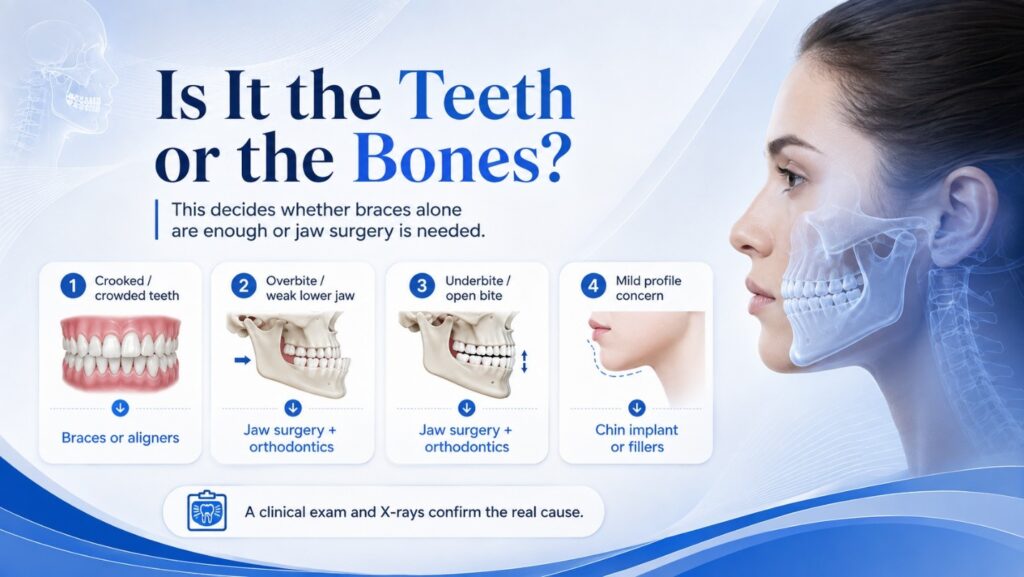
This is the question that decides your whole treatment path, and it’s worth understanding before you’re sitting in anyone’s chair:
What you notice | Likely cause | What corrects it | ||
Crooked or crowded teeth, jaws meet correctly | Dental — tooth position only | Braces or aligners alone | ||
Lower jaw sits well behind the upper; ‘weak’ chin, deep overbite | Skeletal Class II (mandibular retrusion) | Jaw surgery (mandibular advancement), often bimaxillary | ||
Lower jaw protrudes; underbite | Skeletal Class III (mandibular prognathism) | Jaw surgery (mandibular setback and/or maxillary advancement) | ||
Front teeth don’t touch when back teeth do | Skeletal open bite | Maxillary surgery — rarely correctable with braces alone | ||
One side of the face or jaw is visibly different | Facial asymmetry / uneven jaw | Asymmetric orthognathic correction with 3D planning | ||
Excessive gum shows when smiling | Vertical maxillary excess | Maxillary impaction (Le Fort I) | ||
Mild imbalance, bite is fine | Soft tissue / minor proportion | Non-surgical: chin augmentation or fillers | ||
A useful self-check — then get it assessed properly Bite gently and look in a mirror. Do your upper front teeth sit slightly in front of and over the lower ones (normal), well ahead of them (Class II), or behind them (Class III)? Do the front teeth fail to meet at all while the back ones touch (open bite)? Does your dental midline sit off-centre, or does one side of your jaw look longer than the other (asymmetry)? These point toward a skeletal rather than dental problem — but only a clinical examination with X-rays or a CBCT scan, ideally alongside an orthodontist, can settle it. | ||||
The Full Timeline — What Nobody Tells You Upfront
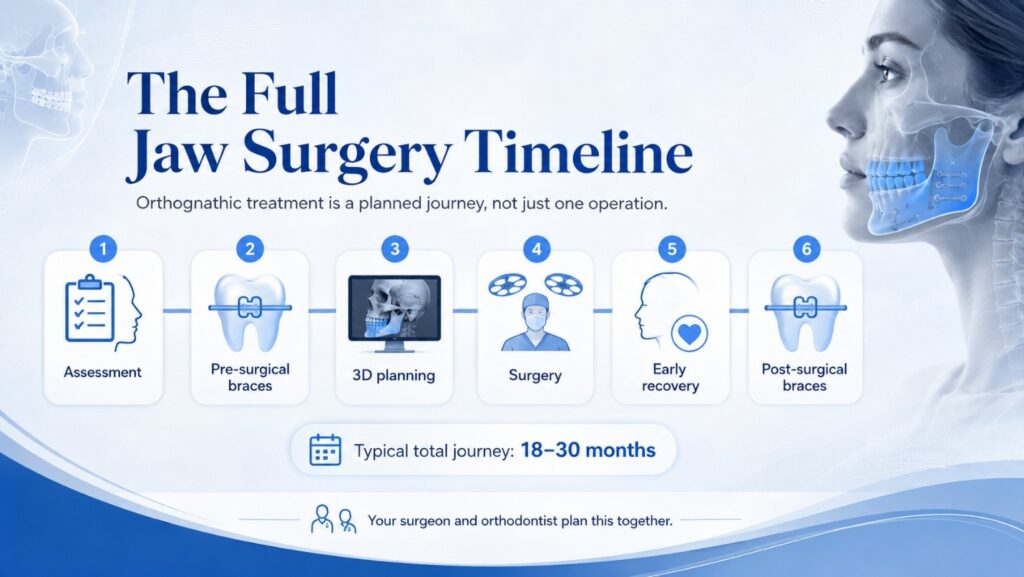
The single biggest surprise for jaw surgery patients isn’t the operation. It’s discovering that the operation sits in the middle of a process lasting roughly 18 to 30 months, and that it needs an orthodontist working alongside the surgeon from the very beginning.
Stage | Duration | What happens |
| |
1. Joint assessment & planning | 1–2 months | Examination, X-rays/CBCT, dental models, photographs. Surgeon and orthodontist agree the plan together. |
| |
2. Pre-surgical orthodontics | 12–18 months | Braces align the teeth within each jaw — and often make the bite look temporarily worse, because compensations are being removed. |
| |
3. Final surgical planning | 3–4 weeks | Fresh records and 3D virtual surgical planning; custom splints or cutting guides produced. |
| |
4. Surgery & hospital stay | 2–3 days | The operation itself, then discharge once eating and pain control are settled. |
| |
5. Early recovery | 6–8 weeks | Soft diet, elastics guiding the bite, close follow-up while bone heals. |
| |
6. Post-surgical orthodontics | 6–12 months | Braces finish the bite precisely, then retainers. |
| |
| Two things worth knowing about that timeline First, stage 2 is psychologically the hardest part: the braces deliberately UNDO the compensations your teeth developed, so for several months your bite and profile can look worse before surgery makes them better. This is planned, not a mistake — but nobody warns people, and it causes a lot of unnecessary alarm. Second, a ‘surgery-first’ approach is available in selected cases, where surgery is performed before the braces phase. It can shorten total treatment substantially and gives an early aesthetic improvement, but it isn’t suitable for everyone — we’ll tell you honestly whether you’re a candidate. | |||
Conditions We Treat
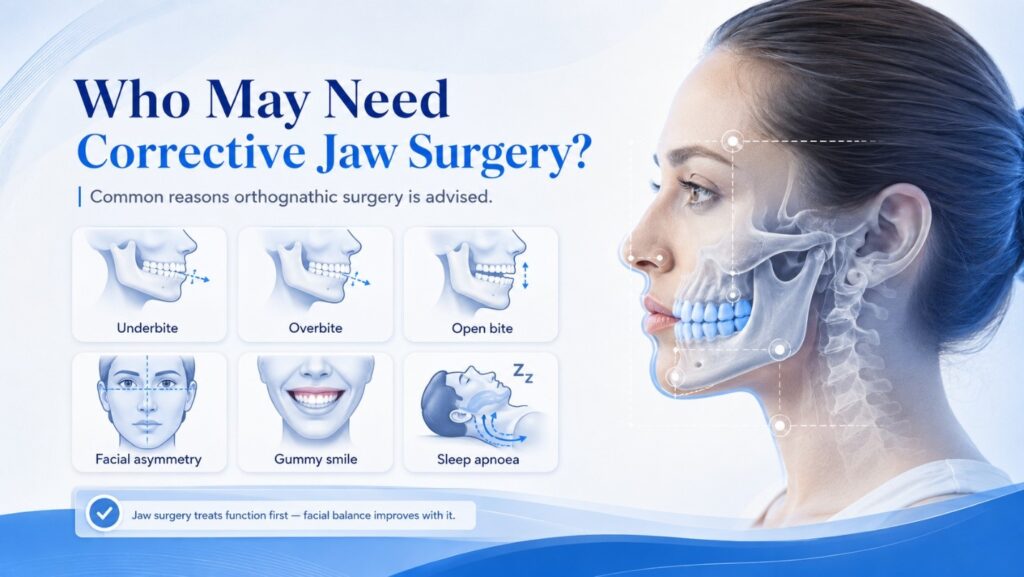
- Underbite (skeletal Class III) — the lower jaw sits ahead of the upper.
- Overbite / receding lower jaw (skeletal Class II) — often with a chin that looks weak and a short lower face.
- Open bite — front teeth that never meet; difficulty biting into food.
- Facial asymmetry and uneven jaw — including chin deviation and one-sided jaw overgrowth.
- Gummy smile from vertical maxillary excess — corrected by impacting the upper jaw.
- Long face or short face syndrome — vertical proportion problems.
- Obstructive sleep apnoea — maxillomandibular advancement enlarges the airway and is among the most effective surgical treatments available for it.
- Chewing, biting and speech difficulty arising from jaw position.
- TMJ pain associated with skeletal imbalance — assessed carefully, since not all TMJ pain is skeletal.
- Post-traumatic malunion and congenital or cleft-related jaw deformity.
- Sleep apnoea and skeletal correction as part of facial feminization or masculinization
Benefits of Corrective Jaw Surgery
- A bite that actually works. Even contact across the teeth, so chewing is efficient and forces are distributed properly.
- Protection of your teeth long term. Correct loading reduces abnormal wear, fracture risk and gum recession.
- Better breathing and sleep. Advancing the jaws enlarges the airway — often transformative in obstructive sleep apnoea.
- Clearer speech where articulation was affected by jaw position; documented improvements after bimaxillary correction.
- Facial balance and profile. Chin projection, lip posture and facial proportion improve as a direct result of skeletal correction.
- Relief of strain in the jaw muscles and joints where imbalance was the cause.
- Permanent, structural correction. This is bone in its correct position, not a camouflage.
- Possible insurance contribution where a functional indication is documented — unlike purely cosmetic surgery.
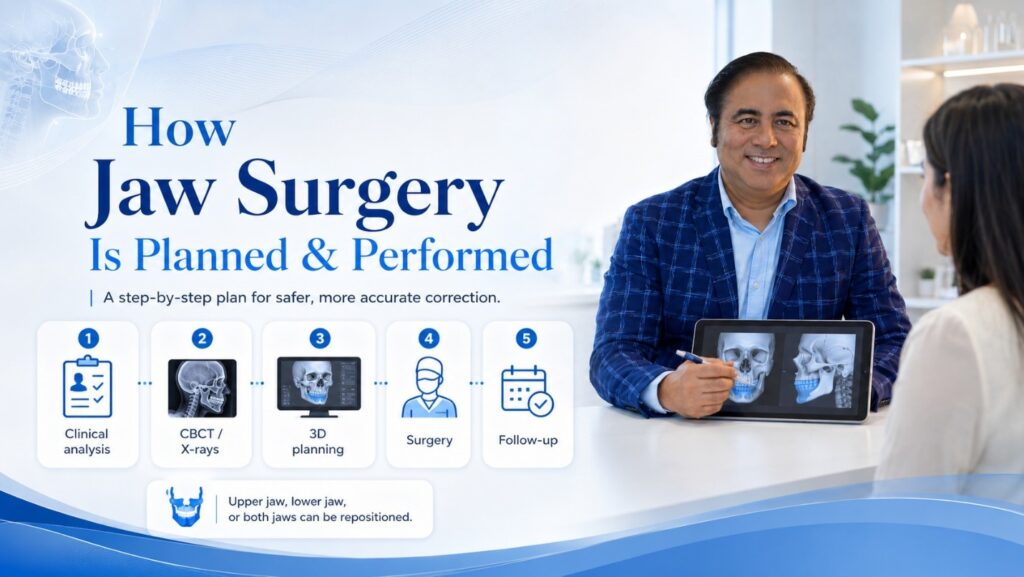
- Joint consultation and records. Clinical examination, CBCT or X-rays, photographs and dental impressions. Where you don’t already have an orthodontist, we’ll coordinate with one.
- 3D virtual surgical planning. Your scan is used to plan the exact movements digitally — millimetres and angles decided in software before theatre, with custom splints or cutting guides produced to transfer that plan accurately to surgery.
- Upper jaw — Le Fort I osteotomy. The maxilla is separated above the tooth roots and repositioned forward, upward or rotated as planned, then fixed with titanium plates.
- Lower jaw — bilateral sagittal split osteotomy (BSSO). The mandible is split on both sides, advanced or set back to the planned position, and fixed. Both jaws are approached entirely from inside the mouth.
- Genioplasty where indicated. The chin segment can be repositioned in the same sitting for final balance — related to but distinct from chin augmentation with an implant.
- Recovery and guidance. Elastics guide the new bite while healing; you’re reviewed closely, with post-surgical orthodontics resuming once the surgeon clears it. Surgery itself runs 2–5 hours depending on whether one or both jaws are moved.
No external scars Both jaw osteotomies are performed through incisions inside the mouth. There are no cuts on the face and no visible scars. Small titanium plates and screws hold the bone in position; they are generally left in place permanently and rarely need removal. |
Recovery — an Honest Timeline
Timeframe | What to expect |
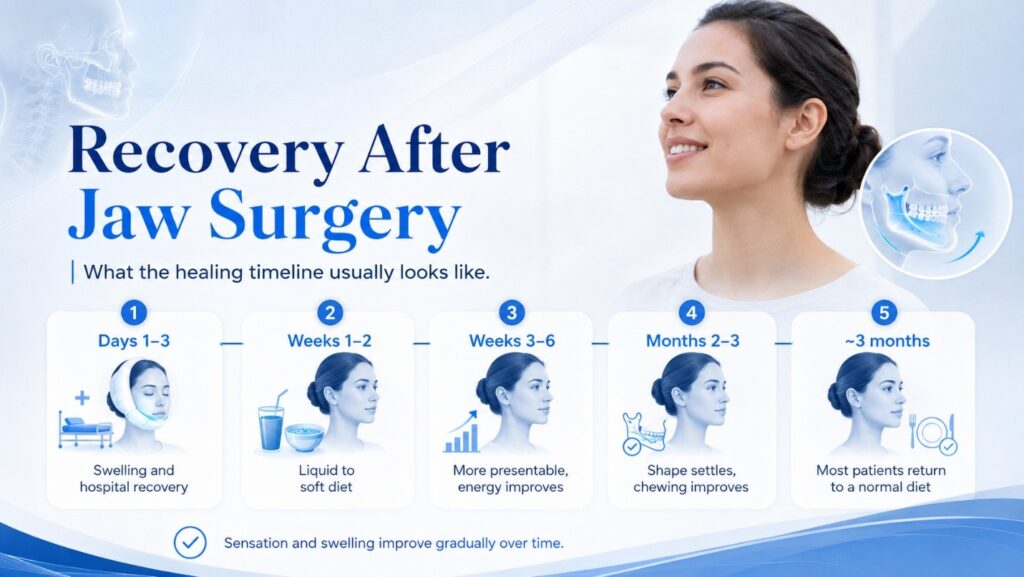
Days 1–3 | Hospital stay. Significant facial swelling peaking around 48–72 hours; liquid diet; nasal congestion is common after upper-jaw work. |
Week 1–2 | Swelling begins to fall; still marked. Liquid to very soft diet. Speech feels awkward. Most people are home and mobile. |
Weeks 3–4 | Noticeably better; many return to desk work or study. Soft diet continues; elastics worn as directed. |
Weeks 6–8 | Bone healing well advanced; diet expands gradually. Numbness of the lower lip and chin is common at this stage. |
Months 3–6 | Normal diet; swelling largely resolved; post-surgical orthodontics in progress. |
Months 6–12 | Final result — bite settled, facial swelling fully gone, sensation continuing to recover. |
Practical aftercare
- Follow the diet stages exactly. Liquid, then soft, then normal — rushing this risks the fixation and the result.
- Meticulous oral hygiene with prescribed rinses; all incisions are inside the mouth.
- Sleep elevated for the first 2 weeks and use cold compresses early to limit swelling.
- Wear elastics as instructed — they guide the bite into its new position and materially affect the outcome.
- Plan 3–4 weeks away from work or study, longer for physically demanding jobs. No contact sport for 3 months.
- Expect weight loss during the liquid-diet phase; we’ll advise on nutrition so it doesn’t slow healing.
Cost of Jaw Surgery in Navi Mumbai
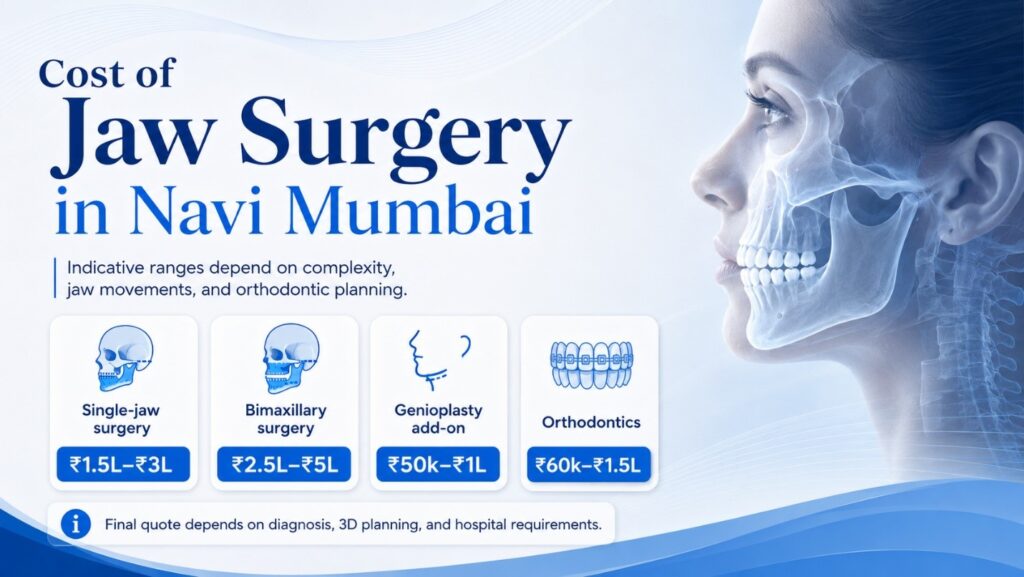
Orthognathic surgery is quoted per case, because a single-jaw advancement and a bimaxillary correction with genioplasty are very different operations. These indicative ranges include hospital stay, anaesthesia, fixation plates and 3D planning. Orthodontic treatment is billed separately by your orthodontist. EMI options are available.
Procedure | Indicative cost (INR) |
| |
Single jaw — upper (Le Fort I) or lower (BSSO) | ₹1,50,000 – ₹3,00,000 |
| |
Bimaxillary (both jaws) | ₹2,50,000 – ₹5,00,000 |
| |
Genioplasty added to jaw surgery | + ₹50,000 – ₹1,00,000 |
| |
Asymmetry correction (complex 3D planning) | ₹3,00,000 – ₹5,50,000 |
| |
Maxillomandibular advancement for sleep apnoea | ₹3,00,000 – ₹5,50,000 |
| |
Pre- and post-surgical orthodontics (separate) | ₹60,000 – ₹1,50,000 |
| |
| Insurance — check before you assume Because orthognathic surgery is frequently a functional necessity rather than a cosmetic choice, health insurance will sometimes contribute — particularly where there is documented difficulty chewing, a significant skeletal discrepancy, obstructive sleep apnoea, or a congenital or post-traumatic deformity. Approval depends heavily on how well the functional indication is documented, so proper clinical records, imaging and a clear surgical rationale matter. We’ll prepare the documentation properly and tell you honestly how strong your case is; what we won’t do is dress up a cosmetic request as a medical one. | ||
Results Timeline
When | What you’ll see |
Weeks 1–2 | Swelling dominates entirely — nothing meaningful to judge. |
Weeks 4–6 | Swelling down substantially; the new profile becomes visible. |
Months 3–6 | Facial shape clear and settled; bite refining under orthodontic control. |
Months 6–12 | Final result — bite finished, retainers fitted, sensation largely recovered. |
Long term | Stable and permanent, with retainers protecting the orthodontic result. |
Jaw Surgery vs the Alternatives
Option | What it corrects | Limits | Permanent? |
Orthognathic surgery | The skeletal position itself — bite, airway, proportion | Requires orthodontics and 18–30 months total | Yes |
Braces / aligners alone | Tooth position within existing jaws | Cannot move jaws; over-compensation harms teeth | With retainers |
Chin projection only | Doesn’t change the bite or jaw position | Yes | |
Soft-tissue camouflage of mild imbalance | No functional change; needs repeating | 12–18 months | |
Width from muscle bulk | Nothing skeletal | 3–6 months |
Where camouflage is the right answer: if your bite is functionally sound and the concern is mild profile imbalance, a chin implant or jawline filler may serve you far better than major surgery — lower risk, faster, cheaper. Part of an honest consultation is identifying that group and saying so. The reverse is also true: camouflaging a genuine skeletal problem leaves the function uncorrected and often disappoints.
Risks & Safety
Orthognathic surgery is well established, with published success rates above 90% for correcting malocclusion and asymmetry. It is nonetheless major surgery, and you should hear the risks plainly.
- Altered sensation of the lower lip and chin — the most common issue after lower-jaw surgery, caused by handling the inferior alveolar nerve. Numbness or tingling for weeks to months is expected; in a small minority some altered sensation is permanent. This is the risk to weigh most carefully.
- Swelling, bruising and temporary difficulty eating and speaking — universal, and resolving.
- Infection, bleeding or plate-related problems — uncommon; plates occasionally need removal.
- Relapse — slight movement back toward the original position, minimised by accurate planning, sound fixation and retainer discipline.
- TMJ symptoms — usually improved by correction, but occasionally provoked; assessed pre-operatively.
- Unfavourable split or the need for revision — uncommon, managed at the time.
- Nasal changes after upper-jaw movement — anticipated in planning, as maxillary repositioning alters nasal base width.
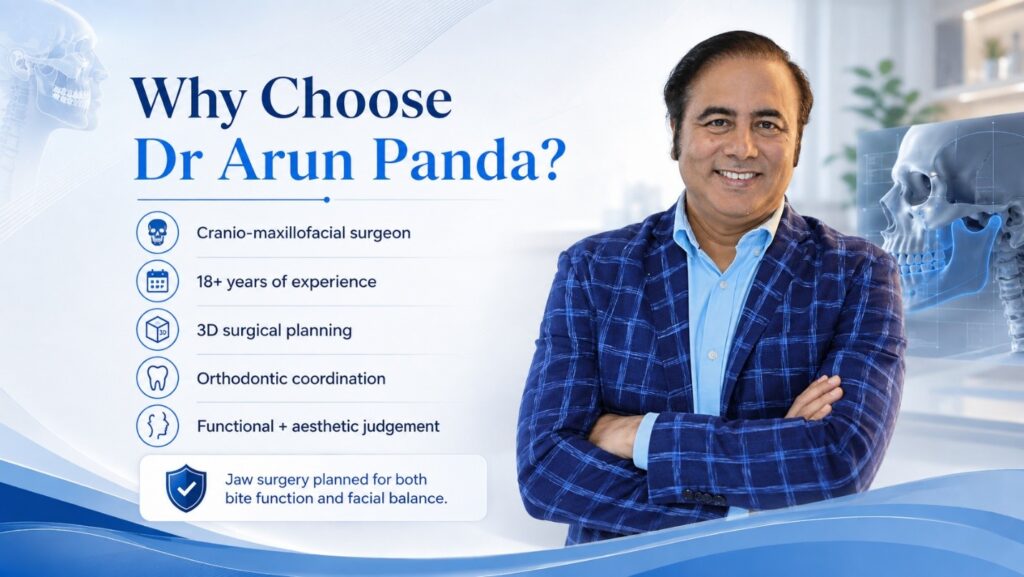
Why Dr. Arun Panda — This Is the Core of Maxillofacial Surgery
Many clinics offer jawline aesthetics. Very few in Navi Mumbai perform orthognathic surgery, because it requires cranio-maxillofacial training, hospital operating facilities and close orthodontic collaboration. Dr. Arun Panda is a Cranio-Maxillofacial and fellowship-trained Facial Plastic and Cosmetic Surgeon with 18+ years of experience, and founder of Trinity Aesthetics Academy. Corrective jaw surgery is not an add-on to his practice — it is the discipline he trained in.
- Functional and aesthetic judgement together. The bite has to work and the face has to look right; planning for one without the other produces a compromised result.
- 3D virtual surgical planning so movements are decided precisely before theatre, with guides transferring the plan accurately — particularly important in asymmetry cases.
- Orthodontic coordination from day one, not after braces are already on — which is when plans most often go wrong.
- Honest triage. If your bite is sound and a chin implant or filler would serve you better than major surgery, that’s what you’ll be told.
- The wider facial context. Jaw surgery planned alongside buccal fat removal, submental contouring or gender-affirming facial surgery where relevant.
Centrally located in Vashi — serving Navi Mumbai and Mumbai Bodyskulpt Aesthetics is in the heart of Vashi, easily reached from Kharghar, Panvel, Belapur, Nerul, Airoli, Thane and across Mumbai. Jaw surgery is a planned, staged treatment, so patients regularly travel to us for it — consultations, imaging review and orthodontic coordination can be scheduled efficiently, and video consultations are available for out-of-town patients. EMI options available. |
Frequently Asked Questions
How much does jaw surgery cost in Navi Mumbai?
Single-jaw surgery (upper or lower) runs approximately ₹1,50,000–₹3,00,000, and bimaxillary surgery on both jaws ₹2,50,000–₹5,00,000 — including hospital stay, anaesthesia, fixation plates and 3D planning. Adding a genioplasty is typically ₹50,000–₹1,00,000 more, and complex asymmetry correction or maxillomandibular advancement for sleep apnoea runs ₹3,00,000–₹5,50,000. Orthodontic treatment is billed separately at ₹60,000–₹1,50,000. Where a functional indication is documented, insurance may contribute.
How long does the whole jaw surgery process take?
Typically 18–30 months end to end. That’s 12–18 months of pre-surgical braces, the surgery itself with a 2–3 day hospital stay, then 6–12 months of post-surgical orthodontics. A ‘surgery-first’ approach can shorten this considerably in selected cases. The surgery is one step in a longer, coordinated treatment plan.
Will I need braces before and after jaw surgery?
In most cases yes. Braces before surgery align the teeth within each jaw and remove the compensations they developed — which can make your bite look temporarily worse, entirely as planned. After surgery, braces refine the bite into its final position, followed by retainers. Some patients are candidates for a surgery-first protocol where the operation precedes the braces phase.
Are there visible scars after jaw surgery?
No. Both upper and lower jaw osteotomies are performed entirely through incisions inside the mouth, so there are no cuts on the face and no visible scars. The titanium plates and screws used for fixation are generally left permanently and rarely need removal.
Will my lip and chin be numb after surgery?
Some altered sensation of the lower lip and chin is expected after lower-jaw surgery, because the nerve supplying that area runs through the bone being repositioned. It usually improves over weeks to months, though in a small minority some numbness is permanent. This is the most important risk to discuss before consenting to surgery.
Can jaw surgery fix an uneven or asymmetric jaw?
Yes — facial asymmetry from uneven jaw growth is one of its clearest indications, and results are usually striking because the correction addresses the actual cause. Asymmetry cases benefit particularly from 3D virtual surgical planning, since the movements differ between the two sides and need to be planned precisely rather than judged in theatre.
Does jaw surgery help sleep apnoea?
It can, substantially. Maxillomandibular advancement moves both jaws forward, enlarging the airway behind the tongue and soft palate, and is regarded as one of the most effective surgical treatments for obstructive sleep apnoea in appropriately selected patients. It requires a proper sleep-medicine assessment first — not everyone with apnoea is a surgical candidate.
How long before I can eat normally and return to work?
Expect a liquid diet for the first 1–2 weeks, soft diet for around 6 weeks, and a normal diet by roughly 3 months. Most people return to desk work or study at 3–4 weeks; physically demanding jobs need longer, and contact sport should wait about 3 months.
Is jaw surgery worth it just for appearance?
If your bite is functionally sound and your concern is mild profile imbalance, a chin implant or jawline filler is usually the better answer — lower risk, quicker, cheaper. Orthognathic surgery is justified when there’s a genuine skeletal problem affecting bite, breathing or chewing, where the facial improvement comes alongside a functional correction. An honest consultation should tell you which group you’re in.
Book a Jaw Assessment
A proper skeletal diagnosis — and an honest view on whether you need surgery at all. Book with Dr. Arun Panda at Bodyskulpt Aesthetics, Sector 9, Vashi, Navi Mumbai. You’ll get a full clinical and radiographic assessment, a clear explanation of whether your problem is dental or skeletal, a coordinated plan with your orthodontist, realistic timelines, and an itemised quote — plus honest advice if a simpler option would serve you better. Explore chin augmentation, facial feminization surgery, or book a consultation. Call / WhatsApp: 9152020907 / 9152020908 • drarunpanda.com • EMI available |
Authoritative references
For independent information, see the American Association of Oral and Maxillofacial Surgeons, Mayo Clinic on jaw surgery and peer-reviewed orthognathic outcome literature.
Educational information only and not a substitute for an in-person surgical consultation. Orthognathic surgery is major surgery requiring coordinated orthodontic treatment; suitability, timelines, costs and results vary between individuals.
Please reach out to us through the contact details below.
- Website: https://drarunpanda.com/
- Phone: +919152020907, +919152020908
- Address: Dr. Arun Panda, BodySkulpt Aesthetics, F1/A-4, Aditi Apartments, Sector 9, Vashi, Navi Mumbai – 400703
- Facebook: https://www.facebook.com/DrArunPanda
- Instagram: https://www.instagram.com/drarunpanda/
- Youtube: https://www.youtube.com/DrArunPanda
- LinkedIn: https://www.linkedin.com/in/drarunpanda
- Twitter: https://twitter.com/DrArunPanda1
- Email: facialaestheticsindia@gmail.com
- Google Directions: https://g.page/DrArunPanda?gm