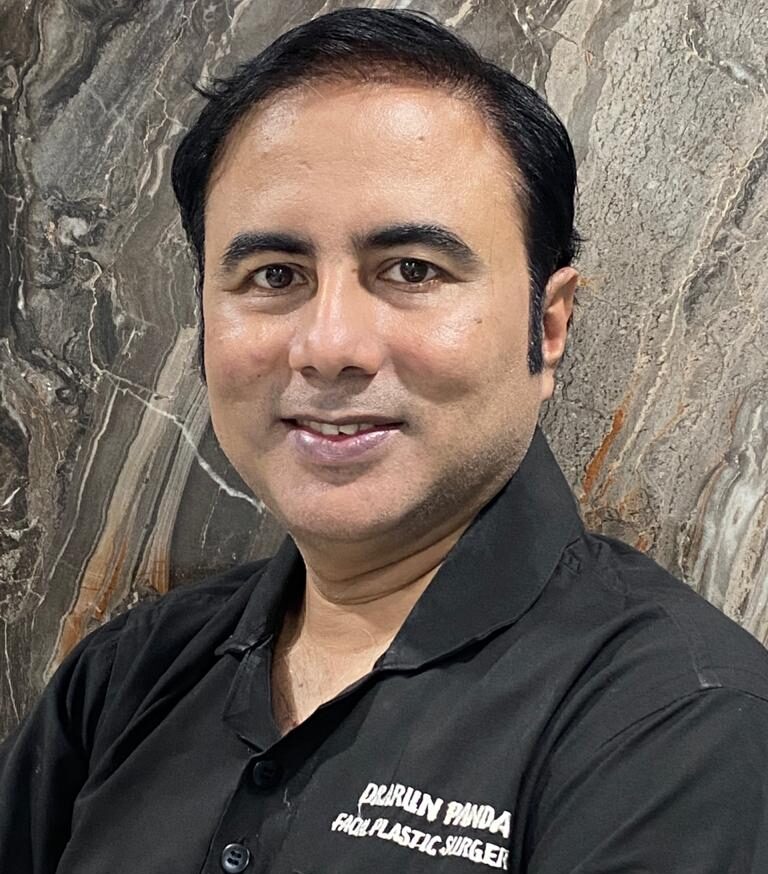
Skin Whitening & Pigmentation Treatment in Navi Mumbai
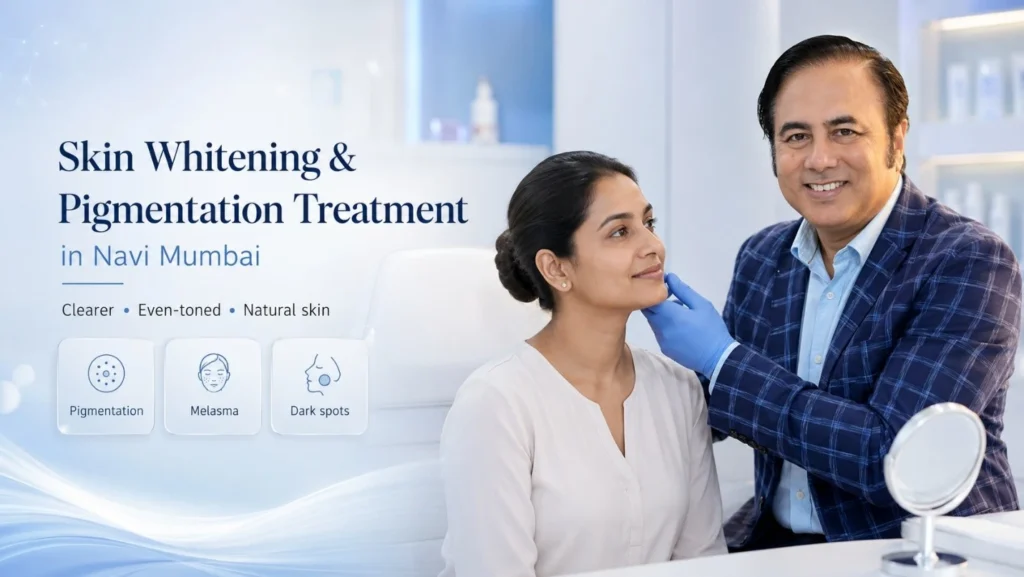
Let's Be Clear About What This Treatment Actually Is
Most people who search for “skin whitening” don’t actually want a different skin colour. They want to get rid of something specific: the tan that never faded after a summer, the dark patches of melasma across the cheeks, post-acne marks that outlasted the acne, dull, uneven tone from years of sun and pollution, or darkening around the underarms, neck or elbows. Those are all genuine, treatable dermatological concerns — and treating them properly gives you clearer, brighter, more even skin that looks like the best version of your own complexion.
What medicine cannot do — and what we won’t pretend otherwise about — is permanently change your constitutive skin colour, the tone written into your genetics. There is no injection, cream or laser that does that safely or permanently. So this page explains what these treatments genuinely achieve, which one suits which problem, what it honestly costs, and — importantly for a market flooded with dangerous products — what you should stay well away from.
The Honest Truth: What Works, What's Temporary, What's Dangerous
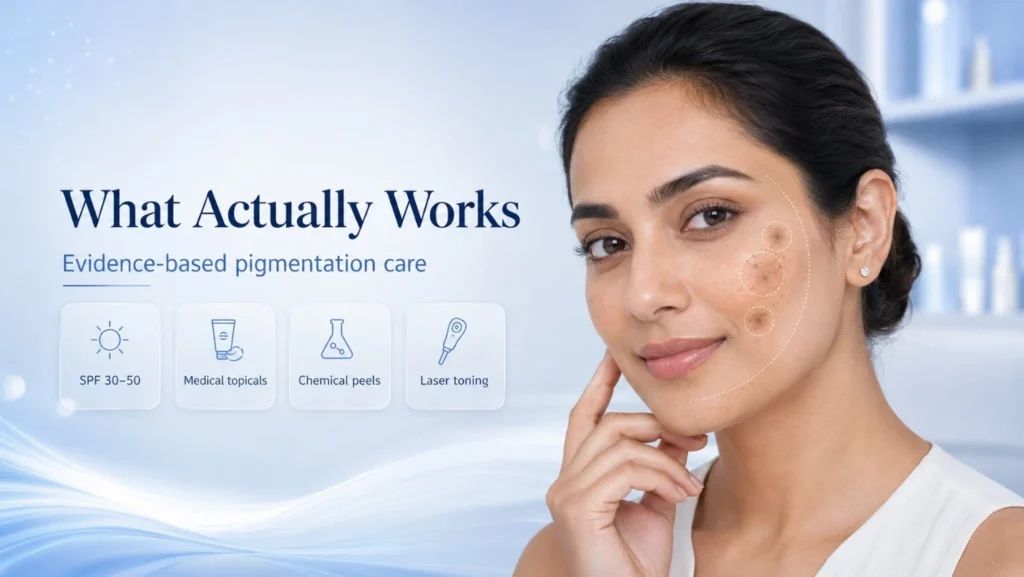
What genuinely works (evidence-based)
- Daily sunscreen. The single most important step. Without it, every other treatment fails — UV re-triggers pigmentation faster than any treatment clears it. SPF 30–50, every day, reapplied.
- Medical-grade topicals. Prescribed actives — tranexamic acid, azelaic acid, kojic acid, niacinamide, retinoids and supervised hydroquinone courses — that reduce melanin production.
- Chemical peels. Superficial and carefully-chosen medium peels lift pigmented cells and speed renewal — see our chemical peel treatment
- Laser toning (Q-switched Nd:YAG). Gently breaks up excess melanin over a course of sessions — part of our aesthetic laser
- Microneedling / mesotherapy. Helps deliver brightening actives and improves post-acne marks and texture.
What’s temporary or oversold
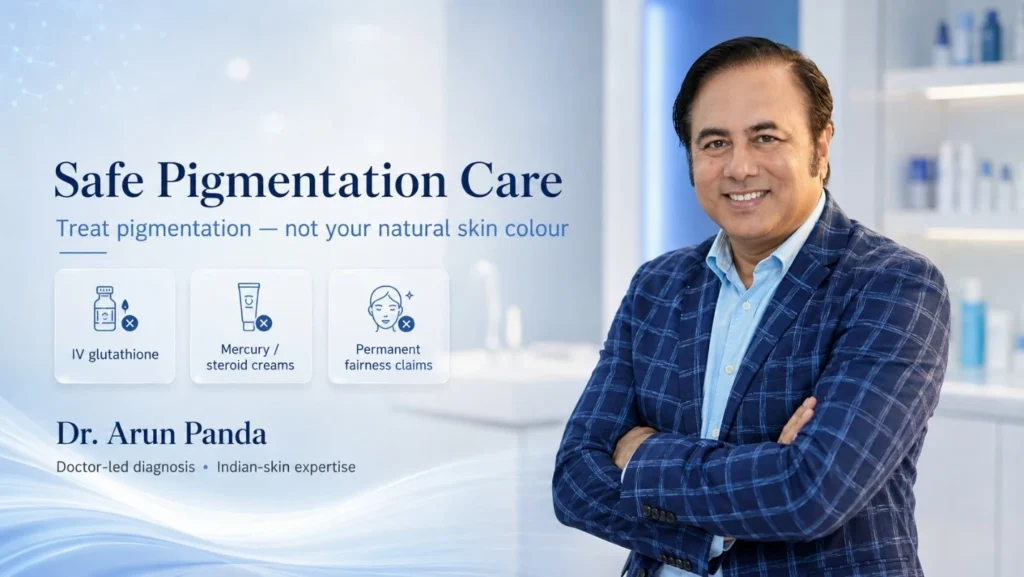
- IV glutathione ‘whitening drips.’ Widely marketed as a celebrity secret. The reality: the US FDA has not approved IV glutathione for cosmetic skin lightening, and in the only placebo-controlled study its effects were partial, temporary, and had reversed within six months of stopping. Oral glutathione has modest supporting evidence at 250–500 mg/day; the intravenous route does not. We don’t sell drips.
- ‘Permanent whitening’ packages. Pigmentation is an ongoing, sun-driven process. Results are maintained, not permanent — anyone claiming otherwise is overselling.
What is genuinely dangerous — please avoid
- Mercury-containing fairness creams. Still circulating in unregulated products. Mercury is toxic, accumulates in the body, and can cause kidney and neurological damage as well as skin problems.
- Unsupervised steroid creams. Extremely common in India, often sold over the counter as ‘fairness’ creams. They cause skin thinning, steroid-induced acne and rosacea, visible blood vessels, and rebound pigmentation worse than what you started with.
- Unsupervised long-term hydroquinone. Effective when prescribed and monitored short-term, but prolonged unsupervised use can cause exogenous ochronosis — a stubborn blue-black discolouration that is very difficult to reverse.
Why we put this warning on our own service page Because the most common thing we treat isn’t pigmentation — it’s the damage from what people used to try to fix it themselves. A great many patients arrive with steroid-damaged skin from a cream a chemist recommended. Telling you this costs us the sale of a ‘whitening package’ and gains you a safer, better result. That’s the trade we’re happy to make. |
What Is the Best Treatment for Skin Whitening?
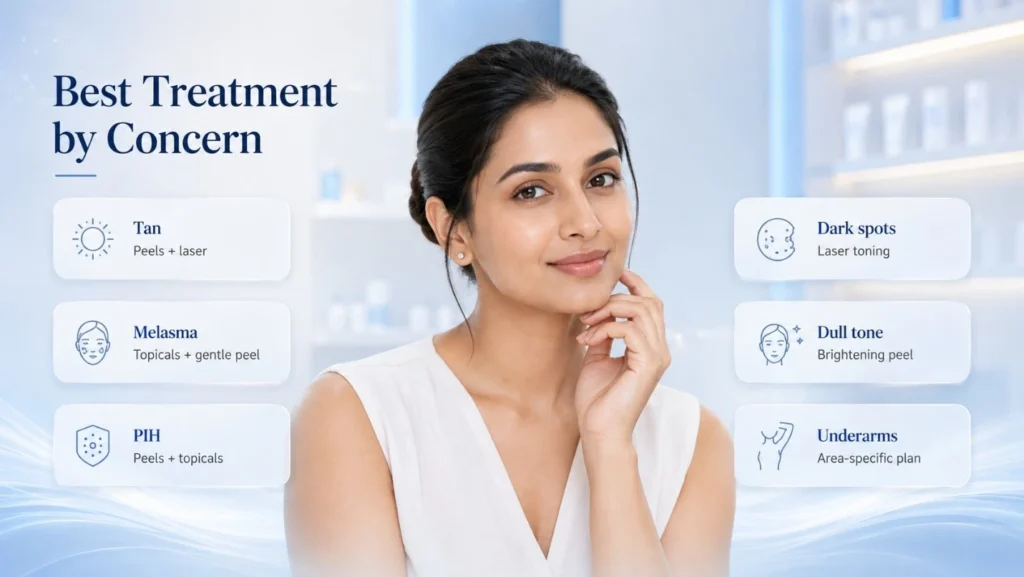
There is no single best treatment — the best treatment is the one matched to the cause of your pigmentation. Treating melasma like a suntan, or a post-acne mark like melasma, is exactly why people waste money. Here’s the honest match:
Your concern | Best-suited approach | Realistic outlook |
| |
Tanning / sun-darkened skin | Peels + laser toning + sunscreen | Responds well; returns without SPF |
| |
Melasma (patchy cheeks/forehead) | Topicals (tranexamic acid) + gentle peels; cautious laser | Manageable, relapsing — not curable |
| |
Post-acne marks (PIH) | Peels + topicals; microneedling | Very treatable over 3–6 months |
| |
Dull, uneven tone | Brightening peels + medical skincare | Quick visible glow; easy to maintain |
| |
Dark spots / sun spots | Laser toning + targeted topicals | Good clearance with a course |
| |
Underarm / neck / elbow darkening | Area-specific peels + topicals | Gradual; needs friction/hair-removal changes too |
| |
| The short version, if you want one answer For most people, the best results come from a COMBINATION programme rather than any single treatment: daily sunscreen, prescribed medical-grade topicals, and a course of 4–6 chemical peels (with laser toning added for stubborn spots), run over 3–6 months. Single ‘miracle’ sessions don’t work; consistent, supervised protocols do. What decides your exact plan is a proper diagnosis of WHY you’re pigmenting — which is what a doctor-led consultation is for. | |||
Benefits of Medical Pigmentation Treatment
- Clears pigmentation & dark spots. Melasma patches, sun spots and post-acne marks visibly fade.
- Evens out skin tone. Patchiness settles into a uniform, natural complexion.
- Removes stubborn tan. The sun damage that skincare alone won’t shift.
- Brighter, healthier-looking skin. Renewed skin reflects light better — the real source of ‘glow.’
- Improves texture at the same time. Peels and microneedling refine pores and smoothness alongside tone.
- Treats the cause, not just the surface. Medical assessment finds triggers — sun, hormones, friction, medication — so results last.
- Safe for Indian skin. Protocols chosen for Fitzpatrick IV–VI, where aggressive treatment backfires.
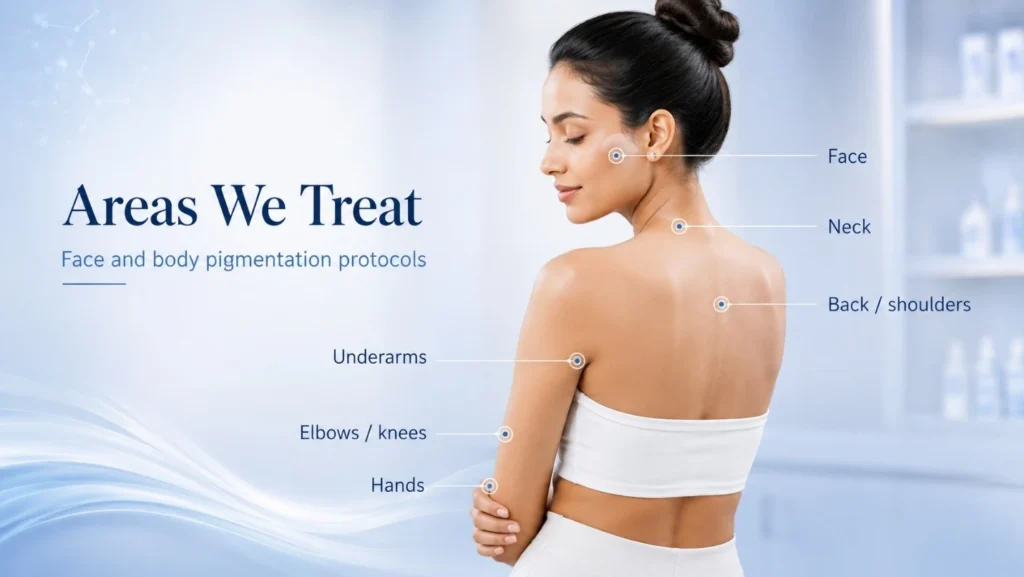
Areas We Treat
- Face — melasma, tan, dark spots, post-acne marks, dullness.
- Neck & nape — including friction and sun-related darkening.
- Underarms — one of the most-requested areas; often linked to shaving, waxing and deodorants.
- Elbows, knees & knuckles — friction-related thickening and darkening.
- Hands & feet — sun-exposed pigmentation and uneven tone.
- Back & shoulders — post-acne marks and sun damage.
- Intimate areas — discreet, gentle protocols where appropriate.
Conditions We Treat
- Melasma — hormone- and sun-driven patches; the most complex to manage.
- Post-inflammatory hyperpigmentation (PIH) — marks left by acne, injury or irritation.
- Sun tanning & photo-damage.
- Solar lentigines (sun/age spots).
- Peri-orbital dark circles — the pigmented type (assessment distinguishes it from hollowing or vascular causes).
- Friction-related darkening — underarms, neck, thighs, elbows.
- Uneven tone & dullness from pollution, dehydration and cell build-up.
- Steroid-damaged skin — repairing damage from misused fairness creams.
An honest word about melasma specifically Melasma is chronic and relapsing. It can be controlled beautifully — lightened substantially and kept quiet with maintenance — but it is not ‘cured’ and it will return with sun exposure, pregnancy or hormonal shifts. Aggressive lasering of melasma often makes it worse. Any clinic promising to permanently remove melasma in a few sessions either doesn’t understand it or isn’t being straight with you. |
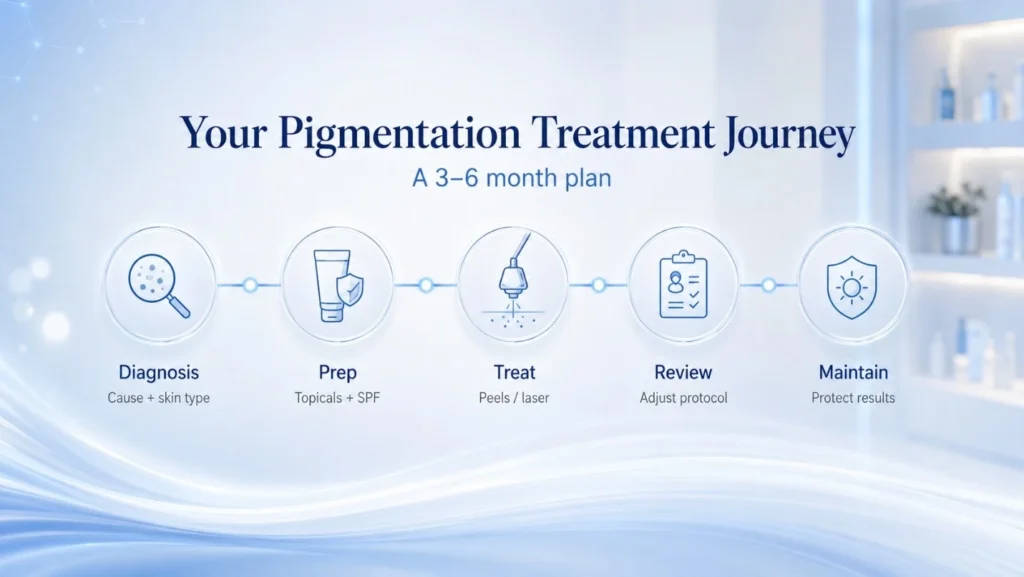
The Process, Step by Step
- Diagnosis first. Your pigmentation type, depth, skin type (Fitzpatrick) and triggers are assessed — hormonal, sun, friction, medication, or post-inflammatory. The plan depends entirely on this.
- Prep phase. Medical-grade topicals and strict sun protection start first, priming the skin and often producing early improvement on their own.
- In-clinic sessions. A course of chemical peels and/or laser toning, spaced 2–4 weeks apart, gradually clearing pigment. Sessions take 20–40 minutes.
- Review & adjust. Progress is reviewed and the protocol tuned — pigmentation treatment is iterative, not one-size-fits-all.
- Once clear, a lighter maintenance routine and sun discipline keep it that way. This step is where most people lose their results.
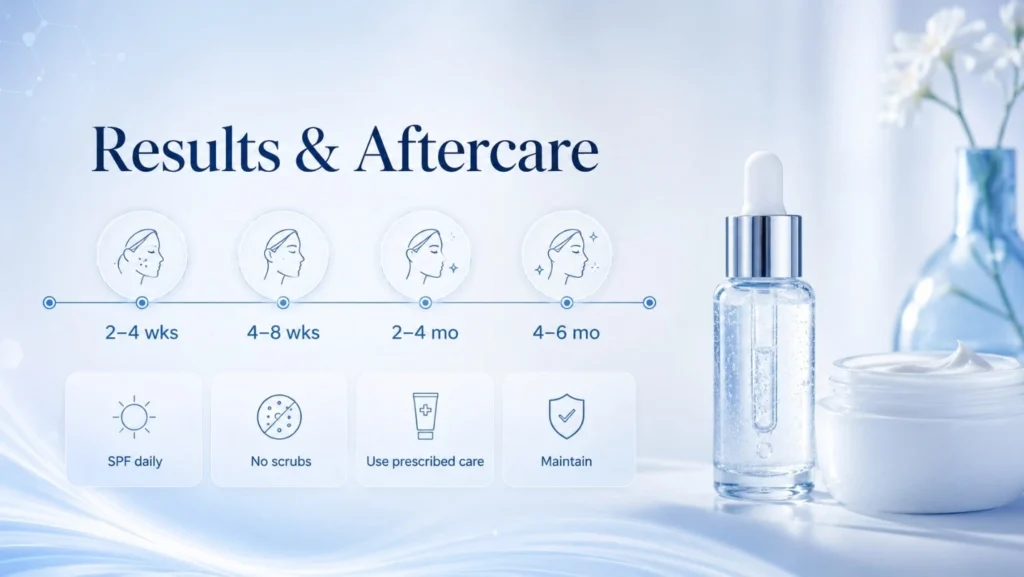
Downtime & Aftercare
Treatment | Downtime | What to expect |
Medical topicals | None | Possible mild dryness or purging in the first weeks. |
Superficial peels | 0–2 days | Light flaking; skin looks brighter within days. |
Laser toning | None | Mild redness for a few hours; gradual clearing over sessions. |
Medium peels | 5–7 days | Visible peeling, then noticeably clearer skin. |
Microneedling | 1–3 days | Redness like mild sunburn. |
Aftercare that decides your result
- Sunscreen, every single day — SPF 30–50, reapplied, indoors near windows too. This is not optional; it is the treatment.
- Never pick or scrub flaking skin — it causes fresh post-inflammatory pigmentation.
- Use only what’s prescribed. No adding chemist-recommended ‘fairness’ creams to your routine.
- Be patient and consistent. Pigment clears over months, not days; stopping early undoes progress.
- Address the trigger. Switch harsh hair-removal, treat the acne, review hormonal factors — or it returns.
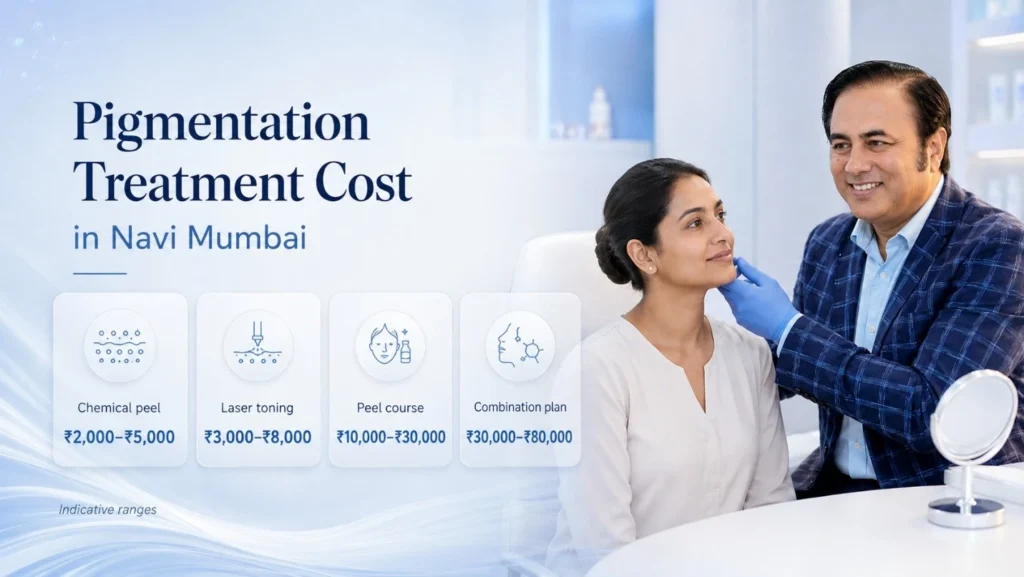
Cost of Skin Whitening & Pigmentation Treatment in Navi Mumbai
Cost depends on the treatments used, the area, and the length of the programme. Most people need a 3–6 month combination course, not a single session. These are honest indicative ranges; your exact plan and quote follow assessment. EMI options are available on packages.
Treatment | Indicative cost | ||
Consultation & medical-grade topical protocol | ₹3,000 – ₹8,000 (initial) | ||
Chemical peel (per session) | ₹2,000 – ₹5,000 | ||
Peel course (4–6 sessions) | ₹10,000 – ₹30,000 | ||
Laser toning (per session) | ₹3,000 – ₹8,000 | ||
Laser toning course (6–8 sessions) | ₹25,000 – ₹60,000 | ||
Microneedling / mesotherapy (per session) | ₹4,000 – ₹10,000 | ||
Underarm / body area course | ₹15,000 – ₹40,000 | ||
Full combination programme (3 months) | ₹30,000 – ₹80,000 | ||
Where people waste money on this treatment Three ways: buying a single ‘miracle’ session when pigmentation needs a course; paying premium prices for IV glutathione drips whose effect reverses once you stop; and skipping the ₹1,000 sunscreen that protects the ₹50,000 course. Ask for a full-programme quote with the number of sessions specified, and make sure medical topicals and sun protection are part of the plan — not an upsell afterwards. | |||
Results Timeline
When | What you’ll see |
Weeks 2–4 | Early brightness and a fresher tone from topicals and first peels. |
Weeks 4–8 | Visible lightening of tan, dullness and superficial marks. |
Months 2–4 | Substantial clearing of pigmentation and post-acne marks; melasma quieter. |
Months 4–6 | Full programme result — even, clear, natural tone. |
Ongoing | Maintenance plus daily SPF keeps it; neglect either and pigment returns. |
Comparing the Options Honestly
Option | Evidence | Downtime | Honest verdict |
Sunscreen + medical topicals | Strong | None | The foundation — nothing works without it |
Strong | 0–7 days | Best value for tone, tan and marks | |
Laser toning (Q-switched) | Strong | None | Excellent for spots; cautious use in melasma |
Oral glutathione | Modest | None | Some evidence at 250–500 mg/day; adjunct only |
IV glutathione drips | Weak / not approved | None | Effects partial & reversed by 6 months — we don’t offer it |
OTC ‘fairness’ creams | Poor / unsafe | — | Risk of steroids & mercury — avoid |
Is It Safe for Indian Skin?
Yes — when protocols are chosen for melanin-rich skin. This matters more here than almost anywhere in aesthetics, because Fitzpatrick IV–VI skin responds to over-aggressive treatment by producing more pigment, not less. An overly deep peel, an over-powered laser, or a badly-timed setting can cause post-inflammatory hyperpigmentation that is worse than the original problem — which is precisely why gentle, gradual, supervised protocols beat aggressive ones on Indian skin. Handled properly, side effects are limited to temporary redness, flaking and sensitivity. Handled by an untrained hand, or by a chemist’s cream, the damage can take months to undo.
Why Dr. Arun Panda — a Skin Doctor Who Diagnoses Before Treating
Pigmentation is the area of aesthetics where diagnosis matters most and where the wrong treatment actively backfires. Dr. Arun Panda is a Facial Plastic and Cosmetic Surgeon and founder of Trinity Aesthetics Academy, where other practitioners train in aesthetic skin treatment. If you’re looking for a skin whitening or pigmentation doctor in Navi Mumbai, the difference is a proper diagnosis instead of a package.
- Diagnosis before treatment. Melasma, PIH, tan and friction-darkening look similar and need different plans. We identify which you have.
- Doctor-led, qualified team. Peel depth, laser settings and topical strength chosen medically for your skin type — not a fixed salon menu.
- Expertise in Fitzpatrick IV–VI skin. Gradual protocols that clear pigment without triggering more.
- Honest about outcomes. No ‘permanent fairness’ claims, no IV drips, no packages you don’t need.
- Full skin toolkit. Peels, aesthetic lasers, CO2 resurfacing and skin tightening under one roof, so you get the right combination.
Centrally located in Vashi Bodyskulpt Aesthetics is in the heart of Vashi, easily reached from Kharghar, Panvel, Belapur, Nerul, Airoli and Thane. Book a pigmentation assessment for a proper diagnosis and an honest, itemised plan. EMI options available. |
Frequently Asked Questions
What is the best treatment for skin whitening?
There’s no single best — the right treatment depends on what’s causing your pigmentation. Tanning and dullness respond well to chemical peels plus laser toning; melasma needs medical topicals like tranexamic acid with gentle peels and cautious lasering; post-acne marks respond to peels and microneedling. For most people the best results come from a combination programme — daily sunscreen, prescribed topicals and a course of 4–6 peels over 3–6 months — rather than any single treatment.
Can skin whitening treatment permanently change my skin colour?
No. No safe treatment permanently changes the skin colour you were born with. What these treatments do is clear excess pigmentation — tan, melasma, dark spots, post-acne marks — so your skin returns to its own natural, even tone and looks clearer and brighter. Any clinic promising permanent fairness is overselling.
How much does skin whitening treatment cost in Navi Mumbai?
Indicatively ₹2,000–₹5,000 per chemical peel session, ₹3,000–₹8,000 per laser toning session, ₹10,000–₹30,000 for a peel course and ₹25,000–₹60,000 for a laser toning course. A complete 3-month combination programme typically runs ₹30,000–₹80,000. Ask for a full-programme quote with sessions specified. EMI options are available.
Are glutathione injections safe and effective for skin whitening?
IV glutathione is not approved by the US FDA for cosmetic skin lightening. In the only placebo-controlled study, its effects were partial and temporary, and had reversed within six months of stopping treatment. Oral glutathione has modest evidence at 250–500 mg/day as an adjunct. We don’t offer IV whitening drips — we’d rather put your money into treatments with solid evidence behind them.
Are fairness creams from the chemist safe?
Often not. Many unregulated ‘fairness’ creams contain potent steroids or even mercury. Steroid creams cause skin thinning, acne, visible vessels and rebound pigmentation worse than the original; mercury is toxic and accumulates in the body. A significant part of our pigmentation work is repairing damage from these creams. Only use lightening actives prescribed and monitored by a doctor.
How long does it take to see results?
Early brightness appears in 2–4 weeks, visible lightening by 4–8 weeks, and substantial clearing over 2–4 months. A full programme runs 3–6 months. Pigmentation clears gradually — anything promising dramatic change in one session isn’t being straight with you.
Can melasma be cured permanently?
No — melasma is a chronic, relapsing condition driven by sun and hormones. It can be lightened substantially and kept quiet with the right treatment and maintenance, but it returns with sun exposure, pregnancy or hormonal changes. Aggressive lasering often makes melasma worse, which is why gentle, supervised protocols matter.
Do underarm and body darkening respond to treatment?
Yes, gradually. Underarm, neck and elbow darkening is often friction-related — from shaving, waxing, tight clothing or deodorants — so treatment combines area-specific peels and topicals with changing the trigger. Switching to laser hair removal instead of repeated waxing or shaving frequently helps a great deal.
Book a Pigmentation Assessment
A proper diagnosis — and an honest plan for clear, even skin. Book with Dr. Arun Panda’s team at Bodyskulpt Aesthetics, Sector 9, Vashi, Navi Mumbai. You’ll get a real diagnosis of what’s causing your pigmentation, a treatment plan matched to your skin type, honest expectations, and a clear itemised cost — with no ‘permanent fairness’ promises and no unnecessary drips. Explore our chemical peel treatments and aesthetic lasers, or book a consultation. Call / WhatsApp: 9152020907 / 9152020908 • drarunpanda.com • EMI available |
Authoritative references
For independent information, see the American Academy of Dermatology on melasma, the US FDA on skin lightening products and peer-reviewed evidence on glutathione (NCBI).
Educational information only and not a substitute for an in-person consultation. Treatments address pigmentation and uneven tone; they do not permanently alter natural skin colour. Results vary between individuals.
Please reach out to us through the contact details below.
- Website: https://drarunpanda.com/
- Phone: +919152020907, +919152020908
- Address: Dr. Arun Panda, BodySkulpt Aesthetics, F1/A-4, Aditi Apartments, Sector 9, Vashi, Navi Mumbai – 400703
- Facebook: https://www.facebook.com/DrArunPanda
- Instagram: https://www.instagram.com/drarunpanda/
- Youtube: https://www.youtube.com/DrArunPanda
- LinkedIn: https://www.linkedin.com/in/drarunpanda
- Twitter: https://twitter.com/DrArunPanda1
- Email: facialaestheticsindia@gmail.com
- Google Directions: https://g.page/DrArunPanda?gm