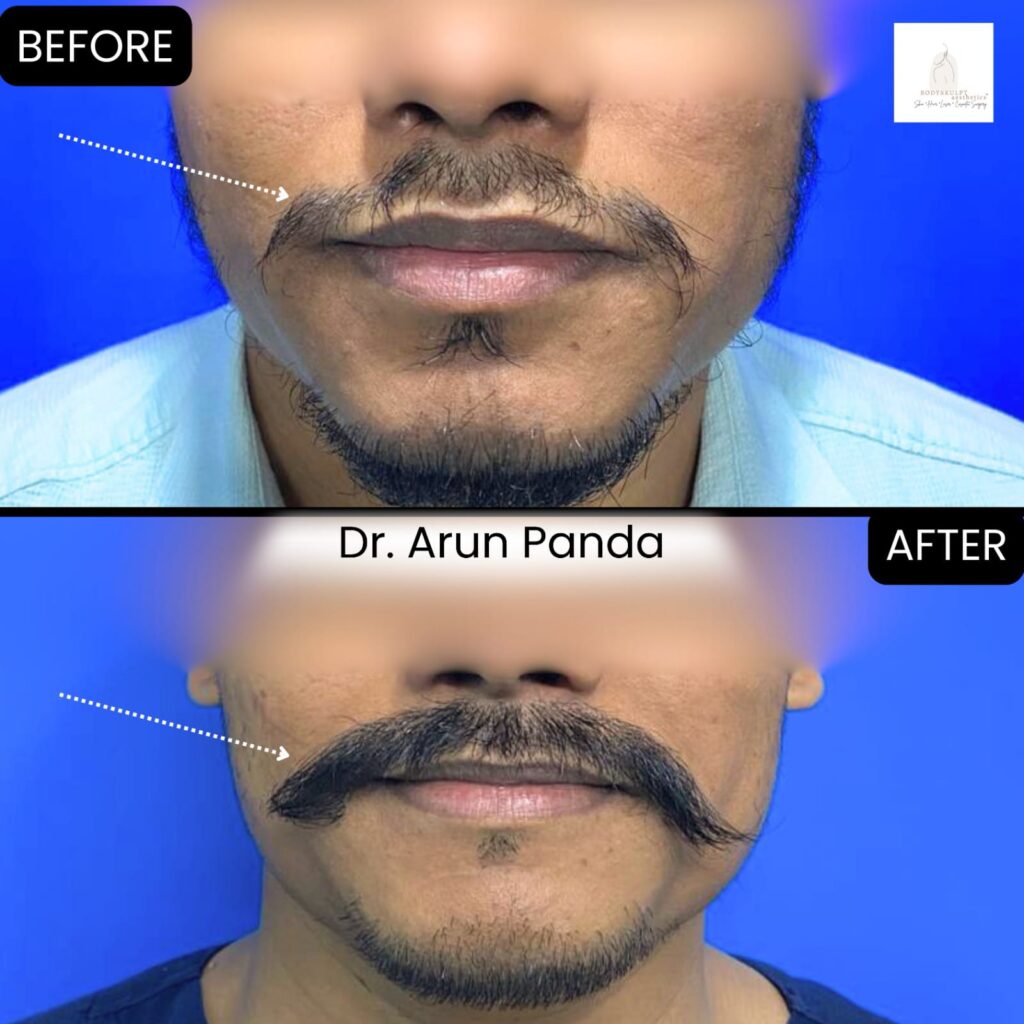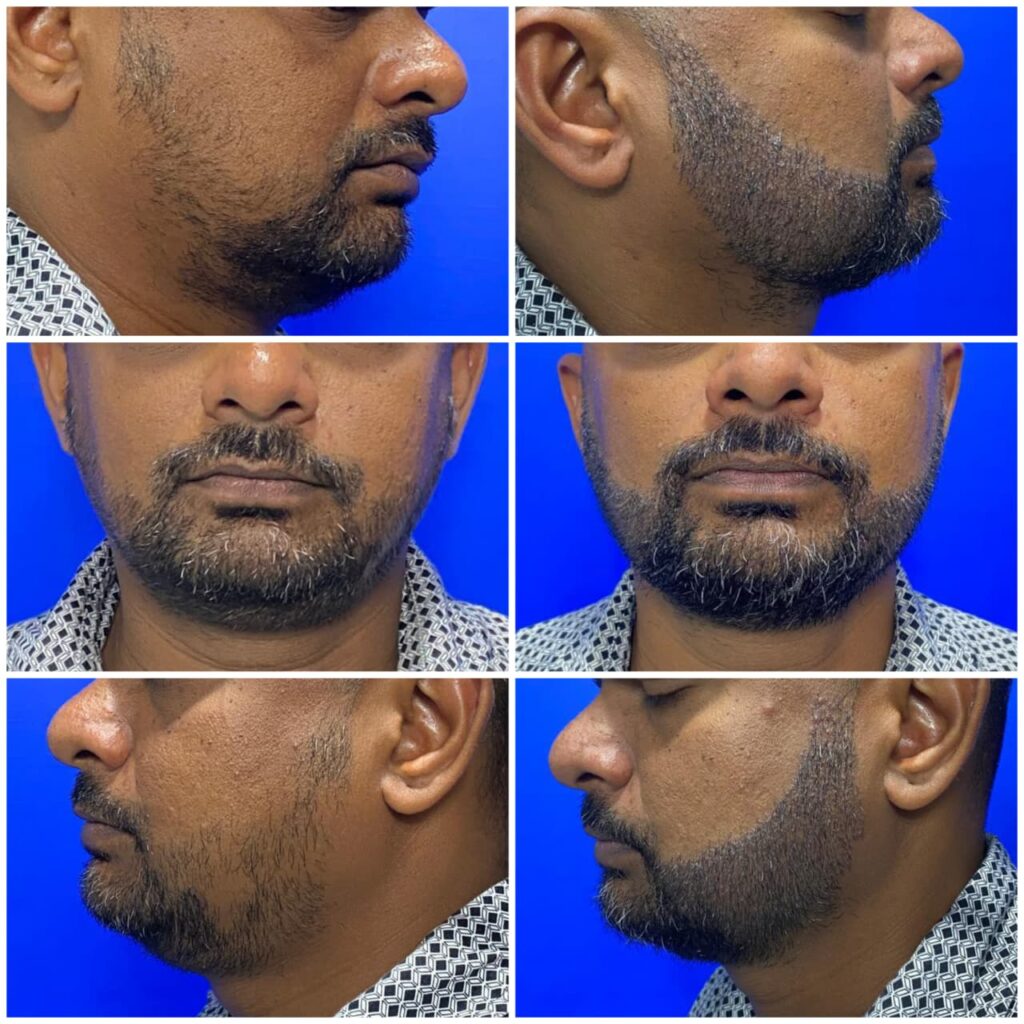
Beard Hair Transplant in Navi Mumbai
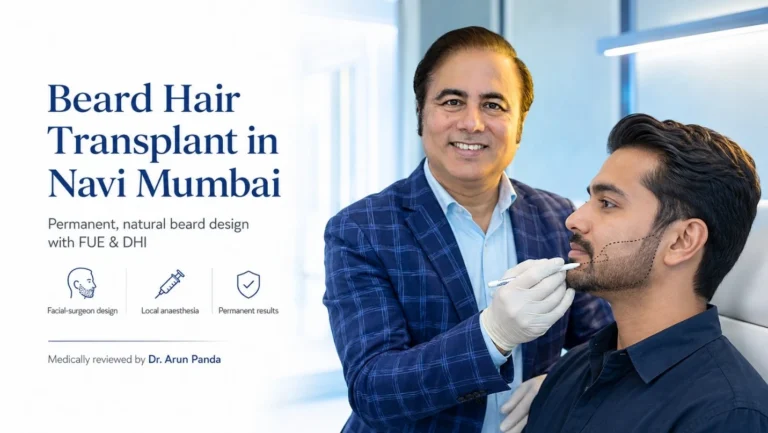
A Beard That Actually Grows – Permanently
Patchy beard growth is genetic for most men, and no oil, serum or supplement changes that: if there are no follicles in an area, nothing will make hair appear there. A beard transplant is the only permanent solution, because it doesn’t try to stimulate absent follicles — it relocates living ones from the back of your scalp, where growth is genetically resistant to loss, into the beard zones where you want density.
Once healed, those follicles behave like the rest of your beard: they grow continuously, you shave and trim them normally, and they stay for life. It’s the same principle as a scalp hair transplant, performed on a far more technically demanding canvas.
Why more demanding? Because the face is unforgiving. Beard hairs emerge at sharp, acute angles — far flatter against the skin than scalp hair — and the angle changes across the chin, cheeks, upper lip and jawline. Place them at a scalp-like angle and the result stands up like bristles and reads instantly as fake. Add the fact that a beard’s shape has to suit your jawline and facial proportions, and it becomes clear why this procedure belongs with a facial surgeon rather than a technician working from a template.
The Honest Conversation No One Else Will Have With You
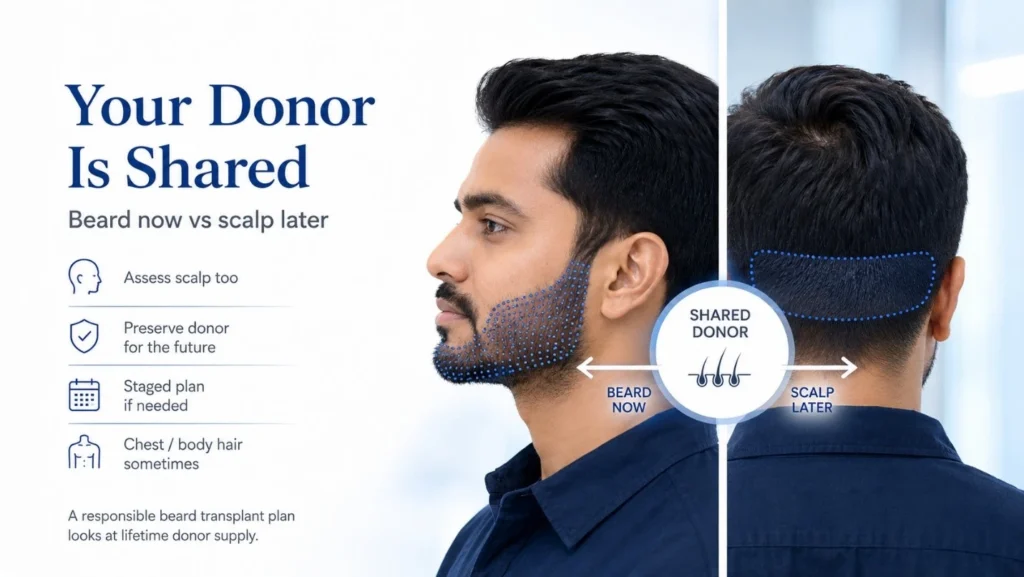
Your scalp donor area is finite, and it is shared. Every graft used to build your beard is a graft that is no longer available for your scalp — permanently. For a man in his twenties with a family history of male-pattern baldness, spending 3,000 donor grafts on a full beard today can mean not having enough donor supply for the scalp restoration he’ll want at forty.
This is the most important thing to think through before a beard transplant, and it’s almost never mentioned — because it’s the conversation that sometimes talks a patient out of the bigger procedure. We’d rather have it:
- Your scalp is assessed too, not just your beard — including family history and any early thinning.
- Donor supply is calculated for your lifetime, not for one procedure.
- Sometimes we recommend a smaller, staged beard procedure to preserve donor for later scalp needs.
- Occasionally we advise waiting until the pattern of scalp loss is clearer.
- Where scalp donor is limited, chest or body hair can sometimes be used for the beard instead — assessed individually.
Also worth knowing: transplanted beard hair keeps its scalp character Hair taken from your scalp retains scalp properties in its new home. It generally grows longer and continuously if left, and is often slightly softer and finer than native beard hair — so it needs regular trimming to sit naturally alongside the rest. In practice this is easily managed and most men stop noticing after a few months, but you should hear it before surgery rather than discover it afterwards. |
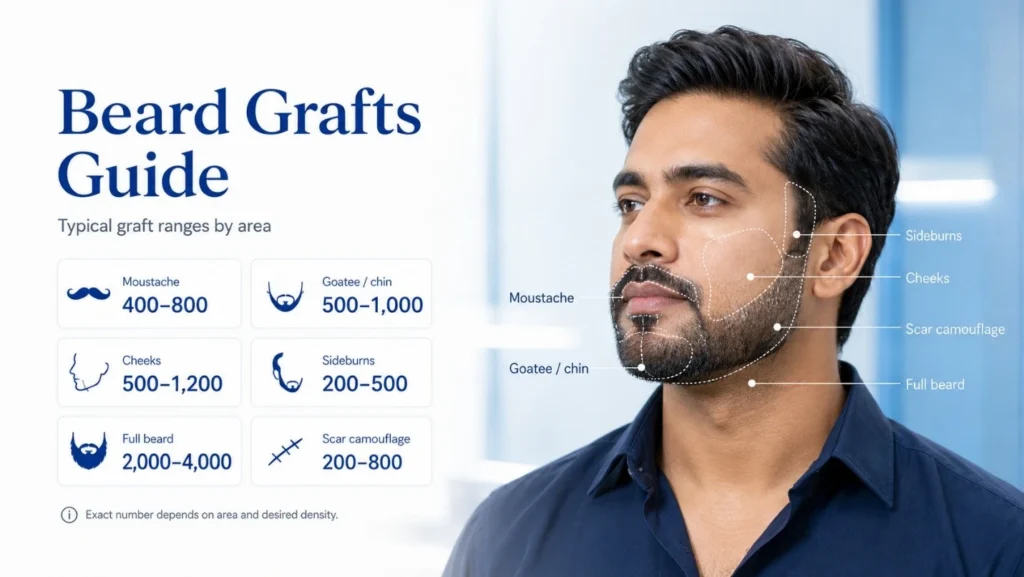
Areas Treated and How Many Grafts Each Needs
Graft numbers depend on the area’s size and the density you want. These are honest indicative ranges; your exact number is calculated at consultation after measuring the area and assessing your donor:
Area | Typical grafts | What it achieves |
Moustache | 400 – 800 | Fills a sparse or thin upper lip |
Goatee / chin | 500 – 1,000 | Builds a defined chin beard |
Cheeks | 500 – 1,200 | Fills the patchy zone most men struggle with |
Jawline definition | 600 – 1,200 | Sharpens and frames the lower face |
Sideburns | 200 – 500 | Connects temples to beard; reshapes |
Patchy-area fill only | 500 – 1,500 | Targeted correction of specific gaps |
Full beard | 2,000 – 4,000 | Complete coverage, cheekbones to neck |
Scar camouflage | 200 – 800 | Hides scars within the beard area |
A note on density: beards are planted at a lower graft density than scalp — typically around 25–35 grafts per cm² — because beard hair shafts are thicker and read as fuller. Over-planting a beard looks unnatural and wastes donor supply.
Who a Beard Transplant Helps
- Genetically patchy or sparse beard growth — by far the most common reason.
- Bare cheeks with a decent chin beard — the classic ‘can’t connect it up’ pattern.
- Thin or gappy moustache.
- Acne, chickenpox or surgical scars in the beard area where hair no longer grows.
- Burn or trauma scars, and cleft-lip repair scars in the moustache line.
- Facial hair for gender-affirming care — beard construction for trans men, planned with the same care and discretion.
- Stable alopecia areata affecting the beard — only once the condition has been quiet for a sustained period.
- Reshaping a beard line — sometimes combined with laser hair removal to clean up neck and cheek borders.
When we’d advise against it — or advise waiting If your alopecia areata is still active, transplanted grafts can be attacked too — the condition must be stable first. If you’re under about 21, beard growth may still be developing naturally and surgery can be premature. If your scalp donor is limited or male-pattern baldness is advancing, we may recommend a smaller staged plan. And if your expectation is a dense, uniform beard from a thin donor area, we’ll tell you honestly what’s achievable before you spend anything. |
Benefits of a Beard Transplant
- Transplanted follicles grow for life — no maintenance products, no repeat treatments.
- Completely natural — your own hair. It grows, greys and behaves like the rest of your facial hair.
- Shave, trim and style freely once healed — including growing it long or keeping it stubbled.
- Fills what genetics didn’t. Connects cheeks, thickens patches, defines the jawline.
- Camouflages scars that no topical treatment can address.
- Beard shape designed for your face. A well-designed beard genuinely improves facial proportion and jawline definition.
- No visible scarring. FUE leaves tiny dot scars in the donor area, hidden by surrounding hair.
- Single session for most cases. One 4–6 hour day under local anaesthesia, awake and comfortable.
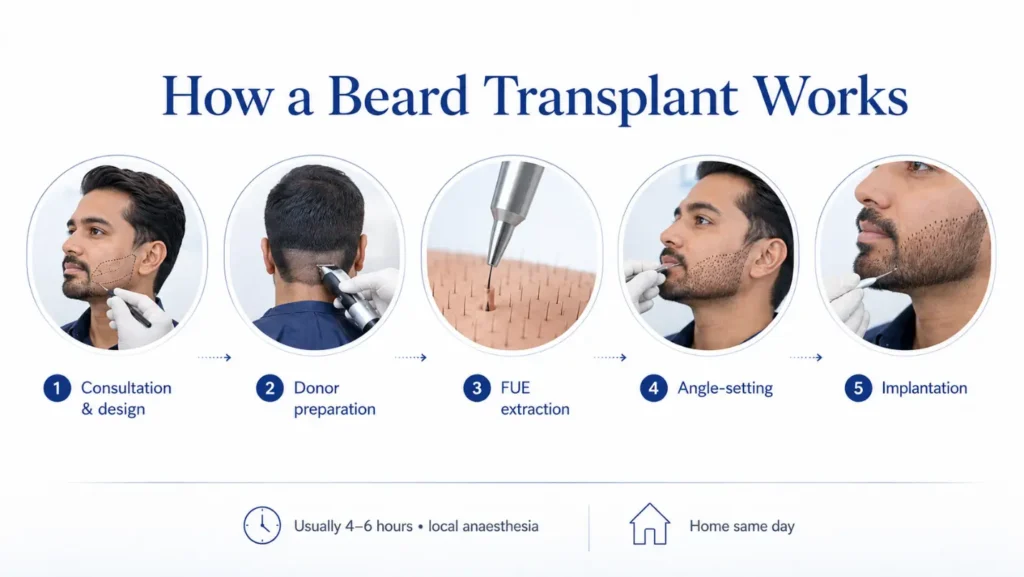
The Procedure, Step by Step
- Consultation, design & donor assessment. Your beard pattern, face shape and donor supply are assessed. The beard shape is designed and drawn on your face, and only begun once you approve it in the mirror. Your scalp’s long-term needs are assessed at the same time.
- Donor preparation. The donor area at the back of the scalp is trimmed and numbed with local anaesthesia.
- FUE extraction. Individual follicular units mostly single-hair grafts, which give the most natural beard are harvested with micro-punches, leaving tiny dot scars that heal invisibly.
- Recipient sites & angles. The most skilled part: sites are created at the sharp, acute angles and directions native to each beard zone. This is what separates a natural beard from bristles.
- Grafts are placed one by one single hairs along borders and the moustache line for softness, slightly denser through the body of the beard.
- Home the same day. No facial dressings; written aftercare and follow-up scheduled. Total: 4–6 hours.
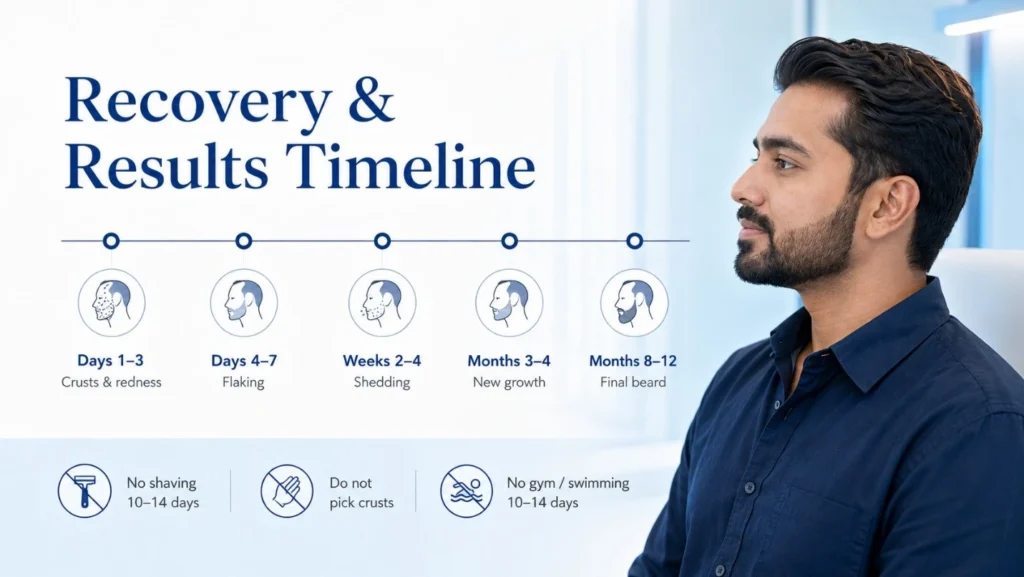
Downtime & Recovery
Timeframe | What to expect |
Days 1–3 | Tiny crusts around each graft; mild redness and some facial swelling. Sleep slightly elevated. |
Days 4–7 | Crusts begin flaking off naturally — do not pick them. Most men return to work around day 4–5. |
Days 7–10 | Crusts gone; the area looks close to normal, perhaps slightly pink. |
Weeks 2–4 | Transplanted hairs shed — completely normal ‘shock loss’, not failure. The roots remain. |
Months 3–4 | New growth begins from the transplanted follicles. |
Months 8–12 | Full, final beard — mature density and texture. |
Aftercare
- Don’t shave or trim for 10–14 days — and no razor over the grafts until cleared.
- Never pick or scratch the crusts — picking dislodges grafts and can cause scarring.
- Wash exactly as instructed from the day you’re told — gentle, no rubbing.
- Sleep on your back, head elevated for the first few nights.
- No gym, sauna, steam or swimming for 10–14 days; no sun exposure on the area.
- Expect the shedding phase at weeks 2–4 and don’t panic — it’s part of the process.
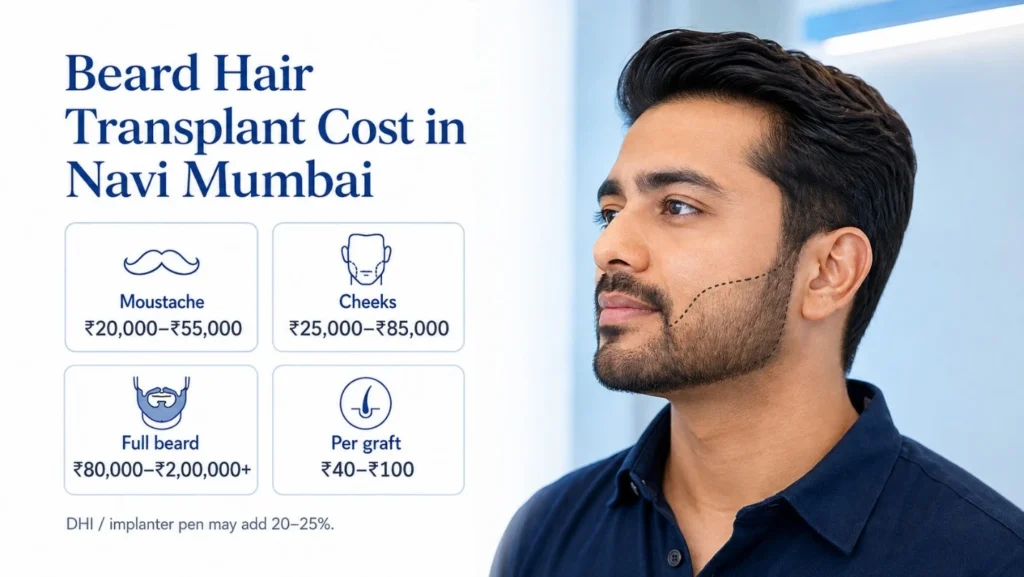
Cost of Beard Hair Transplant in Navi Mumbai
Beard transplants are priced per graft, so your total depends on the area and density you need. Rates in Navi Mumbai typically sit below South Mumbai and Bandra clinics for equivalent expertise. These are honest indicative ranges your exact, itemised quote follows assessment. EMI options are available.
Area | Typical grafts | Indicative cost |
Moustache | 400 – 800 | ₹20,000 – ₹55,000 |
Goatee / chin | 500 – 1,000 | ₹25,000 – ₹70,000 |
Cheeks | 500 – 1,200 | ₹25,000 – ₹85,000 |
Sideburns | 200 – 500 | ₹12,000 – ₹35,000 |
Full beard | 2,000 – 4,000 | ₹80,000 – ₹2,00,000+ |
Scar camouflage | 200 – 800 | ₹12,000 – ₹60,000 |
Per graft, expect roughly ₹40–₹100 beard work generally sits at the higher end of hair-transplant pricing because it uses predominantly single-hair grafts and demands far more precise angle control than scalp work. DHI/implanter-pen techniques add roughly 20–25% for tighter angle control. See our full hair transplant cost guide for how per-graft pricing works.
Why the cheapest beard quote is the riskiest one With a beard, poor work is on your face, in the mirror, every day — and it’s far harder to correct than a scalp result. Low per-graft rates usually mean technician-run extraction and implantation at speed. Speed is exactly what destroys beard results: wrong angles produce bristly, doll-like hair; poor handling reduces graft survival; and over-harvesting spends donor you may need for your scalp. Ask who performs the angle-setting and implantation, and whether a qualified surgeon designs and supervises the case. |
Results Timeline
When | What’s happening |
Weeks 2–4 | Transplanted hairs shed (shock loss) — expected and normal. |
Months 3–4 | New hair starts pushing through from the rooted follicles. |
Months 5–7 | Visible fill; the beard begins to look genuinely denser. |
Months 8–12 | Full, final result — mature density, texture and colour. |
Beyond | Permanent. Shave, trim and style normally; a second session can add density if wanted. |
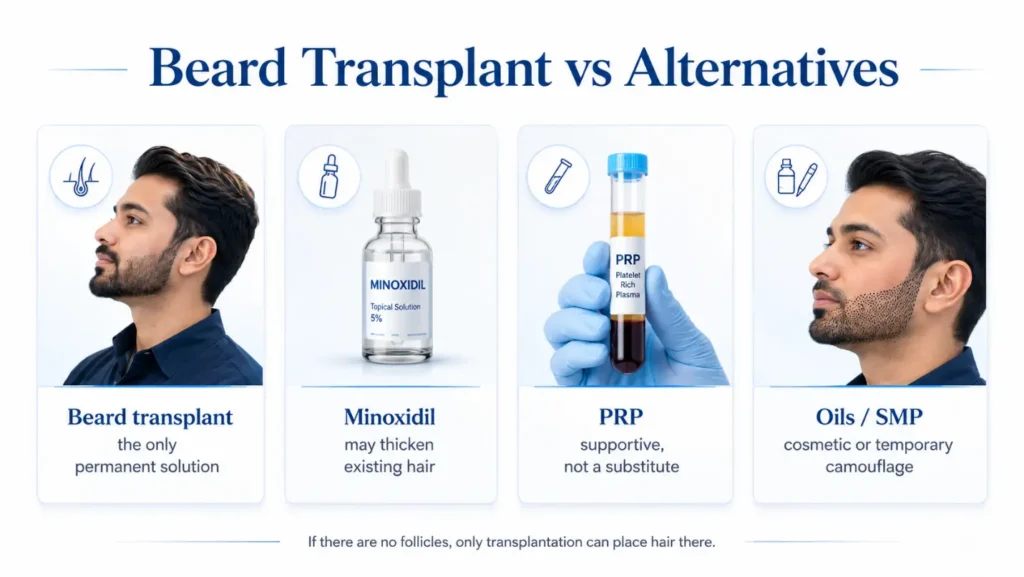
Beard Transplant vs the Alternatives
Option | What it does | Permanent? | Honest verdict |
Beard transplant (FUE) | Relocates living follicles | Yes | The only permanent solution for bare areas |
Minoxidil on the beard | May thicken existing fine hair | No — stops when you stop | Can help thin areas; useless where no follicles exist |
Stimulates existing follicles | No — needs maintenance | Supportive; not a substitute for grafts | |
Beard oils & supplements | Condition existing hair | No | Cosmetic only — cannot create follicles |
Microblading / SMP on beard | Pigment illusion of stubble | No — fades | Temporary camouflage, not real hair |
The honest bottom line: if an area has no follicles, only transplantation puts hair there. Minoxidil and PRP are worth trying where sparse, fine hair already exists — and an honest clinic will suggest that first if it might spare you surgery.
Is a Beard Transplant Safe?
Yes — it’s a minimally invasive day-care procedure performed under local anaesthesia using your own tissue, so there’s no rejection risk, and graft survival in experienced hands is high. Expected effects are crusting, redness and some facial swelling for a few days. Less common issues include folliculitis (small inflamed bumps as hairs re-emerge, usually settling with simple treatment), temporary numbness, and — with poor technique — unnatural angles, visible ‘pluggy’ placement, or donor over-harvesting. Those last three are entirely technique-dependent, which is why the surgeon matters far more than the clinic’s marketing. Read our honest guide to hair transplant safety and technique for more.

Why Dr. Arun Panda — a Facial Surgeon Who Trains Hair Transplant
A beard transplant demands two skills at once: hair restoration technique, and facial aesthetic judgement. Most clinics have the first. Dr. Arun Panda has both — he’s a Cranio-Maxillofacial and fellowship-trained Facial Plastic and Cosmetic Surgeon and founder of Trinity Aesthetics Academy, where he trains other doctors in hair transplantation. If you’re looking for a beard hair transplant doctor in Navi Mumbai or Mumbai, that combination is the meaningful difference.
- Beard design by a facial surgeon. Your beard shape is planned around your jawline and facial proportions — it should improve your face, not just add hair to it.
- Surgeon-set angles and directions. The single technical factor that decides whether a beard looks real. Not delegated.
- Lifetime donor planning. Your scalp’s future needs are assessed before your beard’s present ones — honest advice even when it means a smaller procedure.
- He trains other surgeons. As founder of Trinity Aesthetics Academy, Dr. Panda teaches hair transplantation to other practitioners.
- Scar expertise. A maxillofacial background means scar-related beard gaps — trauma, surgical, cleft-lip — are properly understood, with laser scar treatment available alongside where useful.
Centrally located in Vashi — serving Navi Mumbai and Mumbai Bodyskulpt Aesthetics is in the heart of Vashi, easily reached from Kharghar, Panvel, Belapur, Nerul, Airoli, Thane and across Mumbai. EMI options available, and out-of-town patients can be scheduled for consultation and surgery on consecutive days. |
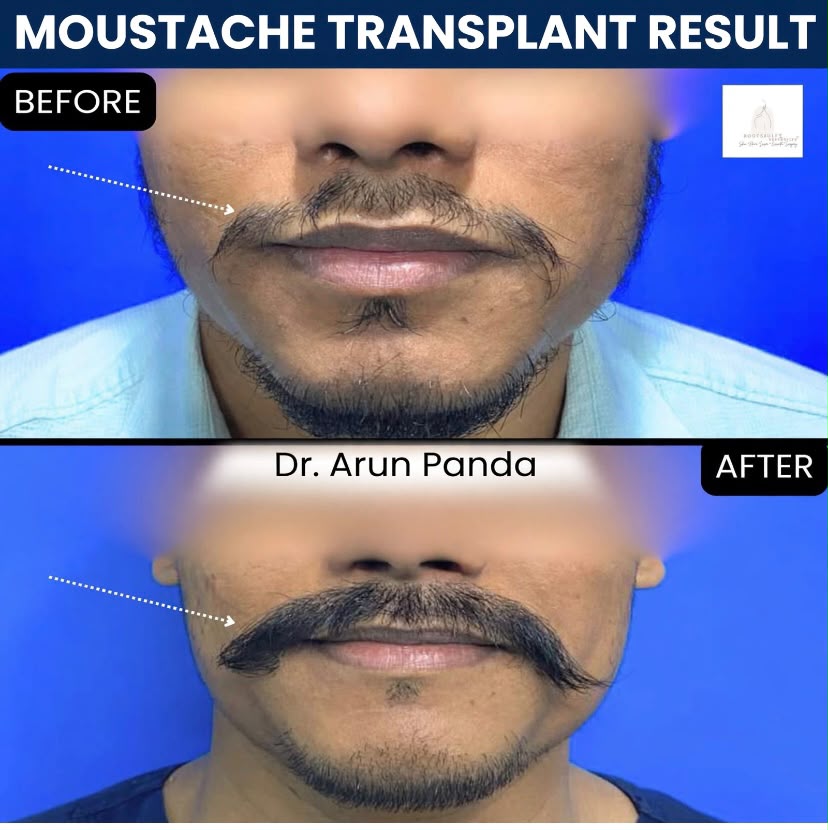
Frequently Asked Questions
How much does a beard hair transplant cost in Navi Mumbai?
Beard transplants are priced per graft, typically ₹40–₹100 per graft in Navi Mumbai and Mumbai. By area that works out to roughly ₹20,000–₹55,000 for a moustache, ₹25,000–₹85,000 for cheeks, and ₹80,000–₹2,00,000+ for a full beard of 2,000–4,000 grafts. Beard work sits at the higher end of hair-transplant pricing because it uses mostly single-hair grafts and demands precise angle control. EMI options are available.
How many grafts do I need for a beard transplant?
It depends on the area: about 400–800 grafts for a moustache, 500–1,000 for a goatee, 500–1,200 for cheeks, 200–500 for sideburns, and 2,000–4,000 for a full beard. Your exact number is calculated at consultation by measuring the area and assessing your donor supply.
Is a beard transplant permanent?
Yes. The transplanted follicles come from the back of the scalp, where hair is genetically resistant to loss, and they continue growing for life in their new location. You can shave, trim and style the beard normally once healed.
Will a transplanted beard look natural?
It should be undetectable — but that depends almost entirely on technique. Beard hair emerges at sharp, acute angles that differ across the chin, cheeks and upper lip, and mostly single-hair grafts must be used along the borders. Angles set incorrectly produce a bristly, artificial look, which is why a surgeon setting the angles matters more than any equipment.
What is the recovery time after a beard transplant?
Tiny crusts form around each graft and flake off over 4–7 days; most men return to work around day 4–5. No shaving for 10–14 days. Transplanted hairs shed at weeks 2–4 — normal shock loss, not failure — with new growth from month 3–4 and the full result at 8–12 months.
Does a beard transplant use up hair I might need for my scalp later?
Yes — and this is important. Your scalp donor area is finite and shared between your beard and any future scalp restoration. If you have a family history of male-pattern baldness, using several thousand grafts on a beard now may leave insufficient donor for scalp work later. A responsible surgeon assesses your scalp and family history before planning your beard, and may recommend a smaller or staged procedure.
Does transplanted beard hair feel the same as native beard hair?
Not exactly. Hair taken from the scalp keeps scalp characteristics — it grows continuously if left, and is often slightly softer and finer than coarse native beard hair — so it needs regular trimming to blend naturally. In practice this is easily managed, but you should know it before surgery.
Is a beard transplant painful?
No — it’s performed under local anaesthesia, so you’re awake and comfortable throughout, feeling only pressure. Mild soreness and tightness for a few days afterwards is easily managed with simple medication.
Can a beard transplant cover acne or surgical scars?
Yes — grafting hair into scarred beard areas is one of its most satisfying uses, camouflaging acne, chickenpox, trauma, surgical and cleft-lip scars. Scarred tissue has poorer blood supply, so graft survival can be slightly lower and a second session is sometimes needed for full density.
Book a Beard & Donor Assessment
An honest plan designed for your face, and for your donor’s lifetime. Book with Dr. Arun Panda at Bodyskulpt Aesthetics, Sector 9, Vashi, Navi Mumbai. You’ll get your beard pattern and face shape assessed, your donor supply calculated for the long term, a beard shape designed and drawn for your approval, an honest graft estimate, and a clear itemised quote. Read our full hair transplant guide, the cost guide, or book a consultation. Call / WhatsApp: 9152020907 / 9152020908 • drarunpanda.com • EMI available |
Authoritative references
For independent information, see the International Society of Hair Restoration Surgery, the American Academy of Dermatology and peer-reviewed literature on beard transplantation.
Educational information only and not a substitute for an in-person surgical consultation. Graft numbers, costs and results vary between individuals and depend on donor supply and beard pattern.
Please reach out to us through the contact details below.
- Website: https://drarunpanda.com/
- Phone: +919152020907, +919152020908
- Address: Dr. Arun Panda, BodySkulpt Aesthetics, F1/A-4, Aditi Apartments, Sector 9, Vashi, Navi Mumbai – 400703
- Facebook: https://www.facebook.com/DrArunPanda
- Instagram: https://www.instagram.com/drarunpanda/
- Youtube: https://www.youtube.com/DrArunPanda
- LinkedIn: https://www.linkedin.com/in/drarunpanda
- Twitter: https://twitter.com/DrArunPanda1
- Email: facialaestheticsindia@gmail.com
- Google Directions: https://g.page/DrArunPanda?gm