Tummy Tuck (Abdominoplasty) in Navi Mumbai
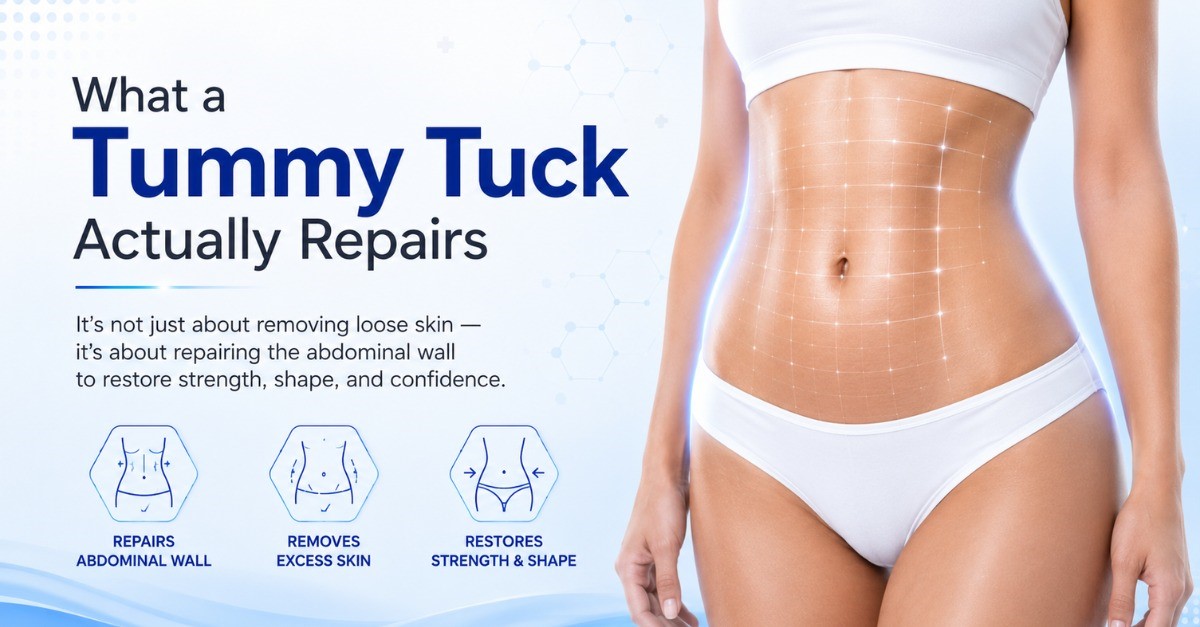
What a Tummy Tuck Actually Repairs
Most people arrive thinking a tummy tuck is about removing loose skin. It is — but that’s the smaller half of the operation. The part that changes how your abdomen works, not just how it looks, is the repair of the abdominal wall underneath.
During pregnancy or significant weight gain, the two vertical bands of the rectus abdominis muscle are pushed apart at the midline. In many people they don’t come back together — a condition called diastasis recti. The gap that remains means the abdominal wall no longer holds tension properly, which is why some people keep a rounded lower belly however lean they get, and why core weakness and lower back pain often persist. No exercise closes a true diastasis, because the problem is a stretched fascial seam, not a weak muscle. Surgical plication — stitching the muscle edges back together — is the only reliable repair.
That’s the honest framing of this operation: skin excision improves the silhouette, and muscle repair restores the structure. Most people need both.
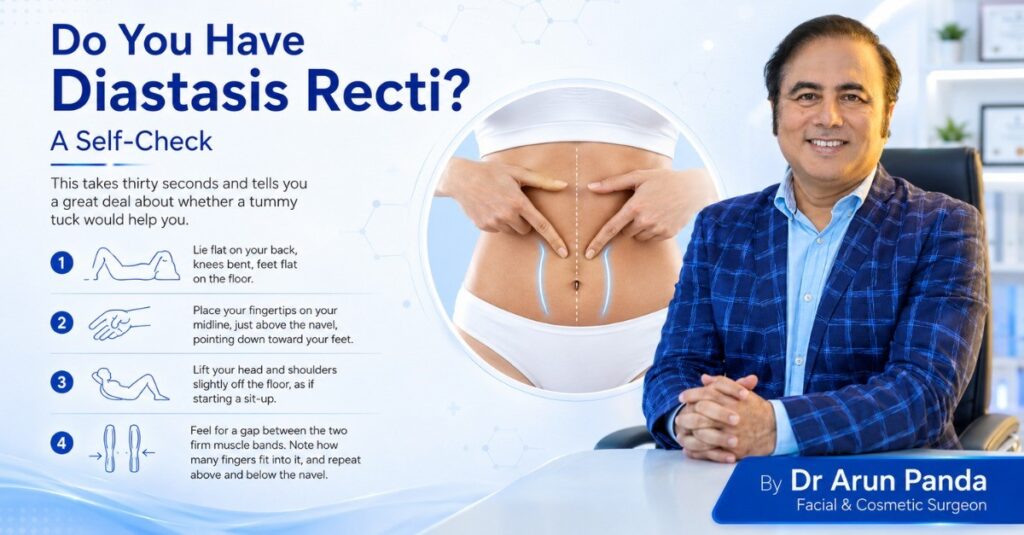
Do You Have Diastasis Recti? A Self-Check
This takes thirty seconds and tells you a great deal about whether a tummy tuck would help you or whether something simpler would:
- Lie flat on your back, knees bent, feet flat on the floor.
- Place your fingertips on your midline, just above the navel, pointing down toward your feet.
- Lift your head and shoulders slightly off the floor, as if starting a sit-up.
- Feel for a gap between the two firm muscle bands. Note how many fingers fit into it, and repeat above and below the navel.
What you find | What it suggests | What usually helps |
| |
Less than 2 fingers wide | Within normal range | Core rehabilitation, not surgery |
| |
2–3 fingers, firm base | Mild diastasis | Physiotherapy first; surgery only if symptomatic |
| |
3+ fingers, or a soft ‘sinking’ gap | Significant diastasis | Muscle repair (abdominoplasty) |
| |
A visible bulge or ridge on straining | Diastasis, possibly with hernia | Surgical assessment — hernia can be repaired at the same time |
| |
No gap, but loose skin | Skin excess only | Mini abdominoplasty or skin excision alone |
| |
No gap, no loose skin, just fat | Fat only | Liposuction — not a tummy tuck |
| |
| Why this matters commercially as well as clinically If your abdomen is firm underneath and the issue is purely fat, liposuction alone is cheaper, quicker and leaves no long scar — and any surgeon recommending a full abdominoplasty in that situation is overselling. Conversely, if you have a genuine 3-finger diastasis, liposuction will make you look slimmer while leaving the structural problem completely untouched, and you’ll be disappointed within months. Getting this distinction right before you pay for anything is the single most useful thing on this page. | |||
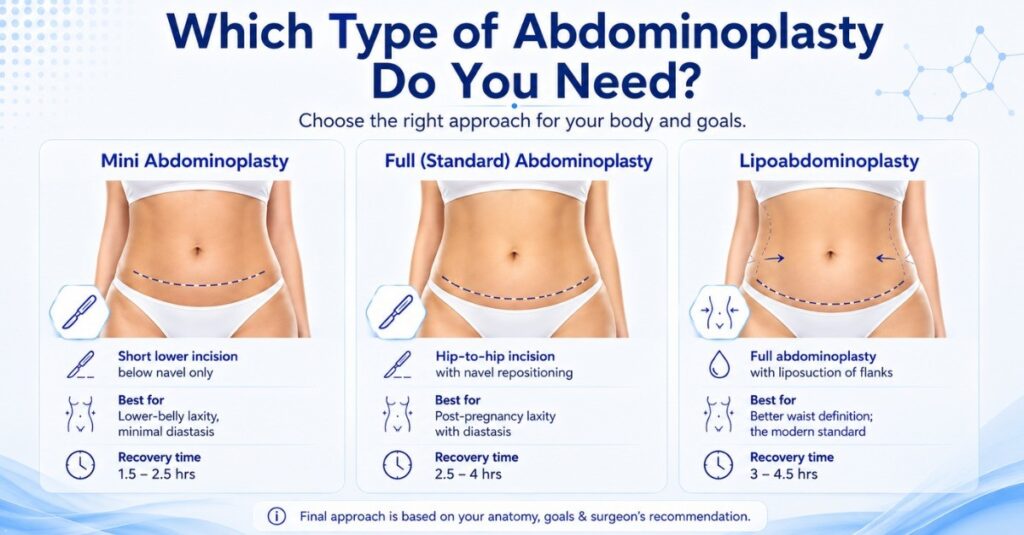
Which Type of Abdominoplasty Do You Need?
Type | Incision & scope | Best for | Theatre time |
| |
Mini abdominoplasty | Short lower incision; below navel only; navel not moved | Lower-belly skin laxity, minimal diastasis | 1.5–2.5 hrs |
| |
Full (standard) | Hip-to-hip incision; navel repositioned; full muscle repair | Post-pregnancy laxity with diastasis — the commonest | 2.5–4 hrs |
| |
Lipoabdominoplasty | Full abdominoplasty combined with liposuction of flanks | Better waist definition; the modern standard in most cases | 3–4.5 hrs |
| |
Extended | Incision extends onto the flanks | Significant flank and hip laxity | 3.5–5 hrs |
| |
Fleur-de-lis | Adds a vertical midline incision | Massive weight loss with horizontal excess | 4–6 hrs |
| |
Panniculectomy | Removes overhanging apron only; no muscle repair | Functional relief — rashes, hygiene, mobility | 2–3 hrs |
| |
| Panniculectomy vs abdominoplasty — the distinction that can affect your bill These are frequently confused, including by clinics. A panniculectomy removes the overhanging apron of skin and fat only; it does not reposition the navel, does not repair the muscles, and does not aim to improve contour — it aims to relieve genuine functional problems such as recurrent skin infections, rashes, hygiene difficulty and restricted mobility, typically after major weight loss. Because it addresses a documented medical problem, a panniculectomy is sometimes eligible for insurance consideration, whereas a cosmetic abdominoplasty is not. If your primary issue is a heavy overhang causing recurrent infections, say so at consultation — it changes both the operation and potentially how it is funded. What we won’t do is dress up a cosmetic request as a functional one. | ||||
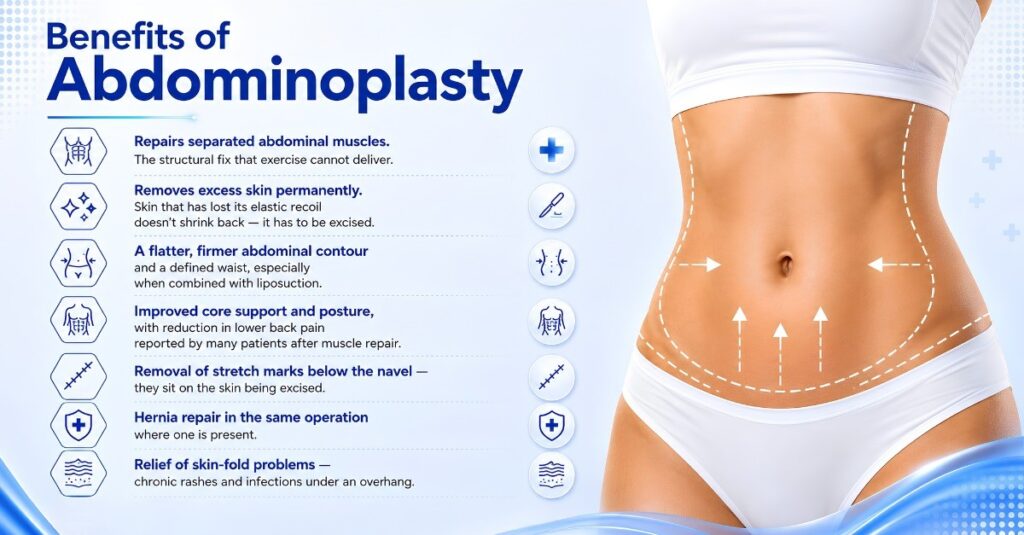
Benefits of Abdominoplasty
- Repairs separated abdominal muscles. The structural fix that exercise cannot deliver.
- Removes excess skin permanently. Skin that has lost its elastic recoil doesn’t shrink back — it has to be excised.
- A flatter, firmer abdominal contour and a defined waist, especially when combined with liposuction.
- Improved core support and posture, with reduction in lower back pain reported by many patients after muscle repair.
- Removal of stretch marks below the navel — they sit on the skin being excised.
- Hernia repair in the same operation where one is present.
- Relief of skin-fold problems — chronic rashes and infections under an overhang.
- Long-lasting results provided weight stays stable and no further pregnancy follows.
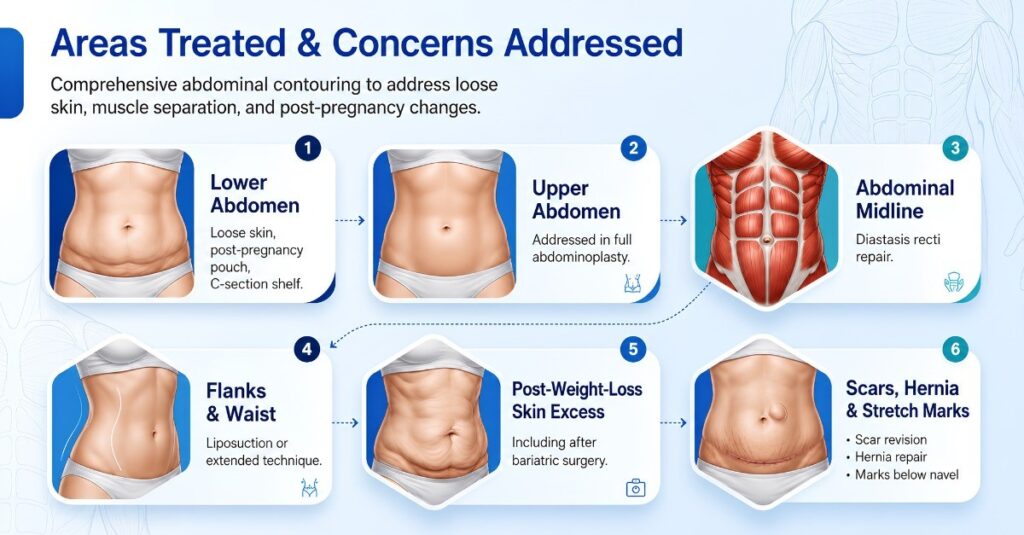
Areas Treated & Concerns Addressed
- Lower abdomen — loose skin, the post-pregnancy ‘pooch’, C-section shelf.
- Upper abdomen — addressed in full abdominoplasty, not mini.
- Abdominal midline — diastasis recti repair.
- Flanks and waist — with liposuction or extended technique.
- Post-pregnancy changes — the commonest reason for surgery.
- Post-weight-loss skin excess — including after bariatric surgery.
- C-section scar irregularity — often revised within the new incision.
- Umbilical or ventral hernia — repaired concurrently where present.
- Stretch marks below the navel — removed with the excised skin.
Who Should Wait — or Choose Something Else
This is not a weight-loss operation An abdominoplasty removes skin and repairs muscle. It is not a substitute for weight loss, and operating at a high BMI increases every complication rate — wound healing problems, infection and blood clots in particular. The best outcomes come from patients at or near a stable target weight, maintained for 6–12 months. If you are still actively losing weight, waiting will give you a better result, a safer operation and a lower chance of needing revision. We would rather tell you to come back in a year than operate at the wrong moment. |
- Planning future pregnancy. Pregnancy will separate the repaired muscles again. Complete your family first — this is one of the few cosmetic operations where waiting is unambiguously the right advice.
- Active smokers. Smoking dramatically increases the risk of wound breakdown and skin necrosis in abdominoplasty specifically, because the blood supply to the elevated skin flap is already reduced. Stopping at least 4–6 weeks before and after surgery is a requirement, not a suggestion.
- Unstable weight or ongoing bariatric journey — wait until weight has plateaued.
- Uncontrolled diabetes, significant cardiac or respiratory disease, or a personal history of blood clots — all need medical assessment first, and some are absolute contraindications.
- Fat without skin laxity or diastasis — liposuction alone is the better, smaller operation.
- Mild laxity only — non-surgical skin tightening may give a modest improvement without surgery, though expectations must be realistic.
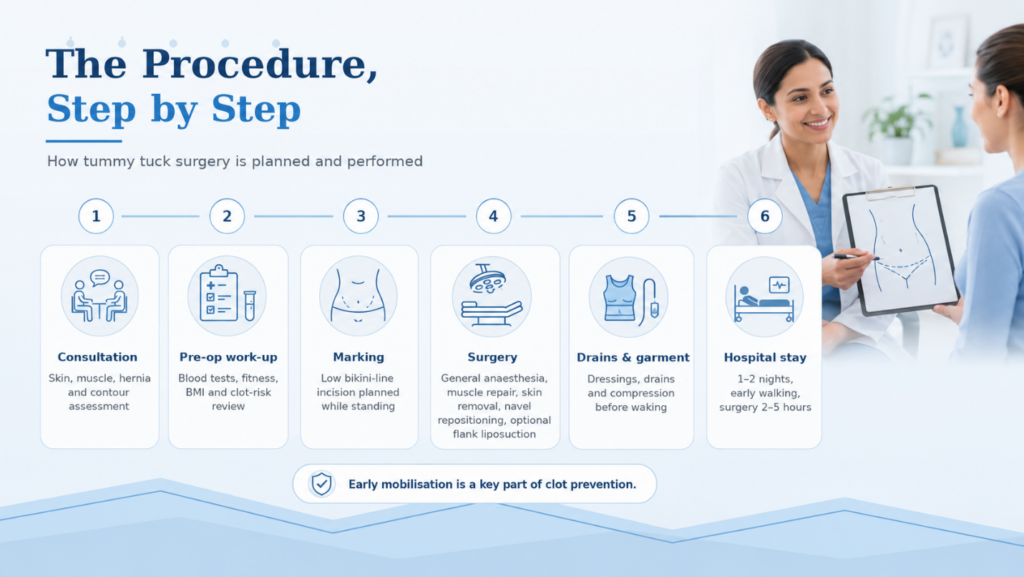
The Procedure, Step by Step
- Consultation with the plastic surgeon. Examination for skin excess, diastasis, hernia and fat distribution; discussion of technique, scar position and realistic outcome. Photographs and measurements taken.
- Pre-operative work-up. Blood tests, fitness and anaesthetic assessment, BMI review, smoking cessation, and individual assessment of blood-clot risk. Ultrasound if hernia is suspected.
- Incision planned with you standing, positioned low so it sits within underwear or a bikini line.
- Surgery under general anaesthesia. Skin flap elevated, diastasis repaired with layered permanent sutures, excess skin excised, navel repositioned through a new opening, liposuction of flanks where planned.
- Drains and dressings. Drains are usually placed to reduce fluid collection, and a compression garment fitted before you wake.
- Hospital stay. Typically one to two nights, with early mobilisation the same evening — which matters more for clot prevention than anything else. Surgery runs 2–5 hours by type.
Recovery — the Honest Timeline
This is a significant operation and the recovery deserves to be described accurately. Plan for it properly and it goes well; underestimate it and it’s miserable.
Timeframe | What to expect |
Days 1–3 | Hospital. You’ll walk bent slightly forward — normal and temporary. Drains in place. Pain controlled with medication. |
Week 1 | Home, walking short distances hourly. Drains usually removed as output falls. Sleeping propped up with knees bent. |
Weeks 2–3 | Standing straighter; most desk workers return around week 2–3. Compression garment worn continuously. |
Weeks 4–6 | Swelling settling; light activity resumed. No lifting over 5 kg and no core exercise yet. |
Weeks 6–8 | Garment usually discontinued; gradual return to full exercise with surgeon’s clearance. |
Months 3–12 | Swelling fully resolves, contour settles, scar matures from red to pale. |
Aftercare that genuinely affects outcome
- Walk from day one, little and often. Early mobilisation is the most effective thing you can do to reduce blood-clot risk.
- Wear the compression garment exactly as instructed for the full six weeks — it controls swelling and reduces seroma.
- No lifting over 5 kg for 6 weeks — including children, which needs planning in advance if you have a toddler.
- Sleep propped with knees bent for the first two weeks to keep tension off the repair.
- Report calf pain, breathlessness or chest pain immediately — these are the warning signs of a clot and need same-day assessment.
- Scar care from week 3 — silicone gel or sheeting and strict sun protection for 12 months, which matters more on Indian skin where scars pigment readily.

Cost of Tummy Tuck in Navi Mumbai
Abdominoplasty is quoted per case, since a mini and a fleur-de-lis are very different operations. These indicative ranges include surgeon and anaesthetist fees, accredited theatre, one to two nights’ stay, garments, drains and routine follow-up. EMI options are available.
Procedure | Indicative cost (INR) |
| |
Mini abdominoplasty | ₹1,00,000 – ₹1,80,000 |
| |
Full (standard) abdominoplasty | ₹1,50,000 – ₹2,80,000 |
| |
Lipoabdominoplasty (with flank liposuction) | ₹2,00,000 – ₹3,50,000 |
| |
Extended abdominoplasty | ₹2,50,000 – ₹4,00,000 |
| |
Fleur-de-lis abdominoplasty | ₹3,00,000 – ₹5,00,000 |
| |
Panniculectomy (functional) | ₹1,20,000 – ₹2,20,000 |
| |
Combined with breast surgery (‘mommy makeover’) | Quoted together — see safety note below |
| |
| What to check in any quote — and a word on combined procedures Ask specifically whether the quote covers the anaesthetist, accredited theatre charges, hospital stay, compression garments, drain removal, all follow-up visits, and what a revision or seroma drainage would cost. Quotes that look dramatically lower usually exclude several of these. On combined procedures: a ‘mommy makeover’ pairing abdominoplasty with breast surgery is popular and can be appropriate — but combining operations lengthens anaesthetic time and measurably increases the risk of blood clots and wound complications. It should be a considered clinical decision based on your health and the surgeon’s judgement, not a package discount decision. If the surgeon advises staging your procedures, that advice is worth more than the saving. | ||
Results Timeline
When | What you’ll see |
Weeks 1–2 | Swollen and bruised; posture bent. Nothing meaningful to judge. |
Weeks 4–6 | Standing straight; the flatter contour becomes visible. |
Months 2–3 | Most swelling resolved; waist definition apparent. |
Months 6–12 | Final contour; scar fading from red toward pale. |
Long term | Permanent, provided weight remains stable and no further pregnancy follows. |
Abdominoplasty vs the Alternatives
Option | Addresses | Doesn’t address | Scar |
Full abdominoplasty | Skin excess + diastasis + fat | — | Hip-to-hip, permanent |
Fat only | Loose skin, muscle separation | Tiny, hidden | |
Mini abdominoplasty | Lower-belly skin only | Upper abdomen, significant diastasis | Short, low |
Very mild laxity | Real skin excess or diastasis | None | |
Exercise & physiotherapy | Muscle strength, mild diastasis | Skin excess, established diastasis | None |
The honest sequence: exercise and physiotherapy first — they cost nothing and resolve mild cases. Liposuction if the problem is genuinely fat with good skin. Abdominoplasty when skin has lost its recoil or the diastasis is established, because at that point nothing else works.
Risks — Including the One Most Pages Omit
Abdominoplasty is a well-established operation with high satisfaction rates, but it is major surgery and the risk profile deserves plain description.
- Blood clots (DVT and pulmonary embolism). This is the most serious risk and abdominoplasty carries a higher rate than most cosmetic procedures — particularly when combined with other operations. It is managed with risk scoring, compression devices, early walking and, where indicated, blood-thinning medication. Any clinic that doesn’t raise this with you has not prepared you properly.
- Seroma — fluid collection under the skin flap. The commonest complication; managed with drains, compression and occasionally needle drainage in clinic.
- Wound healing problems and skin necrosis, markedly more likely in smokers and at higher BMI.
- Permanent numbness of the skin above the scar. Almost universal to some degree and rarely mentioned in advance — a band of reduced sensation across the lower abdomen that may never fully return. It bothers few people once expected, and many when it isn’t.
- Infection, bleeding or haematoma — uncommon with proper technique and accredited facilities.
- Scar quality issues — widening, thickening or hyperpigmentation, more likely on Indian skin without disciplined scar care and sun protection.
- Dog-ears at the scar ends, asymmetry, or navel positioning issues — sometimes needing minor revision.
- Persistent swelling for months — expected rather than a complication, but worth knowing.
Who Performs Your Surgery at Bodyskulpt Aesthetics
Bodyskulpt Aesthetics is a doctor-led aesthetic clinic in Vashi, founded by Dr. Arun Panda, a Cranio-Maxillofacial and fellowship-trained Facial Plastic and Cosmetic Surgeon. His own surgical practice is facial — and we think it matters that we say so plainly. Abdominoplasty and other body contouring procedures are performed by qualified plastic surgeons empanelled with the clinic, operating in accredited facilities and in compliance with Indian medical regulations.
We take that separation seriously, because scope of practice is a patient-safety matter rather than a marketing detail. When you come to us for a tummy tuck, you are seen and operated on by a plastic surgeon whose training is in body contouring — not by a facial surgeon extending beyond his field.
- Qualified plastic surgeons for body procedures, with their credentials available to you at consultation.
- Accredited operating facilities with senior anaesthesia support — not an office procedure room.
- Formal blood-clot risk assessment for every abdominoplasty patient, with prophylaxis protocols applied accordingly.
- Honest triage. If liposuction alone would serve you better, or if you should wait until your weight stabilises or your family is complete, that is what you’ll be told.
- Full body-contouring range under one roof — abdominoplasty, liposuction, breast surgery and gynaecomastia correction.
Centrally located in Vashi — serving Navi Mumbai and Mumbai Bodyskulpt Aesthetics is in the heart of Vashi, easily reached from Kharghar, Panvel, Belapur, Nerul, Airoli, Thane and across Mumbai. Abdominoplasty is a planned procedure with structured follow-up, so consultation, pre-operative work-up and surgery are scheduled to suit you. EMI options available. |
Frequently Asked Questions
How much does a tummy tuck cost in Navi Mumbai?
Approximately ₹1,00,000–₹1,80,000 for a mini abdominoplasty, ₹1,50,000–₹2,80,000 for a full abdominoplasty, and ₹2,00,000–₹3,50,000 for lipoabdominoplasty with flank liposuction. Extended and fleur-de-lis procedures run higher. Quotes should include surgeon and anaesthetist fees, accredited theatre, hospital stay, garments, drains and follow-up — always confirm what’s excluded. EMI options are available.
Who performs the tummy tuck at Bodyskulpt Aesthetics?
Abdominoplasty is performed by qualified plastic surgeons empanelled with the clinic, in accredited operating facilities and in compliance with Indian medical regulations. Bodyskulpt Aesthetics is founded by Dr. Arun Panda, whose own surgical practice is facial plastic and cranio-maxillofacial surgery; body contouring falls outside that scope and is handled by the clinic’s plastic surgery team. You can ask to see your operating surgeon’s credentials at consultation.
Will a tummy tuck fix my separated stomach muscles?
Yes — that’s one of its main purposes. Diastasis recti, the separation of the vertical abdominal muscles after pregnancy or weight change, is repaired by stitching the muscle edges back together (plication). This is the part no exercise can achieve, because the problem is a stretched fascial seam rather than weak muscle. Many patients report improved core support and reduced lower back pain afterwards.
Is a tummy tuck a weight-loss operation?
No. It removes excess skin and repairs muscle; it is not a substitute for weight loss, and operating at a high BMI increases every complication rate. The best results come from patients at or near a stable target weight maintained for 6–12 months. If you’re still actively losing weight, waiting gives a better result and a safer operation.
How big is the scar and where will it be?
A full abdominoplasty leaves a permanent scar running hip to hip, placed low so it sits within underwear or a bikini line, plus a small scar around the repositioned navel. A mini abdominoplasty leaves a shorter scar and doesn’t move the navel. The scar fades from red toward pale over 6–12 months, and disciplined silicone and sun protection matter particularly on Indian skin, which pigments readily.
What is the recovery time after abdominoplasty?
Expect one to two nights in hospital, drains for about a week, and a compression garment for six weeks. You’ll walk bent forward for the first several days. Most desk workers return at 2–3 weeks, no lifting over 5 kg for 6 weeks, and full exercise resumes at 6–8 weeks with surgical clearance. Swelling settles over 3–6 months and the scar matures over 12.
Can I have a tummy tuck if I want more children?
It’s best to wait. Pregnancy will separate the repaired muscles again and stretch the skin, largely undoing the result. This is one of the few cosmetic operations where the advice to complete your family first is unambiguous — the surgery will still be available later and will give you a better and more lasting outcome then.
Is a tummy tuck covered by insurance in India?
A cosmetic abdominoplasty generally isn’t. A panniculectomy — removing an overhanging apron of skin causing documented functional problems such as recurrent infections, rashes or restricted mobility — is sometimes considered, as is concurrent hernia repair. Coverage depends entirely on documentation and your specific policy, so it’s worth asking rather than assuming. We’ll tell you honestly whether your case has a genuine functional component.
What is the most serious risk of a tummy tuck?
Blood clots — deep vein thrombosis and pulmonary embolism. Abdominoplasty carries a higher risk than most cosmetic procedures, and combining it with other operations increases that further. It’s managed with formal risk assessment, compression devices, early walking from the evening of surgery and, where indicated, blood-thinning medication. Report calf pain, breathlessness or chest pain immediately after surgery.
Book a Body Contouring Consultation
An honest assessment — including whether you need this operation at all. Book at Bodyskulpt Aesthetics, Sector 9, Vashi, Navi Mumbai. You’ll be assessed by a plastic surgeon for skin excess, diastasis, hernia and fat distribution; told plainly whether abdominoplasty, liposuction or simply waiting would serve you better; and given an itemised quote covering theatre, anaesthesia, stay, garments and follow-up. Explore liposuction, breast surgery, or book a consultation. Call / WhatsApp: 9152020907 / 9152020908 • drarunpanda.com • EMI available |
Authoritative references
For independent information, see the American Society of Plastic Surgeons on tummy tuck, Mayo Clinic and peer-reviewed literature on abdominoplasty and venous thromboembolism risk.
Educational information only and not a substitute for an in-person surgical consultation. Abdominoplasty is major surgery performed by qualified empanelled plastic surgeons at Bodyskulpt Aesthetics in accordance with Indian medical regulations. Suitability, results, costs and recovery vary between individuals.
Please reach out to us through the contact details below.
- Website: https://drarunpanda.com/
- Phone: +919152020907, +919152020908
- Address: Dr. Arun Panda, BodySkulpt Aesthetics, F1/A-4, Aditi Apartments, Sector 9, Vashi, Navi Mumbai – 400703
- Facebook: https://www.facebook.com/DrArunPanda
- Instagram: https://www.instagram.com/drarunpanda/
- Youtube: https://www.youtube.com/DrArunPanda
- LinkedIn: https://www.linkedin.com/in/drarunpanda
- Twitter: https://twitter.com/DrArunPanda1
- Email: facialaestheticsindia@gmail.com
- Google Directions: https://g.page/DrArunPanda?gm