Facelift Surgery in Navi Mumbai
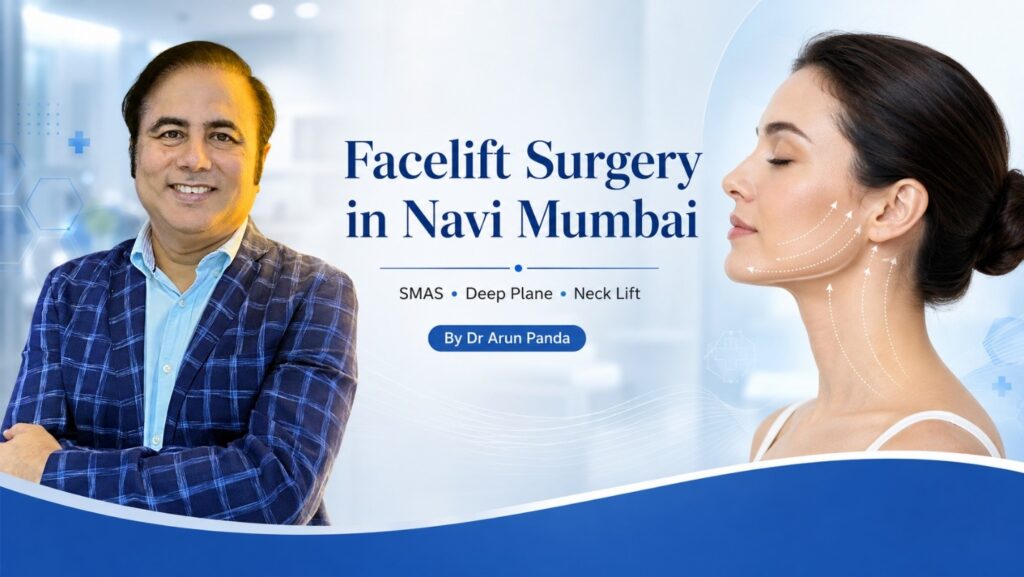
What Actually Sags, and Why Only Surgery Repositions It
The face ages in layers, and understanding which layer is your problem explains almost everything about which treatment will work.
Beneath your skin lies a sheet of fibrous tissue and muscle called the SMAS — the superficial musculo-aponeurotic system — which continues down the neck as the platysma muscle. With time this layer loosens and descends, carrying the fat and skin above it downward. That descent is what creates jowls, a blurred jawline, deepening folds beside the mouth, and the vertical bands that appear on the neck.
Energy devices heat and tighten skin. Threads pull it temporarily. Filler adds volume where it was lost. None of them takes a descended SMAS layer and repositions it upward, because none of them can get to it. A facelift lifts and re-anchors that layer surgically, then removes the excess skin that results. That is the entire difference, and it is why the two categories are not really competitors — they simply address different stages.
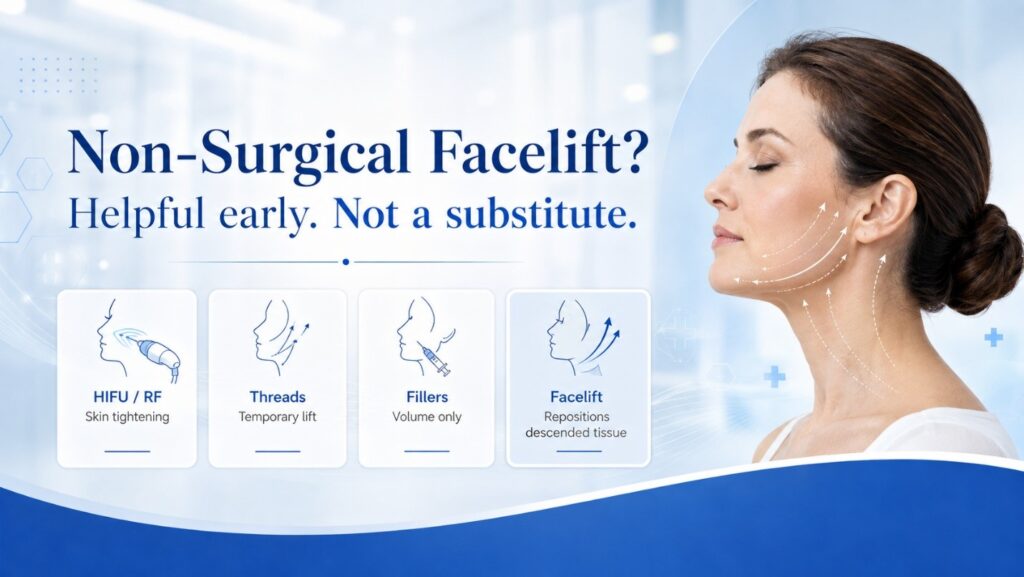
‘Non-Surgical Facelift’: What That Term Really Means
It is one of the most searched phrases in aesthetics and one of the least accurate. Here is what is actually being sold under it, and what each genuinely achieves:
Marketed as | What it actually is | What it genuinely does | Lasts |
| |
‘Non-surgical facelift’ | Tightens skin, modest lift on early laxity | 12–18 months |
| ||
‘Thread lift facelift’ | Repositions tissue mechanically — real but temporary | 12–18 months |
| ||
‘Liquid facelift’ | Restores lost volume; does not lift | 12–18 months |
| ||
‘Laser facelift’ | Tightens and reduces small fat pockets | 12–24 months |
| ||
Surgical facelift | SMAS or deep-plane lift | Repositions the descended layer itself | 7–12 years |
| |
| This is not an argument against non-surgical treatment — quite the opposite For mild to moderate laxity, non-surgical treatment is often the correct recommendation, and we make it frequently. It has no meaningful downtime, costs a fraction of surgery, and started early it can postpone a facelift by several years. What it cannot do is substitute for one. The problem is not the treatments — it is the borrowed name, which sets people up to spend on a package that was never capable of delivering what they pictured. If your jowls hang and your jawline has gone, no number of sessions will lift them, and an honest clinic will tell you that rather than sell you a course. | ||||
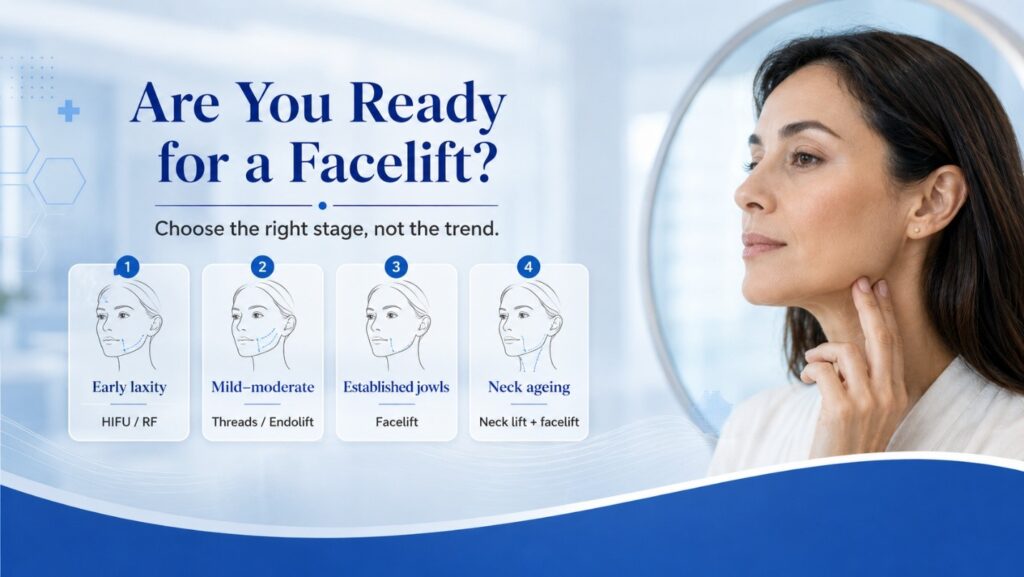
Are You Ready for Surgery, or Is It Too Early?
The commonest mistake is not having a facelift too late — it is having one too early, or having non-surgical treatment long past the point where it can help. Where you sit on this ladder decides which:
What you see in the mirror | Stage | What we’d recommend |
| |
Skin looks less firm; nothing hangs yet | Early laxity | HIFU or RF tightening — surgery is premature |
| |
Softening jawline, early jowl forming | Mild-moderate |
| ||
Defined jowls; jawline lost; folds deepening | Established descent | Facelift — non-surgical will disappoint |
| |
Neck bands, loose neck skin, blurred chin-neck angle | Neck-dominant ageing | Neck lift, usually with facelift |
| |
Hollow and gaunt rather than saggy | Volume loss, not descent | Filler or fat grafting — lifting would worsen it |
| |
Lines at rest but skin still firm | Skin quality, not laxity | Resurfacing or Botox — a lift won’t help |
| |
| The mirror test, and the age question Stand in front of a mirror and lie back, or place your fingertips at your temples and lift gently upward and outward. If that manoeuvre substantially improves your jawline and jowls, a facelift will help you — that is close to what the operation does. If it changes little, your concern is more likely volume, skin quality or the neck, and a lift is the wrong tool. On age: most facelifts are performed between the mid-forties and mid-sixties, but chronological age matters far less than what your tissue is doing. We see 42-year-olds who genuinely need surgery and 60-year-olds who do not. | |||
The Techniques, and Why ‘Mini’ Is Often Oversold
Technique | What it involves | Best for | Longevity |
Mini / short-scar lift | Shorter incision, limited SMAS tightening | Genuinely early jowling in younger patients | 3–6 years |
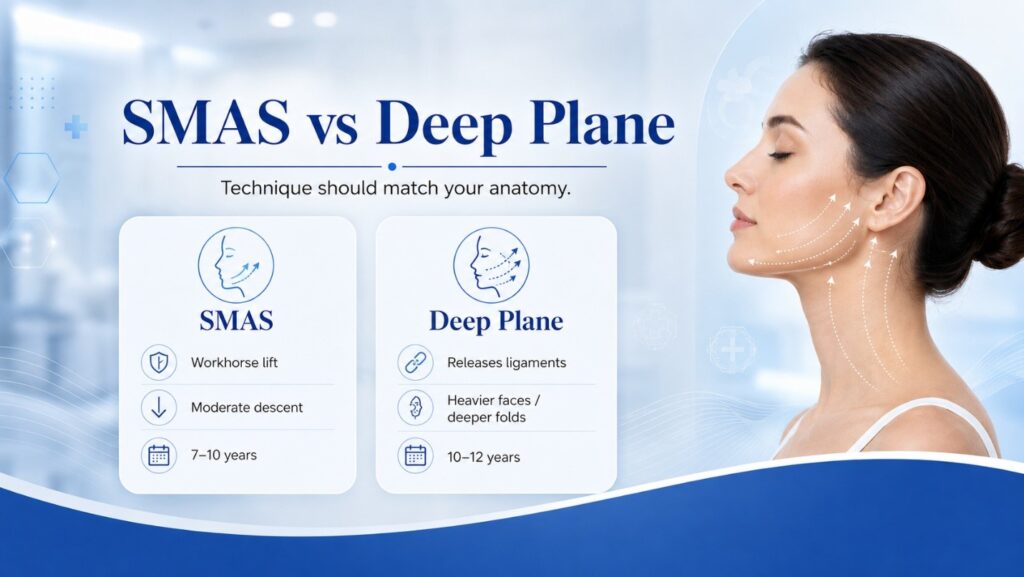
SMAS plication / SMASectomy | The SMAS layer is folded or partly removed and re-anchored | Moderate descent — the reliable workhorse | 7–10 years |
Deep plane facelift | Dissection beneath the SMAS, releasing ligaments and lifting skin and SMAS as one unit | Significant descent, deep folds, heavier faces | 10–12 years |
Neck lift / platysmaplasty | Platysma bands tightened, often via a small incision under the chin | Neck-dominant ageing — frequently combined | 7–12 years |
Facelift + fat grafting | Lifting combined with volume restoration | Faces that are both descended and deflated | Long-lasting |
Two things worth understanding before you compare quotes
- A ‘mini facelift’ on a face that needs a full lift is a short-lived result. The appeal is obvious — smaller scar, faster recovery, lower price. But limited SMAS work on established descent gives a modest improvement that fades relatively quickly, and patients frequently return within a few years wanting the operation they should have had first. It is genuinely the right choice for early jowling in a younger face, and genuinely the wrong one beyond that.
- Deep plane is a technique, not automatically a better outcome. It has real advantages in heavier faces and deeper folds, because releasing the retaining ligaments allows the mid-face to move as one unit. It is also more demanding and takes longer. A well-executed SMAS lift on the right face beats a deep-plane lift performed by someone less comfortable with it. The technique should be chosen for your anatomy, not because a term is fashionable.
What a Facelift Does Not Do
This is where expectations most often go wrong, because a facelift addresses one specific thing extremely well and several others not at all:
- It does not improve skin quality. Sun damage, pigmentation, fine crepey lines and texture are unchanged by lifting — they need resurfacing or medical skincare. Lifted skin with poor quality still looks aged.
- It does not treat the upper face. Brows, forehead and eyelids sit outside a standard facelift — eyelid surgery or a brow lift are separate procedures, often done at the same sitting.
- It does not restore volume. An ageing face loses fat as well as position. Lifting a deflated face tightens it without making it look younger — which is why fat grafting is so often part of a modern facelift.
- It does not soften expression lines. Frown and forehead lines are muscle activity — Botox addresses those.
- It does not stop ageing. It resets the clock; the clock continues. You will always look better than you would have without it, but you will keep ageing from the new starting point.
- It does not fix a weak jaw or chin. Skeletal proportion is a different problem — see chin and jaw augmentation.
Why the best facelifts are rarely a facelift alone The faces that look genuinely rejuvenated — rather than merely tighter — have usually had three things addressed: position (the lift), volume (fat grafting or filler), and skin quality (resurfacing or medical skincare). A facelift on its own can produce a face that is tight but still visibly weathered, which is the classic ‘pulled’ look people fear. Planning all three from the outset is what separates a natural result from a surgical one, and it is a conversation worth having before you compare prices between clinics offering different things. |

Areas Treated
- Jowls — the sagging along the jawline that most patients name first.
- Jawline definition — restoring a clean line from chin to ear.
- Mid-face and cheeks — lifting descended cheek fat back over the cheekbone.
- Nasolabial folds — softened by repositioning, though rarely eliminated.
- Marionette lines — the creases running down from the corners of the mouth.
- Neck — platysma bands, loose skin and the chin-neck angle; often combined with submental liposuction.
- Pre-jowl hollow — the dip in front of the jowl, addressed with lifting and often grafting.
Concerns It Addresses
- Established facial sagging that no longer responds to non-surgical treatment.
- Loss of jawline definition and visible jowls.
- Loose neck skin and platysma banding.
- Deep nasolabial and marionette folds caused by tissue descent.
- A tired or heavy appearance disproportionate to how you feel.
- Post-weight-loss facial laxity — often needing lifting plus volume restoration.
- Asymmetry that has become more visible with age.
- Results of previous surgery that have relaxed — secondary or revision facelift.
When we would advise against operating
- Active smoking. This is close to an absolute contraindication. Smoking dramatically increases the risk of skin flap necrosis — the skin dying at the edges — which is disfiguring and difficult to correct. Stopping for a minimum of 4–6 weeks before and after is a requirement, not a preference.
- Uncontrolled blood pressure. Haematoma is the commonest complication of facelift surgery, and hypertension is the strongest modifiable risk factor. Blood pressure must be controlled before we operate.
- Unrealistic expectations or external pressure — particularly surgery sought to save a relationship or match a photograph.
- Significant untreated medical conditions or bleeding disorders — medical clearance first.
- Too early. If non-surgical treatment would give you five more good years, that is the better recommendation and we will make it.
The Procedure, Step by Step
- Consultation and facial analysis. Assessment of skin quality, degree and pattern of descent, volume loss, neck involvement and underlying skeletal support — plus a frank discussion of whether surgery is warranted yet.
- Planning the combination. Technique selected for your anatomy, and any adjuncts — neck lift, fat grafting, eyelid surgery, resurfacing — planned together rather than added later.
- Pre-operative preparation. Blood tests, anaesthetic assessment, blood pressure optimisation, smoking cessation, and stopping blood-thinning medication and supplements that increase bleeding risk.
- Placed in front of the ear, curving around the earlobe and back into the hairline behind. A small incision under the chin is added where the neck is being addressed. Placement is planned to fall in natural creases and hairlines.
- The lift itself. The SMAS layer is elevated, repositioned upward and outward, and secured. Excess skin is then trimmed and closed without tension — tension on the skin closure is what produces distorted earlobes and visible scars.
- Closure, drains and recovery. Fine sutures, drains where used, and a supportive dressing. Surgery runs 3–6 hours depending on extent; usually one night’s stay.
Recovery — the Honest Timeline
Timeframe | What to expect |
Days 1–3 | Dressing in place; swelling and bruising building. Tightness rather than pain. Overnight monitoring. |
Days 5–7 | Sutures begin coming out; bruising at its most colourful. Still visibly swollen. |
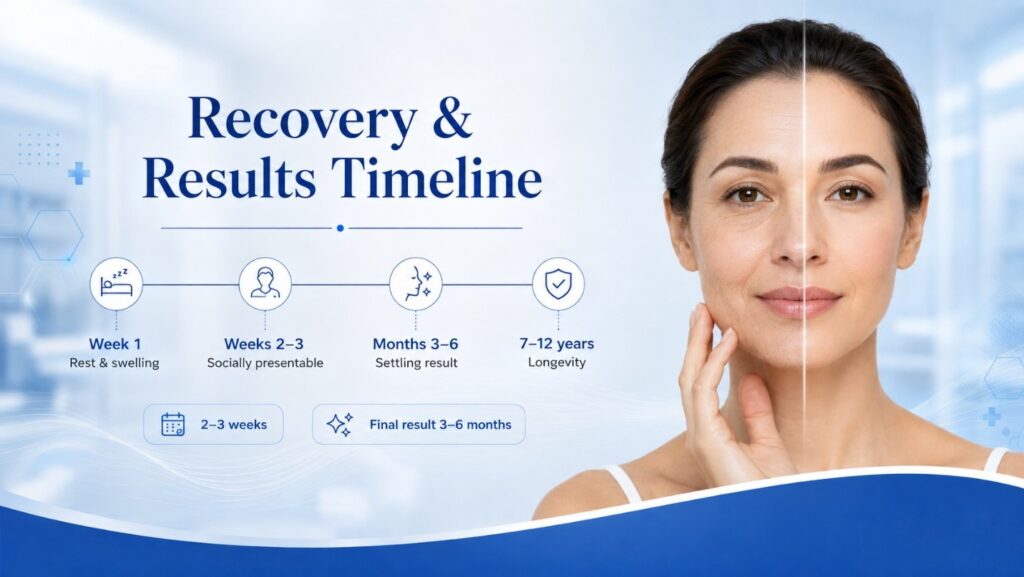
Weeks 2–3 | Most patients are presentable with makeup and comfortable in private company. Numbness around the ears is normal. |
Weeks 4–6 | Back to social life and light exercise. Swelling continuing to settle; scars still pink. |
Months 3–6 | The result looks natural; residual firmness resolves; scars fading. |
Months 6–12 | Final result. Scars pale and inconspicuous; sensation largely recovered. |
Aftercare
- Keep your head elevated for two weeks — it genuinely reduces swelling and bruising.
- Blood pressure control matters most in the first 48 hours — the window in which haematoma occurs. Take prescribed medication, avoid straining, and stay calm.
- No smoking, and no strenuous activity or bending for 3 weeks.
- Sleep on your back for several weeks; avoid pressure on the incisions.
- Expect numbness around the ears and cheeks for weeks to months — normal, and it recovers.
- Strict sun protection on scars for 12 months — particularly important on Indian skin, where scars pigment readily.
- Report sudden one-sided swelling or pain immediately — the sign of a haematoma, which is straightforward to manage if treated promptly.
Cost of Facelift Surgery in Navi Mumbai
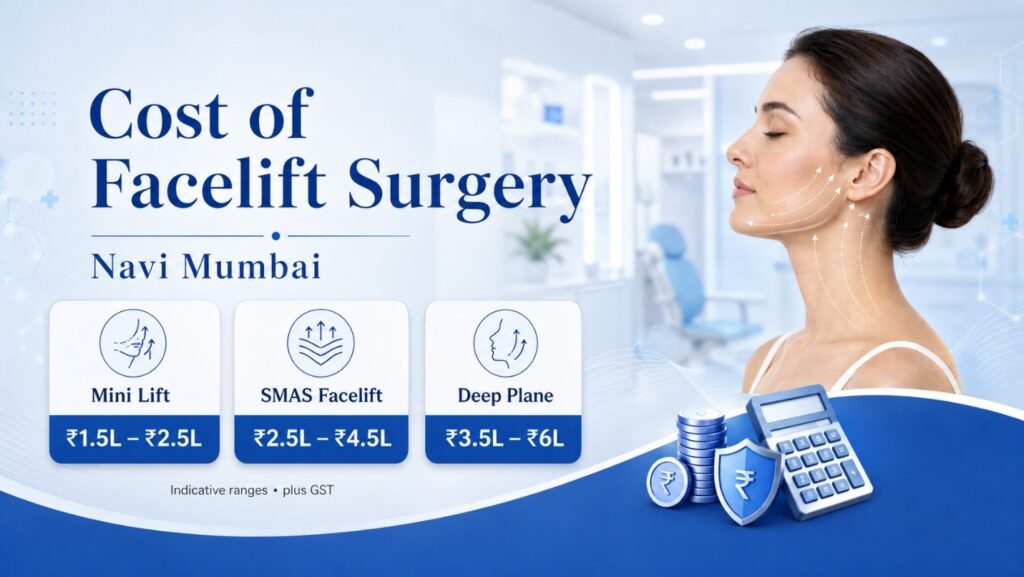
Facelift is quoted per case, since a short-scar lift and a deep-plane lift with neck and fat grafting are very different operations. These indicative ranges cover surgeon and anaesthetist fees, accredited theatre, one night’s stay, dressings and routine follow-up. 18% GST applies. EMI options are available.
Procedure | Indicative cost (INR) |
| |
Mini / short-scar facelift | ₹1,50,000 – ₹2,50,000 |
| |
SMAS facelift (full) | ₹2,50,000 – ₹4,50,000 |
| |
Deep plane facelift | ₹3,50,000 – ₹6,00,000 |
| |
Neck lift alone | ₹1,50,000 – ₹3,00,000 |
| |
Facelift + neck lift combined | ₹3,50,000 – ₹6,50,000 |
| |
Add fat grafting | + ₹50,000 – ₹1,20,000 |
| |
Add eyelid surgery | + ₹80,000 – ₹1,80,000 |
| |
Secondary / revision facelift | Assessed case by case — usually higher |
| |
| Comparing facelift quotes properly First, establish what operation each quote is actually for — a ‘facelift’ at ₹1,50,000 and one at ₹4,00,000 are almost certainly different procedures, not the same procedure at different prices. Ask specifically: which technique, is the SMAS being addressed or only skin, is the neck included, and how long is the operation booked for? Skin-only lifts are quicker and cheaper and relax within a couple of years, which is why they were largely abandoned. Then confirm the quote includes anaesthetist, accredited theatre, overnight stay, dressings, all follow-ups and GST — and ask what a revision would cost. This is not a procedure to buy on price; it is on your face, permanently, and revision surgery on operated tissue is considerably harder. | ||
Results Timeline
When | What you’ll see |
Weeks 1–2 | Swollen and bruised, often looking overtightened. Not your result. |
Weeks 3–6 | Swelling settling; the new contour emerging. Most return to social life. |
Months 2–3 | Looking natural; friends notice you look well rather than operated on. |
Months 6–12 | Final refined result; scars pale. |
Years 7–12 | Result holds well; ageing continues from the new baseline. |
Facelift vs the Non-Surgical Options
Option | Lifts descended tissue? | Downtime | Duration | Best stage |
Facelift | Yes — the only one | 2–3 weeks | 7–12 years | Established descent |
Partially, temporarily | 2–5 days | 12–18 months | Mild-moderate | |
No — tightens skin | None | 12–18 months | Early laxity | |
No — tightens, reduces fat | 2–5 days | 12–24 months | Mild-moderate | |
No — adds volume | 1–2 days | 12–18 months | Volume loss |
Used in sequence rather than opposition: non-surgical treatment in your thirties and forties genuinely delays the point at which surgery becomes the right answer, and non-surgical maintenance after a facelift extends how long the result looks its best. The mistake is only ever using one when the other is indicated.
Risks & Safety
Facelift is a well-established operation with high satisfaction rates in appropriately selected patients, and it is major surgery. The honest list:
- Haematoma — the commonest complication. A collection of blood under the skin flap, typically in the first 24–48 hours, requiring prompt drainage. It is more frequent in men and strongly associated with uncontrolled blood pressure, which is why BP optimisation before and after surgery is not a formality.
- Facial nerve injury. Temporary weakness of a branch is uncommon and usually resolves over weeks to months; permanent injury is rare. Deep-plane techniques work closer to the nerve, which is one reason surgeon experience matters more than technique fashion.
- Skin flap necrosis. Skin dying at the incision edges — uncommon, but dramatically more likely in smokers. This is the specific reason smoking is close to an absolute contraindication.
- Prolonged numbness around the ears and cheeks — expected for weeks to months, occasionally longer.
- Earlobe distortion (‘pixie ear’) — from closing the skin under tension, and largely avoidable with correct technique.
- Hairline distortion or hair loss around the incisions where planning was imprecise.
- Asymmetry, scarring or an unnatural result — the last usually from lifting skin rather than the SMAS, or from over-tightening.
- Infection — uncommon with proper technique and accredited facilities.
Why Dr. Arun Panda — This Is Core Facial Plastic Surgery
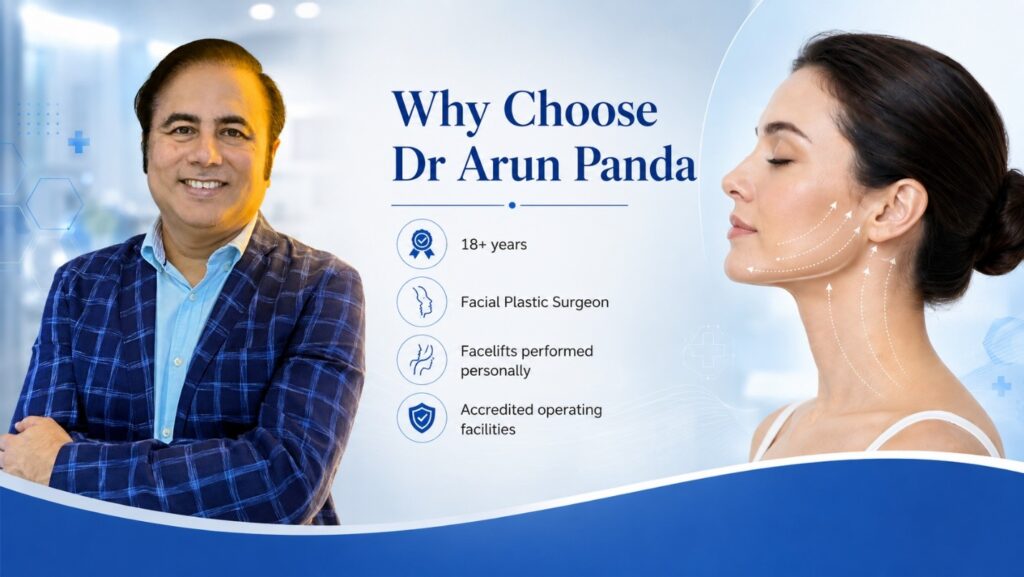
Dr. Arun Panda is a Cranio-Maxillofacial and fellowship-trained Facial Plastic and Cosmetic Surgeon with 18+ years of experience, and founder of Trinity Aesthetics Academy, where he trains other doctors. Facelift surgery sits at the centre of facial plastic surgery — this is the discipline itself, not an extension of it. For a facelift surgeon in Navi Mumbai, that distinction is the one worth checking.
- Surgeon-performed, and surgeon-planned. Technique chosen for your anatomy — short-scar, SMAS or deep plane — rather than a single approach applied to everyone.
- Facial anatomy is his primary training. The facial nerve, the SMAS and the retaining ligaments are cranio-maxillofacial and facial-plastic territory, worked in routinely.
- The full ladder available, from tightening and threads through to surgery — so you’ll be told honestly when surgery is premature, which a surgery-only practice has no incentive to say.
- Combination planning as standard. Lift, volume and skin quality addressed together with resurfacing and fat grafting where indicated — the difference between rejuvenated and merely tightened.
- Safety protocols that matter here: blood pressure optimisation, strict smoking cessation, meticulous haemostasis and tension-free closure.
- He trains other practitioners. As founder of Trinity Aesthetics Academy, Dr. Panda teaches facial aesthetic technique to other doctors.
Centrally located in Vashi — serving Navi Mumbai and Mumbai Bodyskulpt Aesthetics is in the heart of Vashi, easily reached from Kharghar, Panvel, Belapur, Nerul, Airoli, Thane and across Mumbai. Facelift is a planned procedure with structured follow-up over a year; out-of-town patients are scheduled accordingly and video consultations are available beforehand. EMI options available. |
Frequently Asked Questions
How much does a facelift cost in Navi Mumbai?
Approximately ₹1,50,000–₹2,50,000 for a mini or short-scar lift, ₹2,50,000–₹4,50,000 for a full SMAS facelift, and ₹3,50,000–₹6,00,000 for a deep-plane procedure. A neck lift alone runs ₹1,50,000–₹3,00,000, and facelift with neck lift ₹3,50,000–₹6,50,000. Fat grafting or eyelid surgery add further. GST at 18% applies. Confirm which technique each quote covers — widely differing prices usually mean different operations.
Is there such a thing as a non-surgical facelift?
Not really. The term is used to market HIFU, radiofrequency, thread lifts and fillers — all genuinely useful treatments, but none of them repositions the descended SMAS layer, which is what a facelift does. For early to moderate laxity these treatments work well and can postpone surgery by years. Once jowls have formed and the jawline has gone, no number of non-surgical sessions will lift them.
What age should I have a facelift?
Most are performed between the mid-forties and mid-sixties, but tissue matters more than birthdate. The useful test: place your fingertips at your temples and lift gently upward and outward. If that substantially improves your jawline and jowls, a facelift will help. If it changes little, your concern is more likely volume, skin quality or the neck, and a lift is the wrong tool.
How long does a facelift last?
Typically 7–12 years for a properly performed SMAS or deep-plane lift, with deep-plane techniques often at the longer end. A mini or short-scar lift lasts around 3–6 years. Ageing continues from the new baseline — you will always look better than you would have without surgery, but the clock does not stop.
Will the scars be visible?
They are generally well hidden. Incisions run in front of the ear, curve around the earlobe and continue back into the hairline, following natural creases and hair-bearing skin. Scars are pink for several months and fade to pale over about a year. Visible scarring and distorted earlobes usually result from closing skin under tension, which is a technique issue rather than an inevitability.
What is the difference between a SMAS and a deep plane facelift?
A SMAS lift folds or removes part of the SMAS layer and re-anchors it — the reliable workhorse for moderate descent. A deep-plane lift dissects beneath the SMAS, releases the retaining ligaments and lifts skin and SMAS together as one unit, which suits heavier faces and deeper folds and typically lasts longer. Deep plane is more demanding rather than automatically better; the right technique depends on your anatomy and your surgeon’s experience.
What is the recovery time after facelift surgery?
Most people are presentable with makeup at 2–3 weeks and back to normal social life by weeks 4–6. Swelling settles substantially by month 3 and the final result appears at 6–12 months. Numbness around the ears is normal for weeks to months. Plan for around three weeks away from public-facing work.
Can I have a facelift if I smoke?
Not while smoking. Smoking dramatically increases the risk of skin flap necrosis — the skin dying along the incisions — which is disfiguring and hard to correct. Stopping completely for at least 4–6 weeks before and after surgery is a requirement rather than advice, and this is one of the few areas where a responsible surgeon will decline to operate.
Will a facelift make me look pulled or unnatural?
Not if the SMAS layer is lifted rather than the skin. The ‘pulled’ appearance comes from skin-only lifts and over-tightening — techniques largely abandoned for exactly that reason. It also comes from lifting a face that had lost volume without restoring it, which produces tightness without rejuvenation. Addressing position, volume and skin quality together is what produces a natural result.
Book a Facial Assessment
An honest answer on whether you need surgery — including ‘not yet’. Book with Dr. Arun Panda at Bodyskulpt Aesthetics, Sector 9, Vashi, Navi Mumbai. You’ll get your degree and pattern of descent assessed properly, a clear view of whether non-surgical treatment would still serve you, the technique explained and justified for your anatomy, and an itemised quote including GST. Explore non-surgical skin tightening, thread lifts, or book a consultation. Call / WhatsApp: 9152020907 / 9152020908 • drarunpanda.com • EMI available |
Authoritative references
For independent information, see the American Society of Plastic Surgeons on facelift surgery, Mayo Clinic and peer-reviewed facelift outcome literature.
Educational information only and not a substitute for an in-person surgical consultation. Facelift is major surgery; suitability, technique, results and recovery vary between individuals. Non-surgical treatments do not reposition descended tissue and are not equivalent to surgical lifting.