Chemical Peel Treatment in Navi Mumbai
A Skin Reset — Done Right for Indian Skin
A chemical peel is one of the most versatile and cost-effective ways to transform your skin. A carefully chosen acid solution is applied to lift away dull, damaged surface cells and trigger renewal — so pigmentation fades, acne calms, texture smooths, and your skin looks brighter and clearer. It treats a remarkable range of concerns, and a course costs a fraction of laser for many of the same problems.
But there’s a reason this page keeps saying “for Indian skin”. Melanin-rich skin (Fitzpatrick types IV–VI — most Indian skin) is more prone to post-inflammatory hyperpigmentation if a peel is too deep or the wrong acid is used. A superficial mandelic peel can be perfect; an aggressive deep peel can leave dark patches or even bleach the skin. That’s why peel depth should be assessed by a doctor, never self-selected from a menu — and it’s the single biggest reason to choose a doctor-led clinic over a salon for peels.
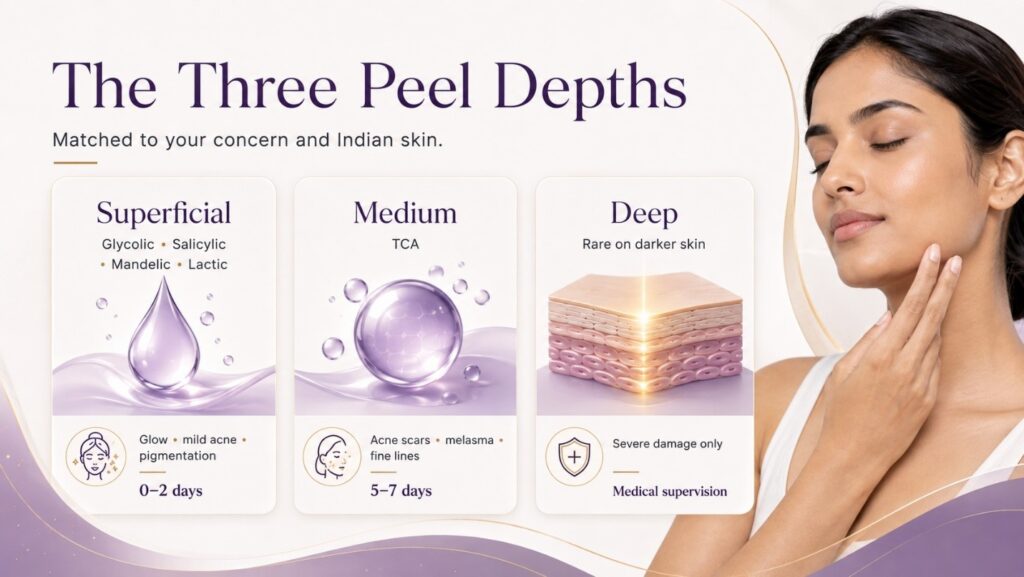
The Three Peel Depths — and Which Suits You
“Chemical peel” isn’t one treatment. Depth and acid are matched to your concern and skin type — here’s the honest breakdown:
Depth | Common acids | Best for | Downtime | ||
Superficial | Glycolic, salicylic, mandelic, lactic | Dullness, mild acne, early pigmentation, glow | 0–2 days light flaking | ||
Medium | TCA (20–35%) | Acne scars, melasma, sun damage, fine lines | 5–7 days peeling | ||
Deep | High-strength TCA / phenol | Severe wrinkles/damage (rarely on darker skin) | Weeks; medical supervision | ||
Why depth matters most on Indian skin For most Indian skin, superficial and carefully-chosen medium peels are the safe, effective workhorses. Deep phenol peels bleach the skin and carry real pigmentation risk on darker (Fitzpatrick IV–VI) tones, so they’re rarely appropriate here. A skilled doctor often starts light and builds up gradually — the safest path to results without post-inflammatory pigmentation. A salon menu that lets you pick a strong peel yourself skips exactly this judgement. | |||||

Which Peel for Your Concern?
Your concern | Often-suited peel |
Active acne / oily skin | Salicylic (BHA) — unclogs pores |
Post-acne marks & pigmentation | Mandelic or glycolic — gentle on Indian skin |
Melasma | Mandelic / combination — cautious, doctor-led |
Dullness & uneven tone | Glycolic or lactic — brightening |
Fine lines & texture | Glycolic / medium TCA — collagen boost |
Acne scars & sun damage | Medium TCA — deeper renewal |
This is a guide, not a prescription. Your exact peel (and strength) is chosen after a skin assessment — the same concern can need a different peel depending on your skin type, sensitivity and history.
Benefits of a Chemical Peel
- Fades pigmentation & dark spots. One of the most effective non-laser routes to a more even tone.
- Clears and calms acne. Salicylic peels unclog pores and reduce breakouts.
- Softens acne scars & texture. Renewed skin looks smoother over a course.
- Brightens dull skin. An instant-glow favourite before events.
- Reduces fine lines. Stimulates collagen for firmer, fresher skin.
- Cost-effective vs laser. Comparable results for mild-moderate pigmentation at a fraction of laser cost.
- Quick, with little downtime. Superficial peels fit into a lunch break.
Areas We Treat
- Face — the most common area, for tone, acne, texture and glow.
- Neck & décolletage — sun damage and crepey texture.
- Hands — pigmentation and ageing.
- Back & shoulders — body acne (‘bacne’).
- Underarms & intimate areas — targeted brightening peels for darkening.
- Under-eye area — specific peels for dark circles and pigmentation.
Concerns & Conditions a Chemical Peel Addresses
- Hyperpigmentation, dark spots & uneven skin tone
- Melasma (with cautious, doctor-led peels).
- Active acne & post-acne marks
- Acne scars & rough texture
- Sun damage & dullness
- Fine lines & early ageing
- Enlarged pores & congested skin
- Tan removal & general brightening
What a peel can’t do — honest limits Chemical peels resurface the skin’s layers — they’re excellent for tone, texture and superficial-to-moderate concerns. They won’t remove deep, pitted (ice-pick or boxcar) acne scars, and they won’t tighten significantly sagging skin. For deep scarring, a CO2 fractional laser often works better; for laxity, skin tightening is the answer. An honest clinic tells you when a peel is right — and when it isn’t. |
The Procedure, Step by Step
- Consultation & skin assessment. Your skin type, concern and history are assessed, and the right peel type, strength and course planned. Sometimes skin is ‘prepped’ with home creams for a week or two first.
- Cleanse & protect. The skin is thoroughly cleansed and sensitive areas (eyes, nostrils) protected.
- Peel application. The solution is applied and left for a controlled time — you’ll feel mild tingling or warmth. It’s carefully timed and neutralised.
- Neutralise & soothe. The peel is neutralised (if needed), and a soothing mask/serum and sunscreen applied. About 20–30 minutes.
- Aftercare & next session. You go home with clear aftercare and your next session scheduled (usually 2–4 weeks later).
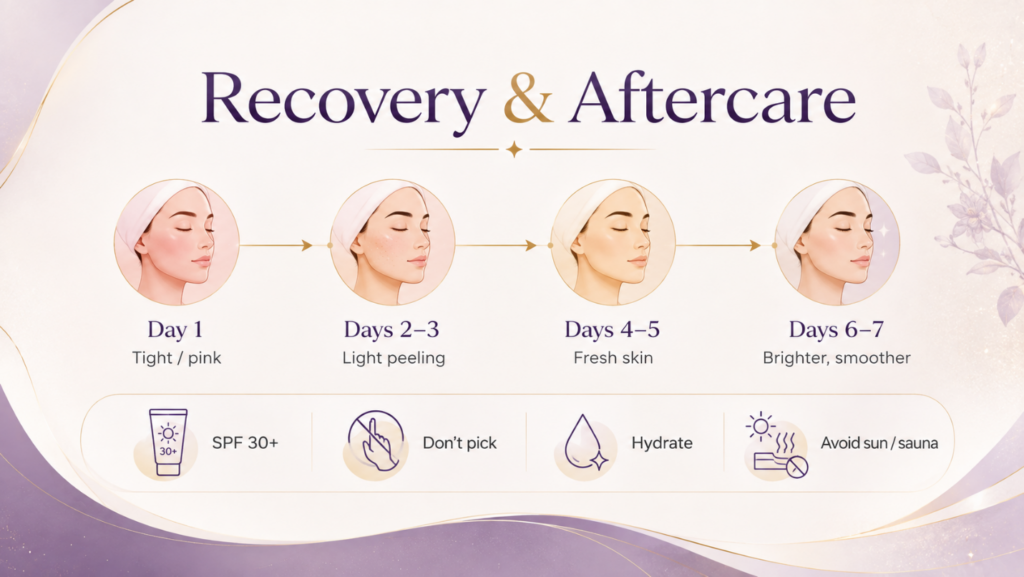
Downtime & Recovery
Timeframe | What to expect (superficial → medium) |
Day 1 | Skin feels tight, looks slightly pink/red; like mild sunburn. |
Days 2–3 | Light flaking or peeling begins — don’t pick or pull it. |
Days 4–5 | Fresh skin emerges; medium peels peel more visibly. |
Days 6–7 | Skin looks smoother, clearer, brighter; superficial fully settled. |
Aftercare (this makes or breaks the result)
- Sunscreen is non-negotiable — SPF 30+ daily; fresh skin burns and re-pigments easily. This is the #1 rule.
- Never pick or peel the flaking skin — it causes scarring and pigmentation.
- Keep it simple & hydrated — gentle cleanser and moisturiser; pause actives (retinol, acids, scrubs).
- Avoid sun, sauna, steam & heavy sweating for a few days.
- Follow the prescribed home routine and complete the course for cumulative results.
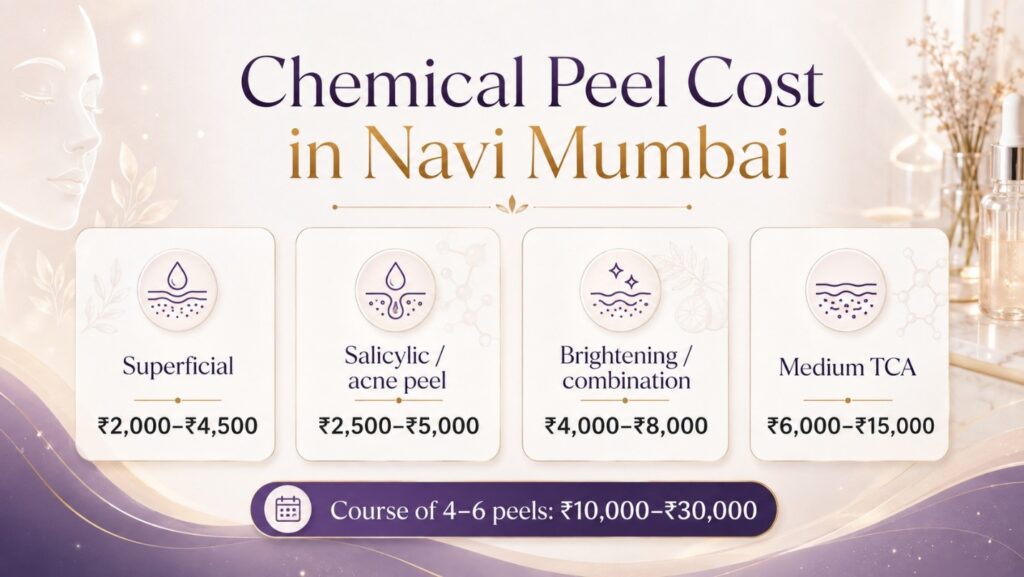
Cost of Chemical Peel Treatment in Navi Mumbai
Cost depends on the peel type and depth, the area, the number of sessions, and the clinic’s expertise. These are honest indicative ranges; see our detailed chemical peel cost guide for more. A course is almost always more economical than single sittings.
Peel type | Indicative cost / session |
Superficial (glycolic, mandelic, lactic) | ₹2,000 – ₹4,500 |
Salicylic / acne peel | ₹2,500 – ₹5,000 |
Combination / brightening (e.g. melasma) | ₹4,000 – ₹8,000 |
Medium (TCA) | ₹6,000 – ₹15,000 |
Course of 4–6 superficial peels | ₹10,000 – ₹30,000 total |
Peels vs laser — the value angle: for mild-to-moderate pigmentation, a course of peels often achieves comparable results to laser at a third to a fifth of the cost. That said, avoid the cheapest salon peels — on Indian skin, an under-qualified hand using the wrong strength can cause pigmentation that’s far costlier to fix. Pay for the right peel and proper assessment. EMI options are available on packages.

Results Timeline
When | What you’ll see |
After 1 peel | An immediate brightness and glow; subtle tone improvement. |
Sessions 2–3 | Pigmentation visibly lightening; clearer, smoother skin. |
After the course (4–6) | Marked improvement in tone, acne, texture and radiance. |
Ongoing maintenance | Periodic peels sustain and build on the results. |
Chemical Peel vs Laser vs Other Treatments
Treatment | Best for | Downtime | Relative cost |
Chemical peel | Tone, pigmentation, acne, glow, texture | 0–7 days | ₹ (most affordable) |
Deeper pigmentation, vascular, resurfacing | Varies | ₹₹₹ | |
Deep acne scars, significant resurfacing | 5–7 days | ₹₹₹ | |
Facial / HydraFacial | Instant glow, hydration (no real ‘peel’) | None | ₹₹ |
The honest positioning: peels are the cost-effective first line for tone, pigmentation and mild scarring; lasers step in for deeper or more stubborn concerns. Often they’re used together in a plan — and a doctor-led clinic can offer both and sequence them safely.
Are Chemical Peels Safe for Indian Skin?
Yes — when the peel is correctly chosen and professionally performed. Superficial and medium peels are used safely on Indian skin every day. Temporary effects are normal: redness, tightness, flaking, and mild sensitivity. The genuine risks — post-inflammatory hyperpigmentation, burns, or uneven lightening — come almost entirely from a peel that’s too deep for the skin type, the wrong acid, poor technique, or neglected sun protection afterwards. This is precisely why a doctor-led assessment matters more for peels on Indian skin than almost any other ‘simple’ treatment: the right depth, the right acid, a gradual build-up, and strict aftercare are what deliver results safely. All of this is planned and supervised at a medical clinic — not left to a walk-in menu.

Why Dr. Arun Panda — a Chemical Peel Doctor Who Knows Indian Skin
Peels are deceptively simple to apply and genuinely easy to get wrong on melanin-rich skin. That’s why the “doctor” in “chemical peel doctor” matters: Dr. Arun Panda is a Facial Plastic and Cosmetic Surgeon and founder of Trinity Aesthetics Academy, where he trains other practitioners in aesthetic skin treatments. When you’re searching for a chemical peel doctor in Navi Mumbai, that’s the difference between safe, glowing results and a pigmentation problem.
- A doctor-led, qualified team. Peels planned and supervised medically — correct depth and acid for your skin type, not a fixed salon menu.
- Expertise in Indian (Fitzpatrick IV–VI) skin. Cautious, gradual protocols that protect against post-inflammatory pigmentation.
- He trains other practitioners. As founder of Trinity Aesthetics Academy, he teaches these techniques to others.
- The full skin toolkit. Because the clinic also offers lasers, CO2 resurfacing and skin tightening, you get the right treatment — or combination — not just a peel.
- Honest, results-first advice. You’ll be told when a peel is ideal and when another treatment suits you better.
Centrally located in Vashi Bodyskulpt Aesthetics is in the heart of Vashi, easily reached from Kharghar, Panvel, Belapur, Nerul, Airoli and Thane. Book a skin assessment for a safe, personalised peel plan and an exact quote. |
Frequently Asked Questions
How much does a chemical peel cost in Navi Mumbai?
Indicatively ₹2,000–₹4,500 per session for superficial peels (glycolic, mandelic, lactic), ₹2,500–₹5,000 for salicylic/acne peels, and ₹6,000–₹15,000 for medium TCA peels. A course of 4–6 superficial peels runs about ₹10,000–₹30,000 in total. Your exact plan and cost are set after a skin assessment.
How many chemical peel sessions will I need?
Most people need a course of 4–6 superficial peels spaced 2–4 weeks apart for the best results, followed by occasional maintenance. Medium peels may need fewer sessions. The number depends on your concern (pigmentation, acne, texture) and skin type.
Are chemical peels safe for Indian/dark skin?
Yes, when the right peel is chosen. Superficial and carefully-selected medium peels are safe and effective on Indian skin. Deep phenol peels are usually avoided on darker tones because they can bleach or cause pigmentation. A doctor-led assessment and gradual approach are the key safeguards against post-inflammatory hyperpigmentation.
Do chemical peels hurt, and is there downtime?
You’ll feel mild tingling or warmth during a superficial peel, easily tolerated; medium peels sting a little more. Downtime is minimal — superficial peels cause 0–2 days of light flaking, medium peels 5–7 days of visible peeling. Sunscreen and not picking the skin are essential afterwards.
Chemical peel or laser — which is better?
It depends on the concern. For tone, pigmentation, mild acne scars and glow, chemical peels give comparable results to laser at a fraction of the cost. For deep acne scars or stubborn pigmentation, laser (including CO2 fractional) may work better. They’re often combined in a plan — a doctor-led clinic can offer both.
What does a chemical peel treat?
Pigmentation and dark spots, uneven tone, melasma (cautiously), active acne and post-acne marks, acne scars, sun damage, dullness, fine lines, enlarged pores and tanning. Different concerns are matched to different peels — salicylic for acne, mandelic/glycolic for pigmentation, TCA for scars, and so on.
Can I get a chemical peel before an event?
Yes — a superficial ‘glow’ peel is popular before weddings and events, but time it right: ideally a week or two before, so any flaking has settled and the fresh glow has emerged. Don’t try a first-time or strong peel just before a big day.
Who is the best chemical peel doctor in Navi Mumbai?
Look for a qualified doctor who understands Indian skin, chooses peel depth by assessment (not a fixed menu), and offers other treatments if a peel isn’t ideal. Dr. Arun Panda, a Facial Plastic and Cosmetic Surgeon and founder of Trinity Aesthetics Academy, provides this doctor-led, skin-type-aware peel expertise in Vashi, Navi Mumbai.
Book a Skin Assessment & Peel Plan
Brighter, clearer skin — safely, with the right peel for your skin type. Book with Dr. Arun Panda’s team at Bodyskulpt Aesthetics, Sector 9, Vashi, Navi Mumbai. You’ll get a proper skin assessment, the right peel type and strength for your concern and skin type, an honest view on whether a peel or another treatment suits you best, and a clear course plan and cost. Explore our laser treatments, or book a consultation. Call / WhatsApp: 9152020907 / 9152020908 • drarunpanda.com • EMI available on packages |
Authoritative references
For independent information, see the American Academy of Dermatology, Cleveland Clinic and peer-reviewed evidence on peels for Indian skin (NCBI).
Educational information only and not a substitute for an in-person skin assessment. Results and suitability vary between individuals and skin types.
Please reach out to us through the contact details below.
- Website: https://drarunpanda.com/
- Phone: +919152020907, +919152020908
- Address: Dr. Arun Panda, BodySkulpt Aesthetics, F1/A-4, Aditi Apartments, Sector 9, Vashi, Navi Mumbai – 400703
- Facebook: https://www.facebook.com/DrArunPanda
- Instagram: https://www.instagram.com/drarunpanda/
- Youtube: https://www.youtube.com/DrArunPanda
- LinkedIn: https://www.linkedin.com/in/drarunpanda
- Twitter: https://twitter.com/DrArunPanda1
- Email: facialaestheticsindia@gmail.com
- Google Directions: https://g.page/DrArunPanda?gm