Acne & Acne Scar Treatment in Navi Mumbai
Why Acne Scarring Is Treated by Type, Not by Machine
Most clinics offering acne scar treatment own a device and recommend it to everyone. That is why so many people complete an expensive course of something and see modest change: the treatment was reasonable, but it was the wrong tool for the scars they actually have.
Acne scars are not one thing. A narrow, deep ice-pick scar and a broad, tethered rolling scar are different problems requiring different solutions — one needs the base destroyed and closed, the other needs a fibrous band released beneath the skin. No laser does both well, and no laser does either as well as the specific technique designed for it.
The approach that works is diagnostic: identify each scar type, match the technique to it, and combine them in the right sequence. That requires a clinic able to offer the surgical adjuncts — subcision, TCA CROSS, punch excision — alongside the lasers, which is where a facial surgeon’s toolkit differs from a device-led practice.
First: Do You Actually Have Scars?
This is the most useful thirty seconds you’ll spend on this page. Close your eyes and run a fingertip slowly over the affected area.
What you find | What it is | What it needs |
| |
Flat to the touch, red or pink | Post-inflammatory erythema (PIE) — not a scar | Time. Fades over 3–12 months; sunscreen speeds it |
| |
Flat to the touch, brown or grey | Post-inflammatory hyperpigmentation (PIH) — not a scar | Pigmentation treatment — not resurfacing |
| |
A dip, pit or depression you can feel | True atrophic scar | Scar treatment matched to type — see below |
| |
A raised, firm lump | Hypertrophic or keloid scar | Steroid injection — NOT resurfacing lasers |
| |
Active spots still appearing | Acne is not yet controlled | Treat the acne first — scar work comes later |
| |
| Why this matters more than any treatment on this page Post-inflammatory erythema and hyperpigmentation are, between them, what a large proportion of people mean when they say ‘acne scars’ — particularly on Indian skin, where PIH is common and persistent. Neither is scarring, and neither needs resurfacing. Red marks fade largely on their own given time and disciplined sun protection; brown marks respond to pigmentation treatment costing a fraction of a laser course. If you are told you need a course of fractional laser for flat marks, get a second opinion. A good consultation frequently ends with someone being told their skin will settle on its own — and that is a legitimate outcome, not a wasted appointment. | |||
Matching the Technique to the Scar
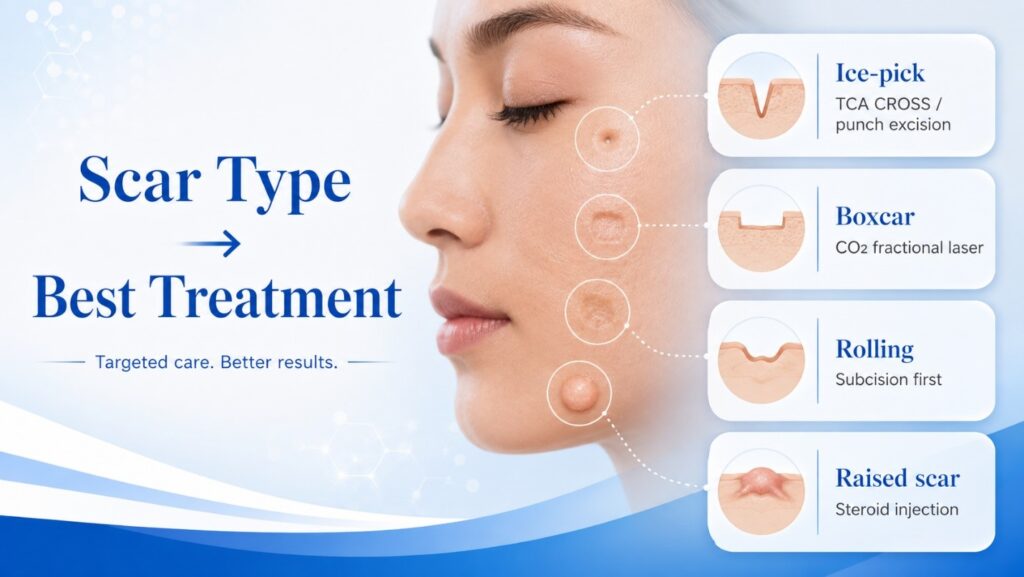
Once true scarring is confirmed, this table is the plan. Most people have a mixture, which is why single-modality treatment disappoints:
Scar type | How to recognise it | What genuinely works |
Ice-pick | Narrow, deep, steep-sided — like a pinprick | TCA CROSS or punch excision. Laser alone barely reaches the base |
Boxcar | Wider, sharp-edged, flat-bottomed depressions | CO2 fractional laser; punch elevation for deep ones |
Rolling | Broad, shallow, wavy — tethered from beneath | Subcision FIRST to release the bands, then resurfacing |
Atrophic, widespread | General loss of skin volume and texture | RF microneedling or fractional laser; filler for volume |
Hypertrophic / keloid | Raised, firm, sometimes itchy | Steroid injections, silicone — resurfacing can worsen it |
Mixed (most people) | Several of the above together | Staged combination — surgical first, resurfacing after |
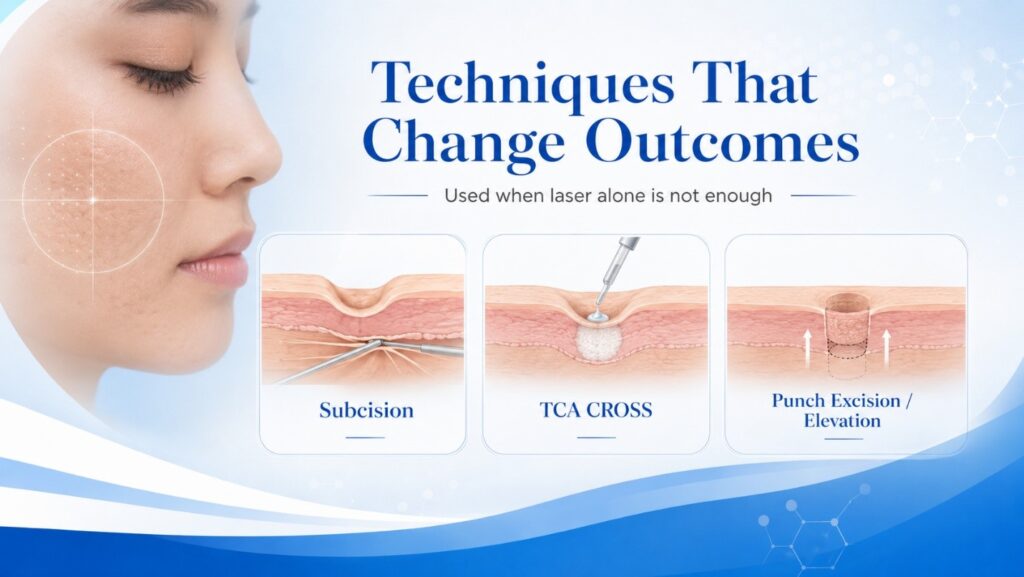
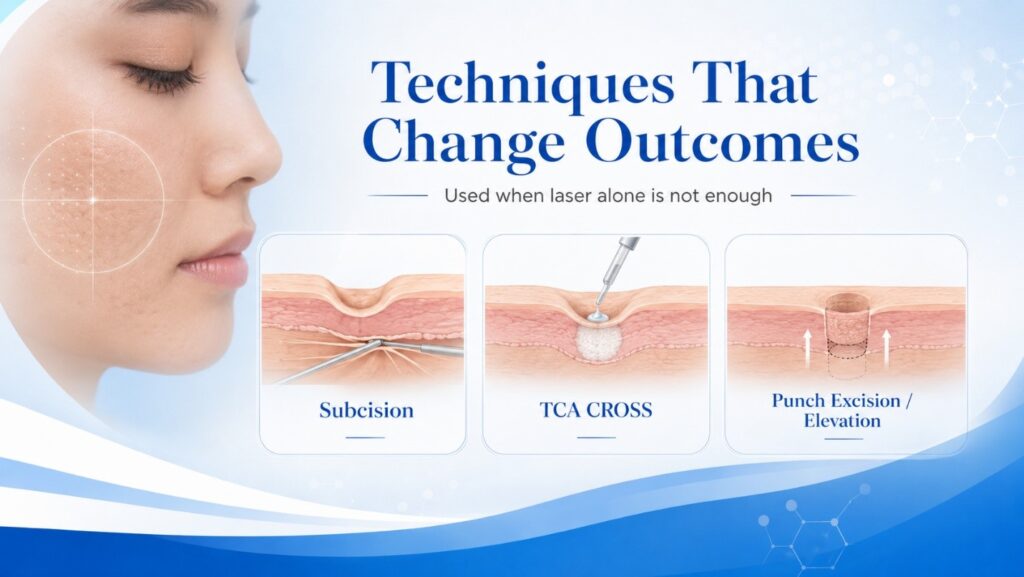
The three surgical techniques that change outcomes
- A fine needle or cannula is passed beneath a rolling scar to cut the fibrous bands tethering it downward. Until those bands are released, the scar physically cannot lift — no amount of surface resurfacing will raise it. This single step is the commonest reason a scar programme succeeds or fails.
- TCA CROSS. A high-concentration acid is applied precisely into the base of an ice-pick scar, destroying it so it heals shallower and narrower. Done across several sessions, it addresses scars that lasers cannot reach.
- Punch excision and elevation. The scar is cut out and closed as a fine line, or its base is lifted flush with the surrounding skin. For deep boxcar and ice-pick scars this converts an untreatable pit into a small, resurfaceable scar.
Why a device-only clinic can’t offer you this
Subcision, TCA CROSS and punch excision are procedural surgical techniques rather than machine settings. A clinic whose acne-scar offering is a laser platform will treat everything with that platform, because it is the only tool present. That produces a reasonable result on boxcar scars, a poor one on rolling scars that were never released, and almost nothing on ice-pick scars. If you have mixed scarring — which most people do — ask specifically whether the clinic performs subcision and TCA CROSS, and how they sequence them with resurfacing. The answer distinguishes a scar programme from a laser package.
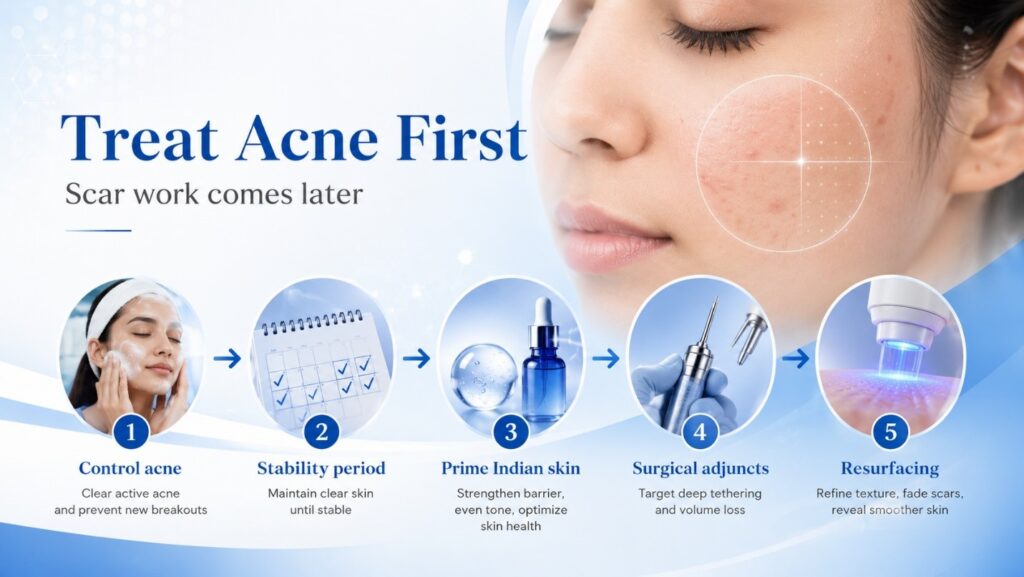
The Sequence: Control the Acne Before Touching the Scars
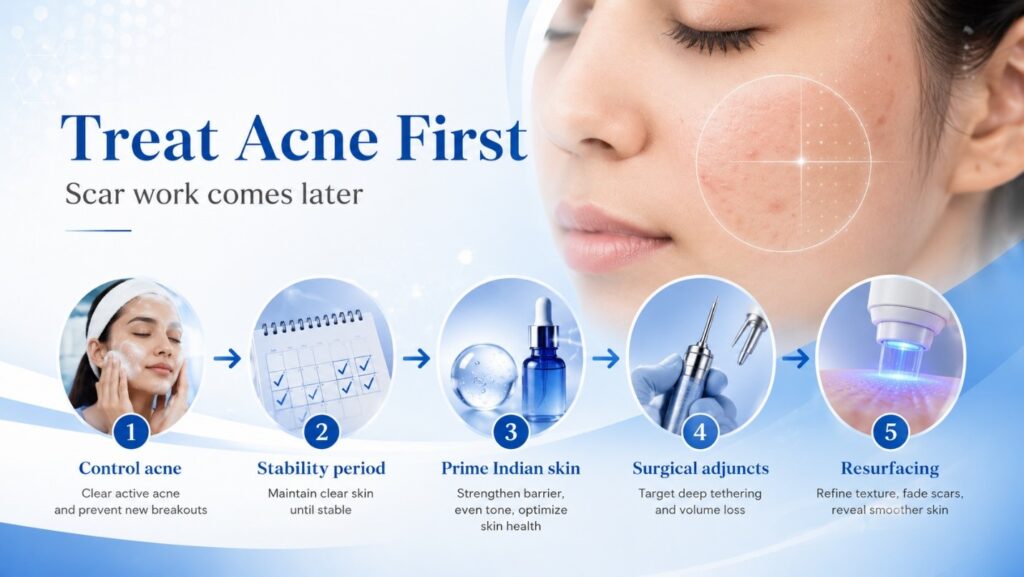
Resurfacing skin that still has active inflammation creates new scars. This is not a cautious preference — it is the reason scar programmes started too early make people worse. The correct order:
- Get the acne under control. Medical management with topicals, oral therapy or hormonal treatment as appropriate. Where acne is severe or resistant we co-ordinate with a dermatologist rather than improvising — that is the right specialist for isotretinoin and complex cases.
- Wait for stability. Several months with acne quiet before scar work begins. Where isotretinoin has been used, a further waiting period is standard before resurfacing or surgical scar treatment.
- Prime the skin. On Indian skin, pigment-suppressing topicals for 2–4 weeks before any resurfacing meaningfully reduces the risk of post-treatment pigmentation.
- Surgical adjuncts first. Subcision, TCA CROSS and punch excision where indicated — these address what resurfacing cannot reach.
- Resurfacing next. CO2 fractional, RF microneedling or microneedling with PRP to refine the surface once the structural work is done.
- Pigment and maintenance last. Any residual pigmentation addressed at the end, with lifelong sun protection to protect the result.
Active Acne: What We Do, and When We Refer
Acne is a medical condition, and treating it properly matters as much for preventing future scars as for clearing current spots. Our role and its limits, stated plainly:
- What we manage: mild to moderate acne with medical-grade topicals, prescribed actives, and in-clinic treatments — salicylic and other chemical peels, comedone extraction, and laser or light-based treatment where indicated.
- What we co-ordinate: moderate to severe inflammatory acne, where oral therapy is needed alongside in-clinic treatment.
- What we refer: severe nodulocystic acne, isotretinoin management, suspected hormonal causes such as PCOS requiring investigation, and acne unresponsive to standard treatment. A dermatologist or endocrinologist is the right specialist, and saying so is more useful to you than us improvising.
The most valuable thing we can tell an acne patient Every month of uncontrolled inflammatory acne adds to the scarring you will later pay to correct. Scar treatment costs several times what acne treatment does, takes months, and never returns skin fully to baseline. If you are currently breaking out, the highest-return decision available to you is getting the acne properly treated now — whether that is with us, with a dermatologist, or both. We would genuinely rather see you for acne control this year than for scar revision in three years’ time. |
Benefits of Treatment
- Smoother, more even skin texture — the measurable goal of scar treatment.
- Shallower, less shadowed scars. Much of what makes scarring visible is shadow; reducing depth reduces visibility disproportionately.
- Ice-pick scars genuinely addressed rather than worked around, using TCA CROSS or excision.
- Rolling scars released and lifted through subcision — something no topical or laser achieves alone.
- Improved skin quality overall — pores, tone and fine texture improve alongside the scars.
- Prevention of further scarring through proper acne control.
- Long-lasting results. Collagen remodelling continues for up to a year after resurfacing, and structural corrections are permanent.
- Protocols designed for Indian skin — conservative settings and priming to avoid trading scars for pigmentation.
Areas & Conditions We Treat
- Cheeks and temples — where atrophic acne scarring concentrates.
- Jawline and chin — common in adult and hormonal acne.
- Forehead — boxcar and rolling scars.
- Nose — enlarged pores and ice-pick scarring.
- Back and chest — acne and scarring, including hypertrophic scars which are commoner here.
- Active acne — comedonal, inflammatory and hormonal patterns.
- Post-inflammatory pigmentation and erythema — see pigmentation treatment.
- Enlarged pores and rough texture associated with long-standing acne.
- Hypertrophic and keloid scars — treated medically rather than with resurfacing.
How a Scar Programme Runs
- Consultation and scar mapping. Each area assessed by touch as well as sight, scar types identified and recorded, and pigment distinguished from true scarring. Photographs under standardised lighting.
- Honest expectation-setting. You are told the realistic percentage improvement for your scar types, the number of sessions likely, and the total cost — before anything is booked.
- Acne stabilisation, if needed. Scar work does not begin until acne is quiet.
- 2–4 weeks of prescribed topicals to prepare the skin and reduce pigmentation risk.
- Surgical adjunct sessions. Subcision, TCA CROSS or punch excision under local anaesthesia, spaced 4–6 weeks apart.
- Resurfacing sessions. CO2 fractional or RF microneedling, spaced 6–8 weeks apart, once structural work is complete.
- Review and maintenance. Reassessed at 3 and 6 months with the same lighting and angles, since gradual change is impossible to judge from memory.
Downtime by Treatment
Treatment | Downtime | What to expect |
Chemical peel (superficial) | 0–3 days | Light flaking; skin brighter within days |
Microneedling / PRP | 1–3 days | Redness like mild sunburn |
Subcision | 3–7 days | Bruising and swelling — sometimes marked; entirely expected |
TCA CROSS | 5–7 days | White frosting then small crusts at each treated scar |
RF microneedling | 1–3 days | Redness and minor swelling |
5–7 days | Redness, bronzing, then peeling — plan a clear week | |
Punch excision | 7–10 days | Tiny sutures removed at about a week |
Aftercare that protects the result
- Sunscreen daily, without exception — on Indian skin this is what stands between a good result and post-treatment pigmentation.
- Never pick crusts or peeling skin — picking after scar treatment creates new scars, which is a bitter irony worth avoiding.
- Pause actives for 3–5 days after each session; restart when instructed.
- Expect bruising after subcision and plan socially around it — it can be dramatic for a few days and is not a complication.
- Complete the programme. Scar treatment is cumulative; stopping halfway leaves you with cost and partial benefit.
Cost of Acne Scar Treatment in Navi Mumbai
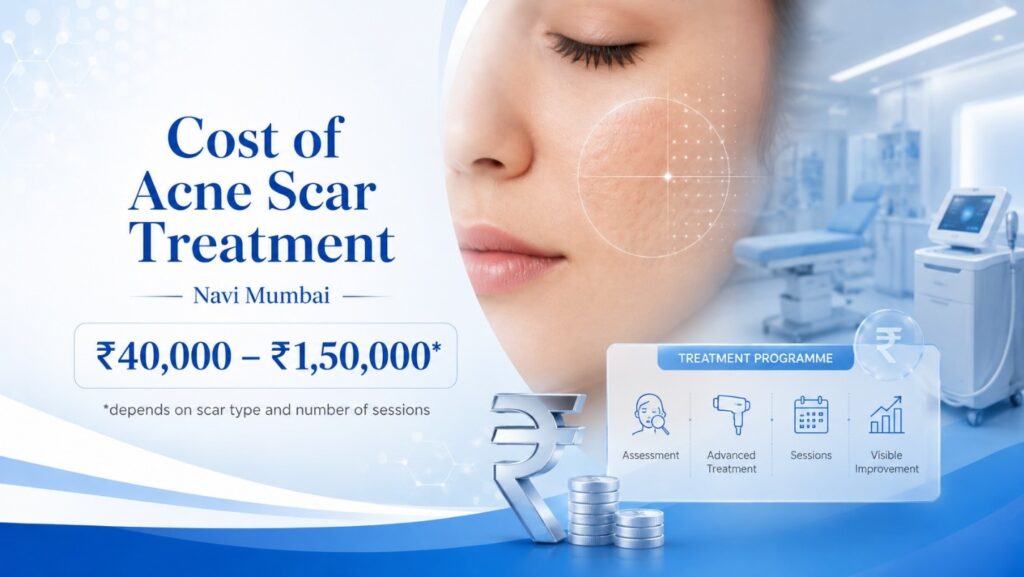
Cost depends entirely on your scar types and how many techniques your plan needs. These are honest indicative ranges; a personalised programme quote follows assessment. EMI options are available on packages.
Treatment | Indicative cost |
| |
Consultation & medical acne protocol | ₹3,000 – ₹8,000 |
| |
Chemical peel (per session) | ₹2,000 – ₹5,000 |
| |
Microneedling with PRP (per session) | ₹6,000 – ₹15,000 |
| |
Subcision (per session) | ₹8,000 – ₹20,000 |
| |
TCA CROSS (per session) | ₹5,000 – ₹15,000 |
| |
Punch excision (per scar / small group) | ₹5,000 – ₹15,000 |
| |
RF microneedling (per session) | ₹15,000 – ₹35,000 |
| |
CO2 fractional laser (per session) | ₹8,000 – ₹25,000 |
| |
Full combination programme | ₹40,000 – ₹1,50,000 |
| |
| Where people waste money on acne scars Three ways, in order of frequency. Paying for resurfacing when the marks were flat pigment that would have faded anyway. Buying a laser package for rolling scars that were never subcised, so they were physically incapable of lifting. And starting scar treatment while acne was still active, then paying again after new scars formed. All three are avoided by diagnosis rather than by choosing a cheaper clinic. Ask for a written plan that names your scar types, the technique for each, the number of sessions and the total cost — if a clinic can’t produce that, they haven’t assessed you. | ||
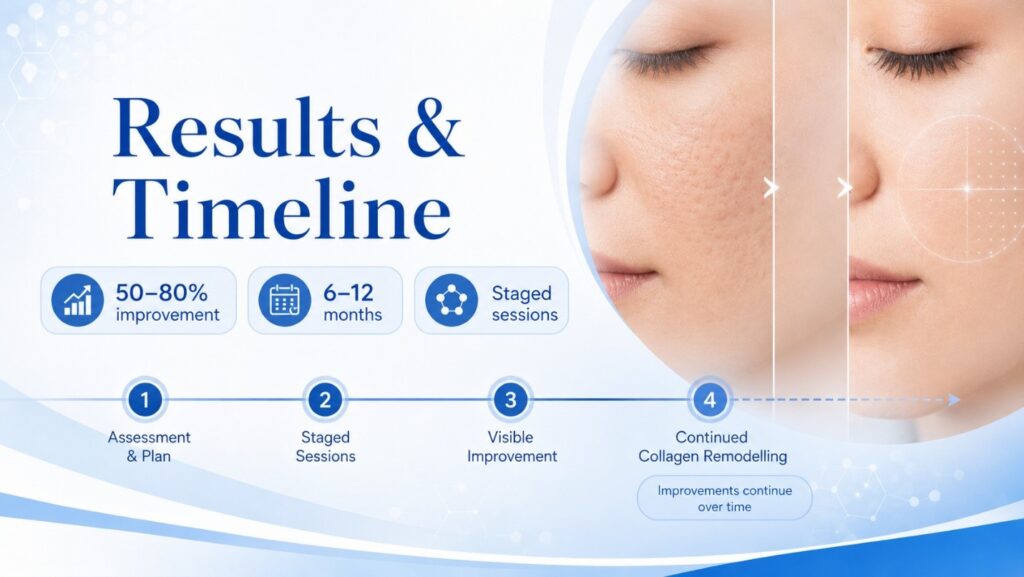
Results Timeline
When | What you’ll see |
Weeks 2–4 | Early texture improvement; bruising from subcision resolved. |
Months 2–3 | Visible softening of scars as collagen begins remodelling. |
Months 4–6 | Substantial change; most of the programme complete. |
Months 6–12 | Continued improvement — collagen remodelling carries on long after the last session. |
Realistic outcome | 50–80% improvement for atrophic scarring — markedly better, not erased. |
On that last figure: any clinic promising complete removal of established acne scarring is overselling. Scars are permanent structural changes; treatment makes them shallower, softer and far less noticeable under normal lighting. Knowing that in advance is what separates a patient delighted with an excellent result from one disappointed by an unrealistic promise.
Comparing the Treatments
Treatment | Best for | Downtime | Indian-skin risk |
Subcision | Rolling scars — essential first step | 3–7 days | Low |
TCA CROSS | Ice-pick scars | 5–7 days | Low–moderate |
Boxcar scars, overall resurfacing | 5–7 days | Higher — needs priming | |
RF microneedling | Mixed atrophic scarring, texture | 1–3 days | Low — spares the epidermis |
Mild scarring, maintenance | 1–3 days | Very low | |
Superficial texture, pigment | 0–7 days | Low–moderate | |
Deep individual depressions | 1–2 days | Low — temporary |
For many Indian patients the most efficient plan is subcision and TCA CROSS for the structural scars, followed by RF microneedling rather than CO2 for resurfacing — comparable results in comparative studies with substantially lower pigmentation risk. CO2 remains the stronger resurfacing tool where scarring is significant and the priming protocol can be followed properly.
Safety on Indian Skin
The specific risk that matters here is trading scars for pigmentation. Melanin-rich skin responds to inflammation by producing more pigment, so aggressive resurfacing can leave post-inflammatory hyperpigmentation that is more visible than the scarring it treated. This is managed, not gambled on: 2–4 weeks of pigment-suppressing priming beforehand, conservative energy and density settings, staged sessions rather than one aggressive pass, and disciplined sun avoidance afterwards. Where a patient cannot commit to sun protection, we recommend the lower-risk modalities rather than proceeding regardless.
Not suitable / needs caution
- Active or unstable acne — treat first.
- Recent isotretinoin — a waiting period is assessed individually before resurfacing or excision.
- Keloid tendency — changes the entire approach; discussed carefully.
- Active infection or cold sores in the area — antiviral cover used where there’s a history.
- Recent sun exposure or an active tan — treatment deferred.

Why Dr. Arun Panda — a Surgeon’s Toolkit for Scars
Acne scarring is where the difference between a device-led clinic and a surgical one shows most clearly. Dr. Arun Panda is a Cranio-Maxillofacial and fellowship-trained Facial Plastic and Cosmetic Surgeon and founder of Trinity Aesthetics Academy, where other practitioners train. For acne scar treatment in Navi Mumbai, the relevant advantage is being able to perform the procedures that lasers cannot substitute for.
- Subcision, TCA CROSS and punch excision performed in-house — not referred out, not skipped.
- Diagnosis by touch, not just by eye. Pigment separated from true scarring before anything is recommended.
- Staged, sequenced planning — structural work before resurfacing, in the order that actually produces results.
- Indian-skin protocols with priming and conservative settings to avoid post-treatment pigmentation.
- Honest expectations. You’ll be told 50–80%, not 100% — and told when your marks will fade without treatment at all.
- The full facial range — aesthetic lasers, peels, pigmentation treatment and fillers combined as one coherent plan.
Centrally located in Vashi Bodyskulpt Aesthetics is in the heart of Vashi, easily reached from Kharghar, Panvel, Belapur, Nerul, Airoli and Thane. Book a scar assessment for a written plan naming your scar types, the technique for each and the total programme cost. EMI options available. |
Frequently Asked Questions
How much does acne scar treatment cost in Navi Mumbai?
Individual sessions range from ₹2,000–₹5,000 for a chemical peel to ₹8,000–₹25,000 for CO2 fractional laser, with subcision at ₹8,000–₹20,000 and TCA CROSS at ₹5,000–₹15,000 per session. A full combination programme typically runs ₹40,000–₹1,50,000 over several months, depending on your scar types and how many techniques are needed. Ask for a written plan with session numbers and total cost. EMI options are available.
Are my marks scars, or will they fade?
Run a fingertip over them. If the skin is flat and the mark is red or brown, it is post-inflammatory erythema or hyperpigmentation — not a scar. Red marks fade largely on their own over 3–12 months with sun protection; brown marks respond to pigmentation treatment. Only a change you can feel — a dip, pit or raised lump — is a true scar requiring scar treatment. A great many people are told at consultation that their marks will settle without any procedure.
Can I treat acne scars while I still have active acne?
No, and attempting it makes things worse. Resurfacing inflamed skin creates fresh scarring, so acne must be controlled and stable for several months before scar treatment begins. Where isotretinoin has been used, a further waiting period is standard. Getting acne properly treated now is also the single best way to limit the scarring you’ll need to correct later.
What is subcision and why does it matter so much?
Subcision passes a fine needle or cannula beneath a rolling scar to cut the fibrous bands tethering it downward. Until those bands are released the scar physically cannot lift, so resurfacing over an unsubcised rolling scar achieves very little. It’s the commonest reason an expensive laser course underdelivers, and it’s a procedural technique rather than a machine setting — so device-only clinics generally don’t offer it.
Which treatment is best for ice-pick scars?
TCA CROSS or punch excision — not laser. Ice-pick scars are narrow and deep, and fractional laser cannot reach their base effectively. TCA CROSS applies high-concentration acid precisely into the scar so it heals shallower and narrower, usually across several sessions. Deeper ones are excised. Any plan for ice-pick scarring that relies on resurfacing alone will disappoint.
How much improvement can I realistically expect?
Around 50–80% for atrophic scarring with a properly matched combination programme — markedly shallower and far less noticeable, but not erased. Acne scars are permanent structural changes to the skin, and treatment reduces their depth and shadow rather than removing them. Any clinic promising complete removal is overselling.
Is laser treatment safe for acne scars on Indian skin?
Yes, with the right protocol. The risk on melanin-rich skin is post-inflammatory hyperpigmentation, which is managed with 2–4 weeks of pigment-suppressing priming beforehand, conservative staged settings, and strict sun avoidance afterwards. For many Indian patients RF microneedling is the more forgiving resurfacing option, with comparable results and lower pigmentation risk than ablative CO2.
How long does a full acne scar programme take?
Typically 6–12 months. Surgical adjuncts such as subcision and TCA CROSS are spaced 4–6 weeks apart, resurfacing sessions 6–8 weeks apart, and collagen remodelling continues for up to a year after the final session. Results should be judged at 6 months and again at 12, not between sessions.
Book a Scar Assessment
A written plan naming your scar types — and an honest answer if you don’t need treatment. Book with Dr. Arun Panda at Bodyskulpt Aesthetics, Sector 9, Vashi, Navi Mumbai. You’ll have your skin assessed by touch as well as sight, pigment separated from true scarring, each scar type matched to the technique that treats it, realistic improvement figures given, and a written programme with sessions and total cost. Explore CO2 fractional laser, microneedling with PRP, chemical peels, or book a consultation. Call / WhatsApp: 9152020907 / 9152020908 • drarunpanda.com • EMI available |
Authoritative references
For independent information, see the American Academy of Dermatology on acne scars, AAD on acne and peer-reviewed literature on subcision and fractional laser for acne scarring.
Educational information only and not a substitute for an in-person consultation. Acne scarring is improved rather than eliminated by treatment. Severe or resistant acne, isotretinoin therapy and suspected hormonal causes require dermatological or endocrinological assessment. Results, suitability and recovery vary between individuals.
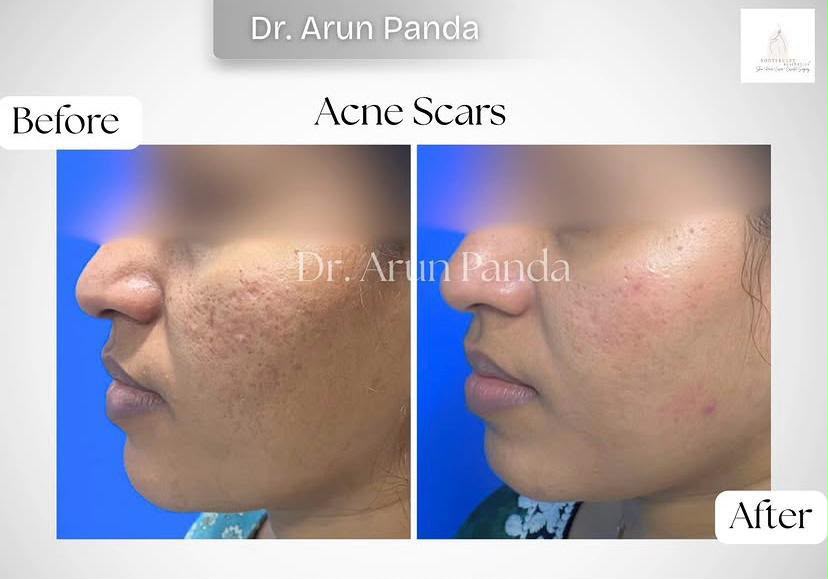
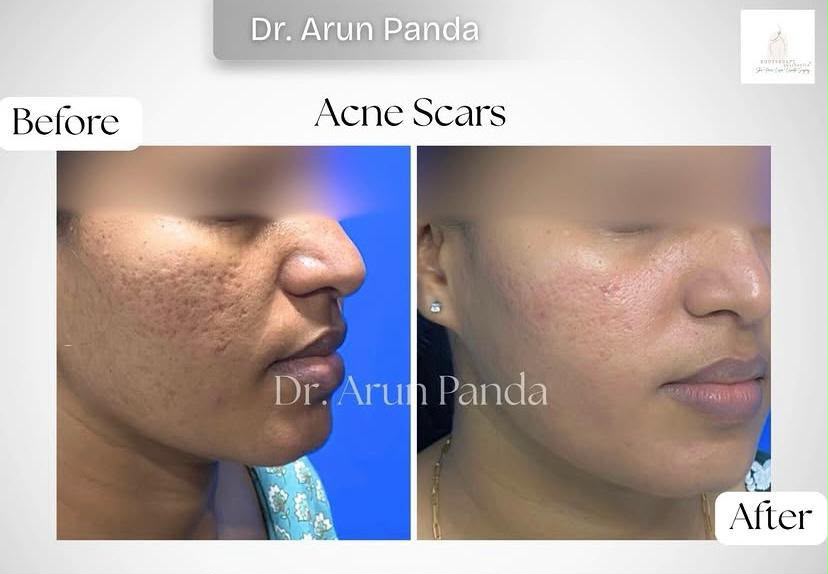
Please reach out to us through the contact details below.
- Website: https://drarunpanda.com/
- Phone: +919152020907, +919152020908
- Address: Dr. Arun Panda, BodySkulpt Aesthetics, F1/A-4, Aditi Apartments, Sector 9, Vashi, Navi Mumbai – 400703
- Facebook: https://www.facebook.com/DrArunPanda
- Instagram: https://www.instagram.com/drarunpanda/
- Youtube: https://www.youtube.com/DrArunPanda
- LinkedIn: https://www.linkedin.com/in/drarunpanda
- Twitter: https://twitter.com/DrArunPanda1
- Email: facialaestheticsindia@gmail.com
- Google Directions: https://g.page/DrArunPanda?gm