CO2 Fractional Laser in Navi Mumbai
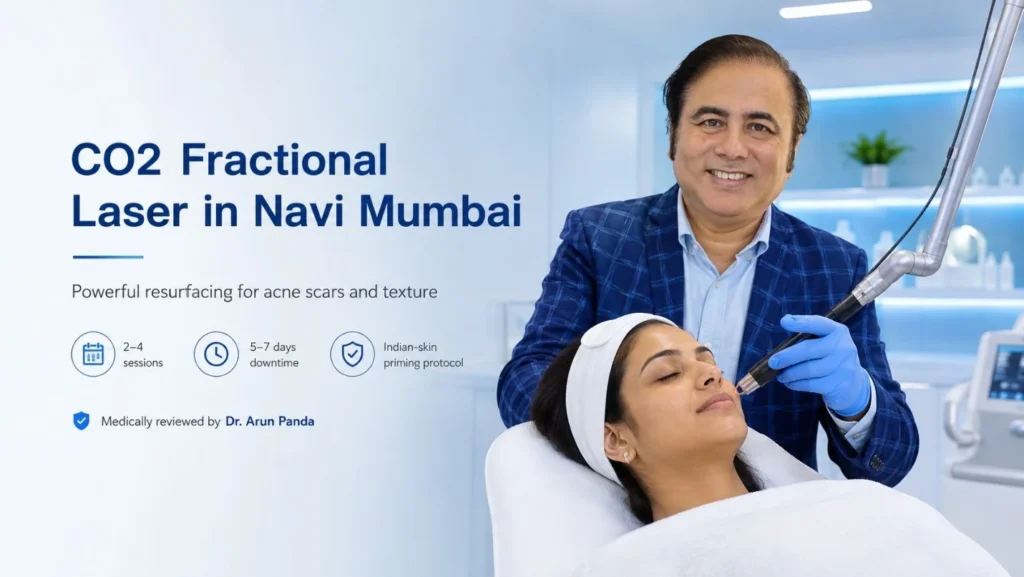
The Most Powerful Resurfacing Tool We Have - Used Properly
If peels and microneedling haven’t shifted your acne scars, CO2 fractional laser is the next serious step. It works by delivering a 10,600 nm beam split into thousands of microscopic columns that vaporise damaged tissue right down into the dermis, while deliberately leaving untouched skin between each column. Those untouched bridges are what make it fractional — they supply the cells that heal the treated zones, so you get near-ablative power with a fraction of the recovery of old full-field resurfacing.
The results are genuinely superior to gentler options. In head-to-head research, fractional CO2 produced roughly three times the scar-grading improvement of standard microneedling, with substantially higher patient satisfaction. But that power comes with two honest trade-offs that this page will not gloss over: real downtime of five to seven days, and a genuine pigmentation risk on melanin-rich skin unless the treatment is run with a proper priming and aftercare protocol. Understand both, and CO2 becomes one of the most rewarding treatments in aesthetics. Ignore them, and it becomes the treatment people regret.
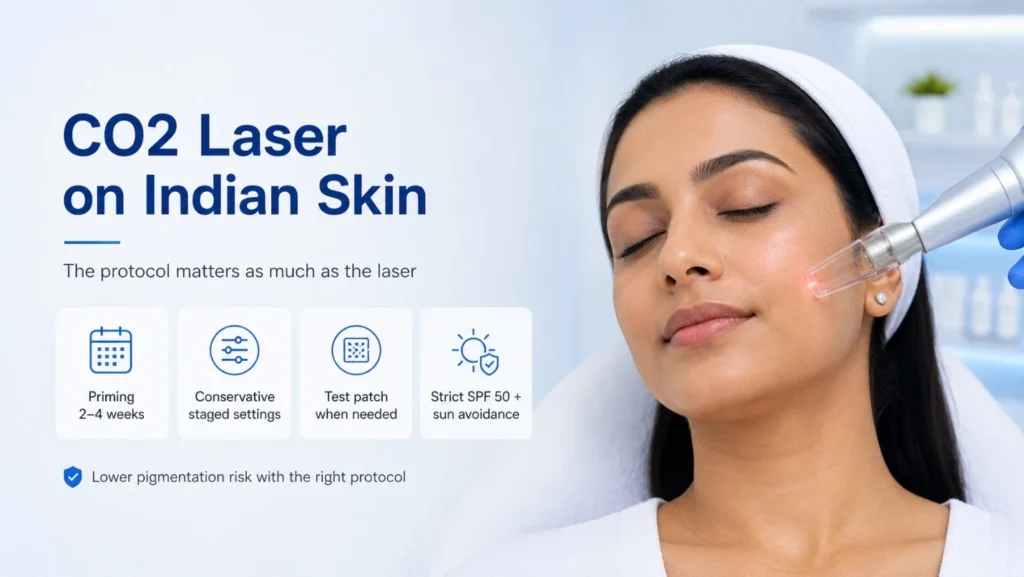
CO2 Laser on Indian Skin - the Honest Risk, and How We Manage It
Ablative lasers remove the epidermis in the treated columns. On melanin-rich skin, that inflammatory insult can trigger post-inflammatory hyperpigmentation (PIH) — brown patches that appear weeks later and can take months to fade. Published data on Fitzpatrick IV–VI patients undergoing CO2 resurfacing without prophylactic pigment-suppressing agents and strict UV avoidance has reported PIH in a substantial proportion of cases.
That figure is not an argument against the laser. It’s an argument against doing it casually. With the correct protocol — skin primed for weeks beforehand, conservative energy and density settings, and disciplined aftercare — the risk drops dramatically, and a 2025 clinical trial found that a structured pre- and post-treatment peel protocol significantly reduced PIH in Fitzpatrick III–V patients undergoing fractional CO2.
Our protocol for Indian skin
- Priming, 2–4 weeks before. Medical-grade pigment-suppressing topicals prepare the skin and lower PIH risk before the laser is ever switched on.
- Conservative, staged settings. Lower density and energy across more sessions beats one aggressive pass. Slower is safer and, on Indian skin, usually better.
- A test patch where appropriate for higher-risk skin types or histories of pigmentation.
- Strict post-treatment discipline. Absolute sun avoidance, daily SPF 50, prescribed post-care, and resumption of pigment-suppressing topicals at the right moment.
- Honest re-routing. If your skin type, history or lifestyle means you can’t follow the protocol, we’ll recommend RF microneedling or peels instead — which spare the epidermis and carry far lower pigmentation risk.
The question to ask any clinic offering you CO2 “What is your priming protocol before the laser, and what do you do afterwards to prevent pigmentation on my skin type?” If the answer is vague, or if they can book you for a full-face ablative session this week with no preparation at all, that’s your answer. On Indian skin the protocol around the laser matters as much as the laser itself. |
Which Acne Scars Actually Respond — and Which Need Something Else
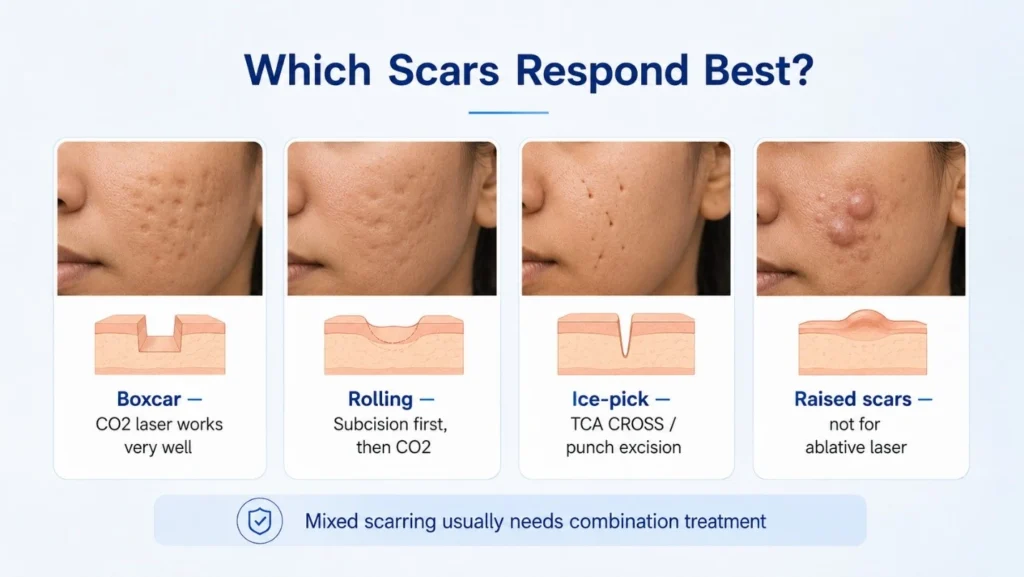
No single treatment fixes every scar, and this is where most clinics quietly overpromise. Acne scars come in distinct structural types, and each needs a different tool. A surgeon-led clinic can offer all of them; a laser-only clinic can offer one:
Scar type | What it looks like | Best treatment |
| |
Boxcar | Wide, sharp-edged depressions | CO2 fractional laser — excellent response |
| |
Rolling | Broad, wavy, tethered dips | Subcision first, then CO2 laser |
| |
Ice-pick | Narrow, deep pits | TCA CROSS or punch excision — laser alone barely helps |
| |
Atrophic/mixed | Combination of the above | Staged combination protocol |
| |
Hypertrophic / keloid | Raised, thickened | Steroid injection first — NOT ablative laser |
| |
PIE / PIH marks | Red or brown flat marks (not scars) | Peels, pigmentation treatment, time |
| |
| Why a surgeon’s toolkit matters for scars Most people have MIXED scarring, which is why single-modality treatment disappoints. Rolling scars tethered by fibrous bands must be released with subcision before any laser will lift them. Ice-pick scars need TCA CROSS or punch excision. Only then does CO2 refine the surface. Dr. Panda performs the surgical adjuncts — subcision, TCA CROSS, punch excision — alongside the laser, so your scars are treated by type rather than by whichever machine the clinic happens to own. | |||
Benefits of CO2 Fractional Laser
- The strongest scar improvement available non-surgically. Measurably outperforms microneedling for atrophic acne scars.
- Deep collagen remodelling. Improvement continues building for up to 12–18 months after treatment.
- Resurfaces texture comprehensively. Pores, roughness, fine lines and tone all improve together.
- Treats scars other methods can’t. Surgical, traumatic and burn scars, plus stretch marks.
- Removes lesions precisely. Skin tags, warts, moles, syringoma and DPN can be treated in the same setting.
- Tightens as it resurfaces. Thermal collagen contraction gives mild firming.
- Fewer sessions than gentler options. 2–4 sessions versus 6–8 of something milder.
Long-lasting. Structural collagen change, not a temporary surface effect.

Areas We Treat
- Full face — the standard treatment for acne scarring and resurfacing.
- Cheeks & temples — where atrophic acne scarring concentrates.
- Around the mouth — perioral ‘barcode’ lines respond particularly well.
- Around the eyes — fine crepey lines (with careful, conservative settings).
- Neck & décolletage — treated cautiously; thinner skin heals differently.
- Hands — sun damage, texture and pigmentation.
- Body — scars & stretch marks on the abdomen, arms, chest and back.
- Individual lesions — targeted removal anywhere on the face or body.
Conditions It Treats
- Atrophic acne scars — boxcar and rolling types especially.
- Surgical, traumatic & burn scars — flattening and blending them into surrounding skin.
- Stretch marks — texture and colour improvement, particularly older white ones.
- Wrinkles & fine lines — especially perioral and periorbital.
- Sun damage & photoageing — rough, weathered, mottled skin.
- Enlarged pores & uneven texture.
- Skin lesions — skin tags, warts, seborrhoeic keratoses, syringoma, xanthelasma and dermatosis papulosa nigra (DPN), common in Indian skin.
- Rhinophyma — thickened, bulbous nasal skin.
What CO2 fractional laser can’t fix It won’t clear active acne — acne must be stable and controlled for several months before scar resurfacing begins, or you’ll simply create new scars while treating old ones. It won’t remove ice-pick scars on its own. It won’t treat raised keloid or hypertrophic scars, which need a different approach entirely. It won’t replace volume — that needs filler. And it won’t lift significant sagging — see skin tightening. We also don’t use CO2 lasers for so-called vaginal rejuvenation, an application major regulators have warned against. |
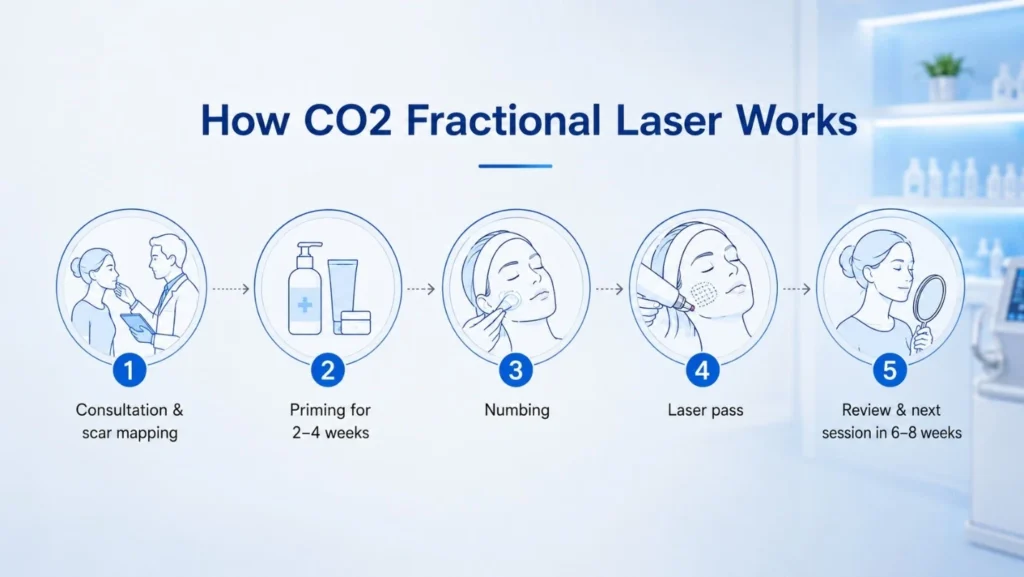
The Procedure, Step by Step
- Consultation & scar mapping. Your scar types, skin type (Fitzpatrick), pigmentation history and downtime tolerance are assessed, and a staged plan built — including any surgical adjuncts needed first.
- Priming phase, 2–4 weeks. Prescribed topicals prepare the skin and reduce pigmentation risk. This step is not optional on Indian skin.
- Strong topical anaesthetic for 45–60 minutes; nerve blocks or sedation for extensive treatment.
- Laser pass. Settings chosen per facial zone — deeper on scarred cheeks, conservative around eyes and neck. Full face takes 30–45 minutes.
- Immediate aftercare. Cooling, a barrier ointment and detailed written instructions. You go home the same day.
- Review & repeat. Reviewed at 2 weeks; next session at 6–8 weeks once the skin has fully recovered.
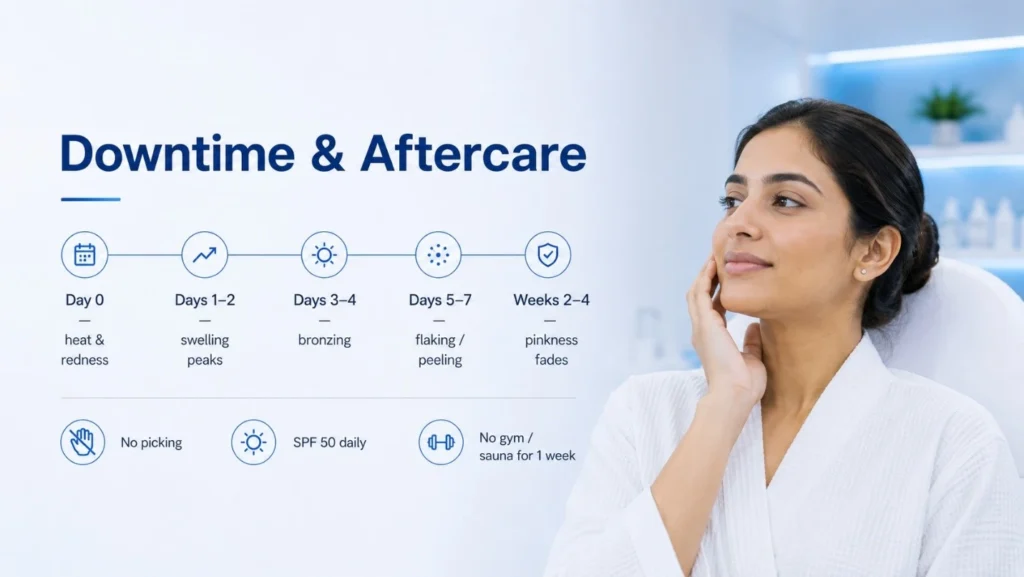
Downtime — the Honest Version
This is a treatment you plan your calendar around. Anyone describing full-face fractional CO2 as a ‘lunchtime procedure’ is misleading you. Budget a clear week.
Timeframe | What actually happens |
Day 0 | Skin feels like severe sunburn; heat and stinging for several hours. Swelling begins. |
Days 1–2 | Peak redness and swelling — face may look puffy, especially around the eyes. Oozing is normal. |
Days 3–4 | Bronzing: skin darkens and takes on a sandpaper texture as micro-crusts form. |
Days 5–7 | Flaking and peeling reveal new pink skin. Most people return to work around now. |
Weeks 2–4 | Pinkness fades gradually; makeup can cover it from about day 7–10. |
Months 1–18 | Collagen remodelling continues — results keep improving long after healing. |
Aftercare — this is where results are won or lost
- Absolute sun avoidance, then SPF 50 daily. The single biggest factor in avoiding post-treatment pigmentation.
- Never pick the crusts or peeling skin. Picking causes scarring and pigmentation — let it shed on its own.
- Follow the prescribed regimen exactly — barrier ointment, gentle cleansing, and restarting pigment-suppressing topicals when instructed.
- No makeup until cleared (usually around day 7).
- No gym, sauna, steam or swimming for at least a week.
- Plan your diary. Don’t book this within three weeks of a wedding, holiday or major event.
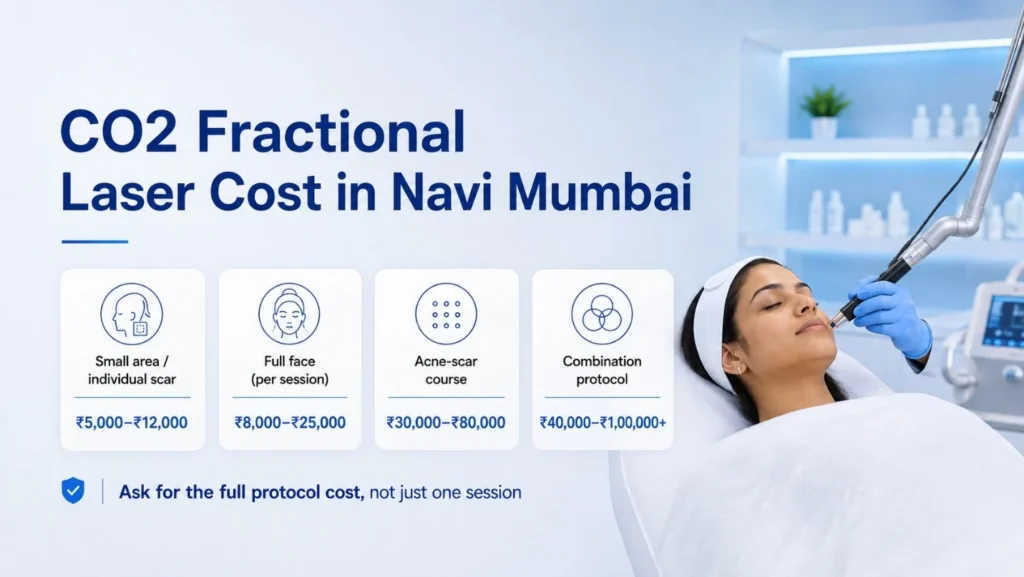
Cost of CO2 Fractional Laser in Navi Mumbai
Cost depends on the area, the depth and density of treatment, and whether surgical adjuncts (subcision, TCA CROSS) are part of the plan. Because scars need a staged course, ask for the full protocol cost, not a single-session figure. These are honest indicative ranges. EMI options are available.
Treatment | Indicative cost |
| |
Small area / individual scar | ₹5,000 – ₹12,000 |
| |
Full face (per session) | ₹8,000 – ₹25,000 |
| |
Acne-scar course (3–4 sessions) | ₹30,000 – ₹80,000 |
| |
Combination protocol (subcision/TCA CROSS + laser) | ₹40,000 – ₹1,00,000+ |
| |
Face + neck (per session) | ₹15,000 – ₹35,000 |
| |
Stretch marks / body area (per session) | ₹10,000 – ₹30,000 |
| |
Lesion removal (per lesion) | ₹2,000 – ₹8,000 |
| |
| What the price should include — and why cheap CO2 is a false economy A proper quote includes the priming topicals, the sessions, post-care products and follow-up reviews. A bargain ‘CO2 laser session’ that skips priming and aftercare on Indian skin isn’t a saving — it’s how people end up spending far more treating pigmentation afterwards. Also ask who operates the device: an aggressive setting in inexperienced hands on melanin-rich skin is the single most expensive mistake in this field. | ||
Results Timeline
When | What you’ll see |
Weeks 2–4 | Fresh, smoother surface once pinkness settles; early texture improvement. |
Weeks 6–8 | Visible scar softening; next session usually due. |
After the full course | Substantial improvement — realistically 50–80% for atrophic scars, not 100%. |
Months 6–18 | Continued collagen remodelling; results keep quietly improving. |
Set expectations honestly: CO2 laser makes scars markedly shallower and less noticeable — it does not erase them. Any clinic promising complete removal of deep acne scarring is overselling, and knowing that in advance is what makes patients happy with an excellent result rather than disappointed by an unrealistic one.
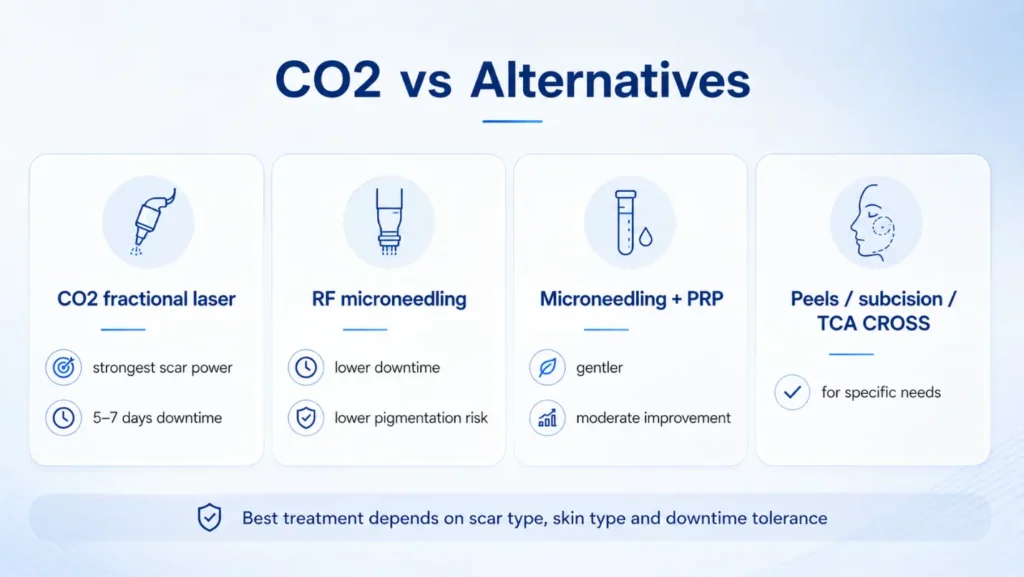
CO2 Fractional Laser vs the Alternatives
Treatment | Power for scars | Downtime | Indian-skin risk |
CO2 fractional laser | Highest | 5–7 days | Higher — needs priming protocol |
RF microneedling (Morpheus-type) | Comparable in studies | 1–3 days | Low — spares the epidermis |
Moderate | 1–3 days | Very low | |
Mild–moderate | 0–7 days | Low–moderate (depth-dependent) | |
Subcision / TCA CROSS | Essential for specific types | 2–5 days | Low |
The honest recommendation: for many Indian patients, RF microneedling is the rational starting point — comparable results in comparative studies with far lower pigmentation risk and less downtime. CO2 fractional is the stronger tool and the better choice when scarring is significant and you can commit fully to the priming and sun-avoidance protocol. We’ll tell you which camp you’re in rather than defaulting to whichever machine is free that day. Explore our full aesthetic laser range.
Is It Safe, and Who Isn’t Suitable?
In experienced hands with appropriate settings, fractional CO2 is safe and well established. Expected effects are redness, swelling, oozing, crusting and peeling in the first week. The risks worth naming are post-inflammatory hyperpigmentation (the main one on Indian skin), prolonged redness, infection, cold-sore reactivation, and — rarely, with excessive settings — scarring or persistent lightening of the skin. Almost all of these track back to settings, skin-type assessment and aftercare discipline.
Not suitable / needs caution
- Active acne or inflamed skin — acne must be controlled and stable for several months first.
- Recent isotretinoin — a waiting period (commonly 6–12 months) is assessed individually.
- Keloid-prone skin or a history of abnormal scarring.
- Active infection or cold sores — antiviral prophylaxis is used where there’s a history.
- Recent sun exposure or active tan — treatment is deferred.
- Pregnancy or breastfeeding — generally deferred.
- Unwilling or unable to follow sun avoidance — genuinely a contraindication on melanin-rich skin, and we will say so.

Why Dr. Arun Panda — a CO2 Laser Doctor With a Surgeon's Toolkit
CO2 fractional is the least forgiving laser in aesthetics, and scar treatment is the area where combination matters most. Dr. Arun Panda is a Facial Plastic and Cosmetic Surgeon and founder of Trinity Aesthetics Academy, where other practitioners are trained in aesthetic techniques. For a CO2 fractional laser doctor in Navi Mumbai, that combination of laser expertise and surgical capability is the meaningful difference.
- Surgical adjuncts under one roof. Subcision, TCA CROSS and punch excision performed alongside the laser — so mixed scarring is treated properly, not partially.
- A protocol built for Indian skin. Priming, conservative staged settings and disciplined aftercare to minimise pigmentation risk.
- Honest re-routing. If RF microneedling, peels or PRP microneedling suit you better, we’ll say so — including when CO2 isn’t worth its downtime for your scarring.
- He trains other practitioners. As founder of Trinity Aesthetics Academy, Dr. Panda teaches these protocols to other doctors.
- Realistic expectations, set in advance. You’ll be told what percentage improvement is achievable for your scar types before you spend anything.
Centrally located in Vashi Bodyskulpt Aesthetics is in the heart of Vashi, easily reached from Kharghar, Panvel, Belapur, Nerul, Airoli and Thane. Book a scar assessment for a staged, honest plan and an itemised protocol cost. EMI options available. |
Frequently Asked Questions
How much does CO2 fractional laser cost in Navi Mumbai?
Indicatively ₹8,000–₹25,000 per session for the full face, ₹5,000–₹12,000 for a small area, and ₹30,000–₹80,000 for a complete acne-scar course of 3–4 sessions. Combination protocols including subcision or TCA CROSS run ₹40,000–₹1,00,000+. Ask for the full protocol cost including priming topicals and post-care, not just the session price.
How many sessions of CO2 laser will I need for acne scars?
Usually 2–4 sessions spaced 6–8 weeks apart, depending on scar depth and type. Realistic improvement is around 50–80% for atrophic scars — marked and lasting, but not complete erasure. Results continue improving for up to 12–18 months as collagen remodels.
What is the downtime after CO2 fractional laser?
Five to seven days of genuine downtime. Days 1–2 bring redness and swelling, days 3–4 a bronzed, sandpapery texture, and days 5–7 peeling that reveals new pink skin. Most people return to work around day 7 and can cover residual pinkness with makeup from about day 7–10. Plan a clear week — this is not a lunchtime treatment.
Is CO2 fractional laser safe for Indian skin?
Yes, with the right protocol — but it needs one. Because CO2 is ablative, published data on Fitzpatrick IV–VI patients treated without pigment-suppressing priming and strict sun avoidance shows post-inflammatory hyperpigmentation in a substantial proportion of cases. With 2–4 weeks of priming, conservative staged settings and disciplined aftercare, the risk falls sharply. If you can’t commit to sun avoidance, RF microneedling is the safer choice.
Does CO2 laser work on ice-pick acne scars?
Not on its own. Ice-pick scars are narrow and deep, and laser resurfacing barely reaches their base. They need TCA CROSS or punch excision first; CO2 laser then refines the surrounding surface. Rolling scars similarly need subcision to release the tethering bands before laser will lift them. Most people have mixed scarring, so a combination protocol is usually the right answer.
Does it hurt?
Strong topical anaesthetic is applied for 45–60 minutes beforehand, and nerve blocks or sedation are used for more extensive treatment, so the session itself is tolerable. Afterwards the skin feels like severe sunburn for several hours, which is managed with cooling and prescribed medication.
CO2 laser or RF microneedling — which is better?
Comparative studies have found similar scar improvement between them, with very different trade-offs. CO2 is the more powerful resurfacing tool but carries 5–7 days of downtime and higher pigmentation risk on Indian skin. RF microneedling spares the epidermis, so it has 1–3 days of downtime and much lower pigmentation risk, but usually needs more sessions. For many Indian patients RF microneedling is the rational starting point; CO2 is the stronger option when scarring is significant and you can follow the protocol.
Can CO2 laser remove moles, skin tags or warts?
Yes — CO2 laser is an excellent precision tool for removing benign lesions including skin tags, warts, seborrhoeic keratoses, syringoma, xanthelasma and dermatosis papulosa nigra (DPN), which is common on Indian skin. Any pigmented lesion is clinically assessed before removal, and anything suspicious is investigated rather than simply lasered off.
Book a Scar & Skin Assessment
A staged, honest plan — built around your scar types and your skin type. Book with Dr. Arun Panda at Bodyskulpt Aesthetics, Sector 9, Vashi, Navi Mumbai. You’ll get your scars mapped by type, an honest view of achievable improvement, a protocol designed for Indian skin including priming and aftercare, and any surgical adjuncts — subcision, TCA CROSS — planned alongside the laser. Explore our aesthetic laser range, chemical peels and PRP microneedling, or book a consultation. Call / WhatsApp: 9152020907 / 9152020908 • drarunpanda.com • EMI available |
Authoritative references
For independent information, see the American Academy of Dermatology on laser resurfacing, Cleveland Clinic on laser skin resurfacing and peer-reviewed literature on CO2 laser and post-inflammatory hyperpigmentation.
Educational information only and not a substitute for an in-person consultation. CO2 fractional laser improves but does not completely erase scarring; results, downtime and pigmentation risk vary with skin type and adherence to protocol.
Please reach out to us through the contact details below.
- Website: https://drarunpanda.com/
- Phone: +919152020907, +919152020908
- Address: Dr. Arun Panda, BodySkulpt Aesthetics, F1/A-4, Aditi Apartments, Sector 9, Vashi, Navi Mumbai – 400703
- Facebook: https://www.facebook.com/DrArunPanda
- Instagram: https://www.instagram.com/drarunpanda/
- Youtube: https://www.youtube.com/DrArunPanda
- LinkedIn: https://www.linkedin.com/in/drarunpanda
- Twitter: https://twitter.com/DrArunPanda1
- Email: facialaestheticsindia@gmail.com
- Google Directions: https://g.page/DrArunPanda?gm