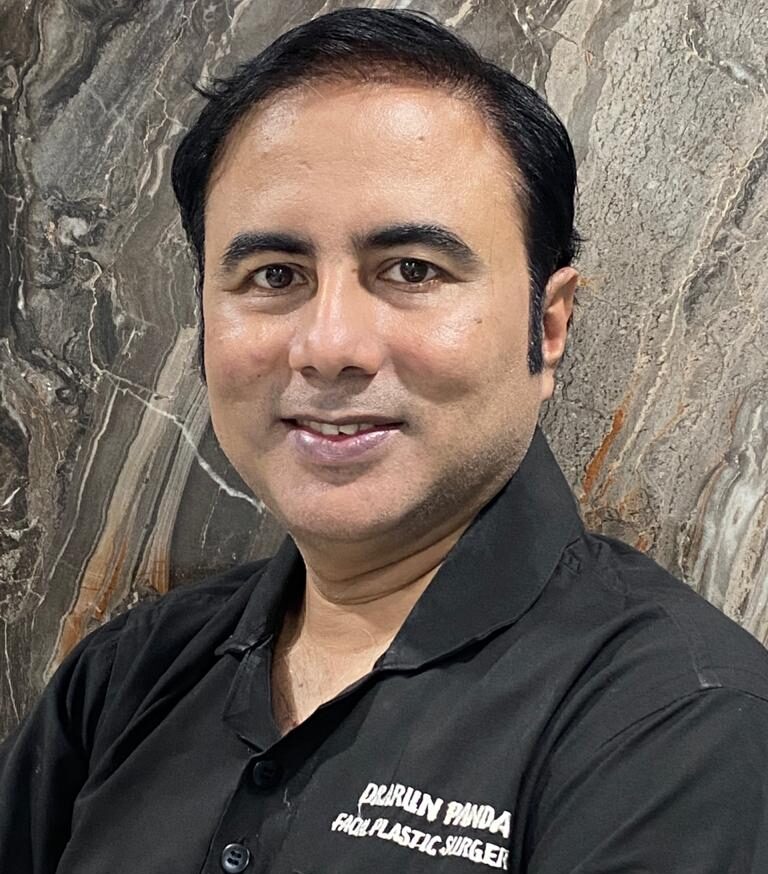
Facial Masculinization Surgery in Navi Mumbai
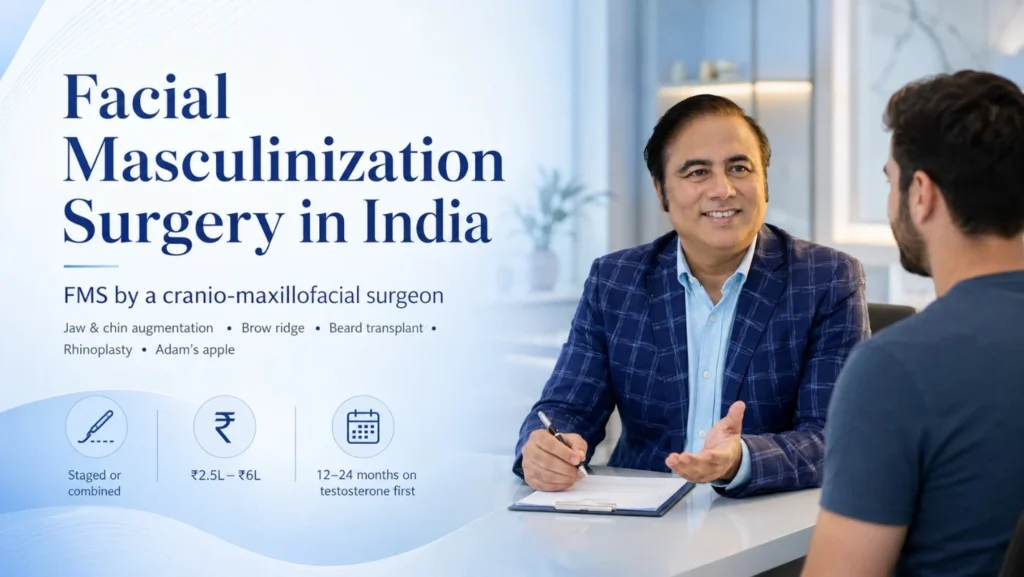
What FMS Does — and Why the Order Matters
Facial masculinization surgery reshapes the features that most influence how strangers read gender: the heaviness of the brow, the width and angle of the jaw, the projection and squareness of the chin, the shape of the nose, and — often most powerfully of all — the presence of facial hair.
The technical difference from facial feminization surgery is worth understanding, because it changes the risk profile. FFS is largely reductive: bone is shaved, set back and removed, permanently. FMS is largely additive: implants and grafts build projection where there wasn’t any. That means different considerations — implant infection and malposition are the risks to weigh rather than over-resection — but it also means a degree of reversibility that FFS doesn’t offer, since an implant can in principle be removed or exchanged.
This page is written for trans men and transmasculine non-binary people considering FMS, and for anyone supporting them. It sets out what each procedure does, what it honestly costs in India, how long recovery takes, and — most importantly — how to sequence decisions so you don’t pay for surgery that hormones were going to do for free.
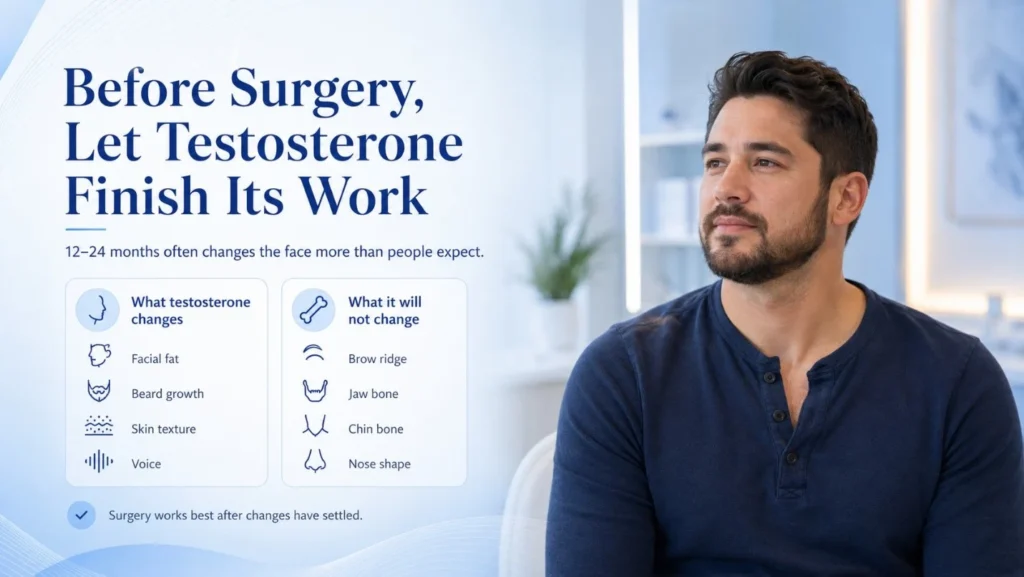
Before Any Surgery: Let Testosterone Finish Its Work
This is the single most useful thing on this page, and it’s the opposite of the advice on our FFS page. For trans women, hormones cannot change bone, so surgery is the only route. For trans men, testosterone does a great deal to the face on its own — and it keeps doing it for years.
What testosterone changes without surgery
- Facial fat redistributes. Cheek fullness decreases and the lower face fills out, producing a squarer, more angular appearance — the exact change jaw implants are used to create.
- Beard and moustache growth. Often the single most powerful masculinising change of all, though density and pattern are genetic and vary widely.
- Skin thickens and coarsens, pores enlarge, and the overall texture reads as more masculine.
- The hairline may recede, producing a more masculine temporal shape — welcome for some, unwanted for others.
- The voice deepens permanently, which is why voice surgery is rarely needed for trans men — a genuine asymmetry with trans women’s experience.
What testosterone will not change
- The bony brow ridge. A flat forehead stays flat; supraorbital projection requires augmentation.
- Jaw and chin bone dimensions. Soft tissue changes, but the underlying skeleton does not grow.
- Nose shape and the thyroid cartilage (Adam’s apple) prominence.
Why we’d rather you waited Most surgeons advise being on testosterone for at least 12–24 months before deciding on facial surgery, and we agree. Faces change substantially in that window, and we regularly see people who would have been quoted a full FMS plan at month three but who, by month eighteen, need one procedure or none. Operating early risks paying for changes hormones were about to deliver — and occasionally risks over-masculinising a face that was still moving. If you come to us early, we’ll assess you properly and, where appropriate, tell you to come back in a year. That costs us a booking and saves you a great deal. |

If Your Budget Is Limited, Start Here
Assuming testosterone has had time to work, here’s the honest ordering by impact-per-rupee — which is not the order most clinics present:
Priority | Procedure | Why it ranks here | ||
1 — Best value | For patchy growth, facial hair changes how you’re read more than any implant — and costs less than most of them | |||
2 | Jaw angle & chin augmentation | Lower-face width, squareness and projection — the strongest skeletal cue | ||
3 | Brow ridge / forehead augmentation | Powerful, but technically demanding and higher-cost | ||
4 | Masculinising rhinoplasty | Straighter, stronger dorsum; high harmony impact, moderate gender impact | ||
5 | Cheek / submental refinement | Angularity via buccal fat removal or submental liposuction | ||
6 | Adam’s apple augmentation | Small but meaningful for some; usually done last | ||
The beard point, stated plainly If testosterone has given you patchy or thin facial hair and your budget is limited, a beard transplant is very often the highest-return procedure available to you. A full beard reframes the lower face, conceals a softer jawline, and is read as unambiguously male in a way that a 4 mm chin implant simply isn’t. It’s also a procedure Dr. Panda performs regularly and teaches to other doctors. We’d rather start you there than sell you a full skeletal plan you may not need. | ||||
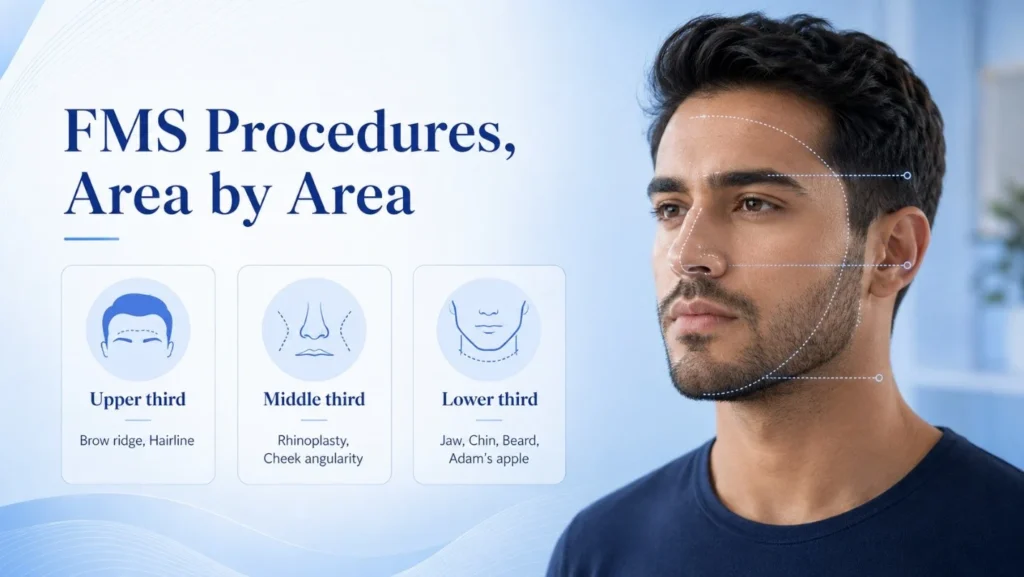
The Procedures, Area by Area
Upper third — forehead, brow and hairline
- Brow ridge / forehead augmentation. Implants or bone grafts build supraorbital projection and a flatter, broader forehead. Approach matters: an incision at the hairline allows the hairline to be brought forward but risks a visible scar; an incision further back in the scalp leaves no visible forehead scar but limits hairline adjustment. We’ll discuss which trade-off suits you.
- Brow position. Masculine brows sit lower and flatter than feminine ones; positioning is addressed alongside ridge augmentation where needed.
- Hairline shaping / temporal recession. Often achieved by testosterone alone. Where wanted, hair transplantation can refine the shape — including restoring density if recession goes further than you’d like.
Middle third — nose and cheeks
- Masculinising rhinoplasty. Building a straighter, higher, wider dorsum and a less rotated tip — typically augmentation rather than reduction, sometimes using cartilage grafts.
- Cheek angularity. Reducing soft mid-face fullness with buccal fat removal for a more hollowed, angular look — though testosterone often achieves much of this alone, which is another reason to wait.
Lower third — jaw, chin and neck
- Jaw angle augmentation. Implants placed through incisions inside the mouth widen the lower face and sharpen the mandibular angle. No external scars.
- Chin augmentation or genioplasty. A squarer, wider, more projected chin — achieved with an implant or by cutting and repositioning the chin bone. See our chin augmentation and jaw surgery pages for the underlying techniques.
- Submental refinement. Sharpening the chin-neck angle with submental liposuction so the new jawline reads clearly.
- Beard and moustache transplantation. Grafting to fill patchy growth or build a full beard — see our detailed beard hair transplant
- Adam’s apple augmentation. A cartilage graft or implant is secured over the thyroid cartilage through a small, well-hidden incision under the chin or on the neck. Some temporary voice weakness in the first few weeks is expected.
What this page doesn’t cover — and where we’ll refer you FMS is facial surgery. Chest (top) surgery, hysterectomy and genital surgeries are different specialties and we refer to appropriate surgeons rather than pretending otherwise. Voice generally deepens permanently on testosterone, so voice surgery is rarely required — but if it is, we can point you to the right service. Body contouring and any surgery for gynaecomastia-type concerns are handled by our empanelled plastic surgery colleagues. |
Benefits of Facial Masculinization Surgery
- Being read as male more consistently. The practical goal for most patients — and the change that affects daily life most.
- A stronger, squarer jawline and defined chin-neck angle.
- Brow and forehead projection that testosterone alone cannot produce.
- Fuller facial hair where genetics or hormones left gaps.
- Minimal visible scarring. Jaw and chin work is done inside the mouth; brow work behind the hairline.
- A degree of reversibility. Implants can be removed or exchanged — an option that reductive surgery doesn’t offer.
- Procedures can be staged to spread cost and recovery, or combined to share theatre and anaesthesia costs.
Who Is a Good Candidate?
Well suited
- At least 12–24 months on testosterone with facial changes largely settled — or not on hormones by choice, with realistic expectations.
- Specific, identifiable concerns — “my jaw is narrow” or “my brow is flat” rather than a general wish to look different.
- Good general health, non-smoker or willing to stop — particularly important with implants.
- Healthy mouth and gums, since jaw and chin implants are placed intraorally.
- Realistic understanding that FMS changes how you’re read, not who you look like.
Not suitable — or not yet
- Early in hormone therapy — wait and reassess; you may need far less.
- Active dental or gum infection — treat before any intraoral implant surgery.
- Smoking that won’t be paused — significantly raises implant infection and healing risk.
- Unstable general or mental health — major elective surgery deserves a settled moment; we’d rather support you toward one than operate at the wrong time.
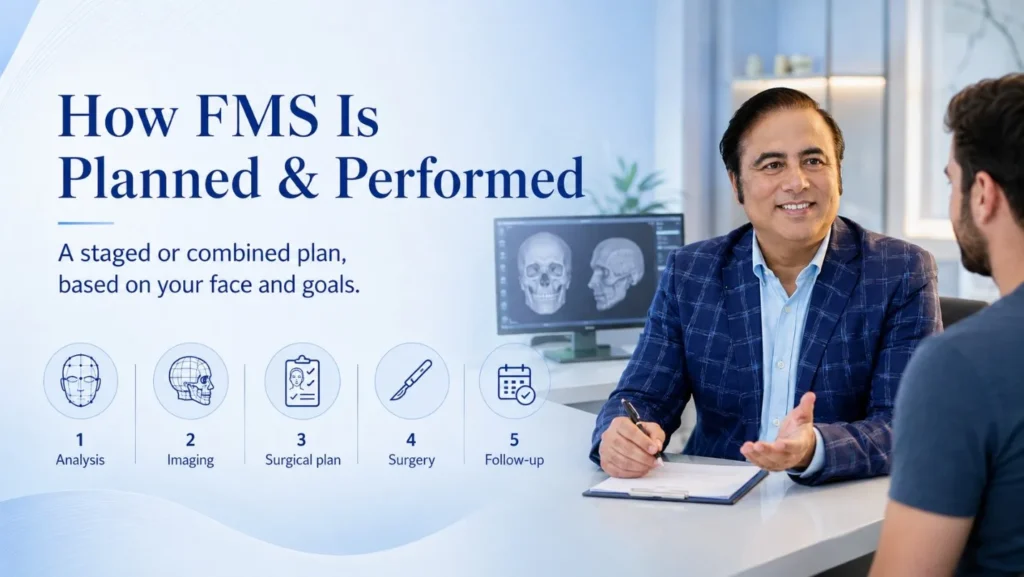
How the Surgery Is Planned and Performed
- Consultation and facial analysis. Assessment of your facial skeleton, soft tissue and beard pattern, how long you’ve been on testosterone, and what specifically you want changed. Imaging where implants are planned.
- An honest sequencing plan. Written, itemised, and ordered by impact — including a recommendation to wait if that’s the right advice.
- Pre-operative preparation. Blood tests, medical fitness and anaesthetic review; dental check before intraoral implants; smoking cessation where relevant.
- Under general anaesthesia for skeletal work. Jaw and chin implants are placed through incisions inside the mouth; brow augmentation through a scalp or hairline incision; Adam’s apple augmentation via a small hidden neck incision. A combined FMS session commonly runs 4–8 hours.
- Beard transplantation is usually performed separately under local anaesthesia, either before or several months after skeletal work.
- Follow-up. Reviews at one week, one month, three months and one year, with remote follow-up for out-of-town and international patients.
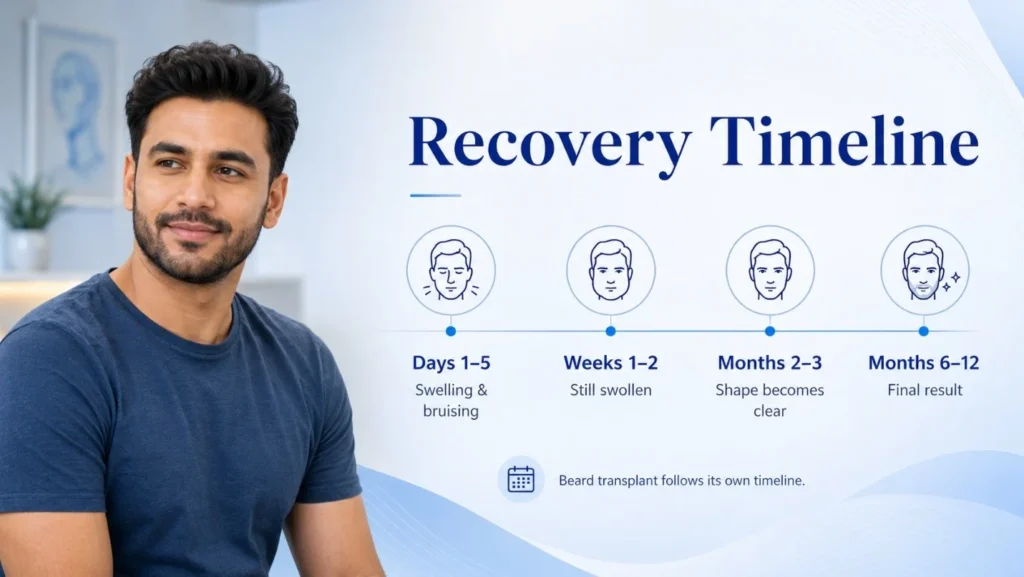
Recovery — an Honest Timeline
Timeframe | What to expect |
Days 1–5 | Marked swelling and bruising, worst at days 2–3. Soft diet after intraoral work; antiseptic mouth rinses. |
Weeks 1–2 | Sutures removed where used; bruising fading. Still visibly swollen. Numbness of chin and lower lip is common. |
Weeks 3–6 | Presentable for most people; normal diet resumes. Implant contours still settling. |
Months 2–3 | Around 70–80% of swelling resolved; the new contour becomes clear. |
Months 6–12 | Final result. Beard transplant follows its own timeline — shedding at weeks 2–4, growth from month 3–4, full at 8–12 months. |
Aftercare
- Soft diet and diligent mouth rinses after intraoral implants — oral hygiene directly protects against implant infection.
- Sleep elevated for the first two weeks.
- No smoking, and no strenuous activity or contact sport for 4–6 weeks with implants in place.
- Report increasing pain, swelling or discharge promptly — early implant infection is far easier to treat than late.
- Expect temporary numbness of the chin and lower lip; it recovers gradually over weeks to months.
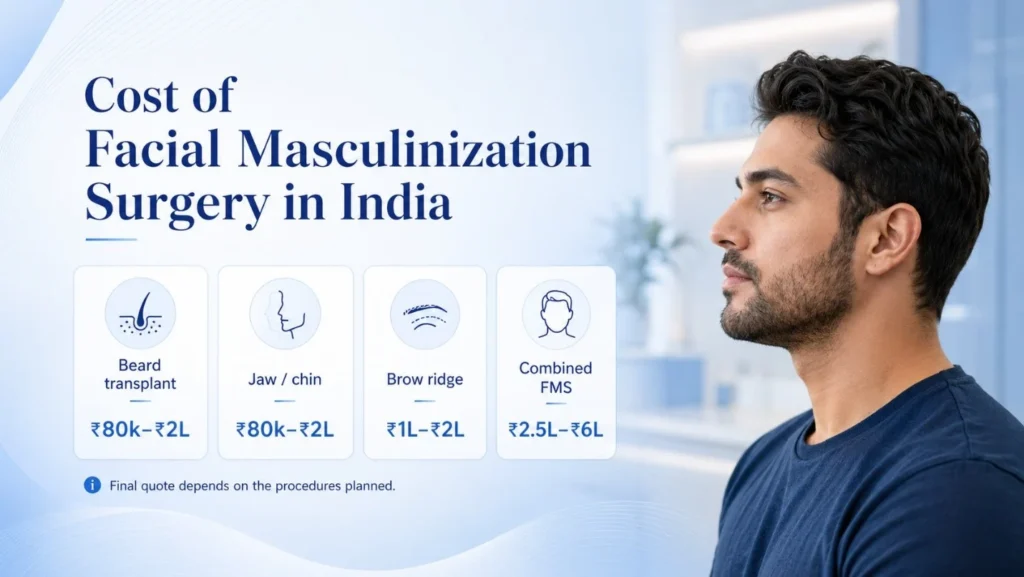
Cost of Facial Masculinization Surgery in India
FMS is priced by the procedures in your plan. India offers substantial savings against the US, UK and Europe for equivalent surgical standards. These are indicative ranges; your exact itemised quote follows consultation. EMI options are available.
Procedure | Indicative cost (INR) | ||
₹80,000 – ₹2,00,000 | |||
Jaw angle augmentation (implants) | ₹1,00,000 – ₹2,00,000 | ||
Chin augmentation / genioplasty | ₹80,000 – ₹1,50,000 | ||
Brow ridge / forehead augmentation | ₹1,00,000 – ₹2,00,000 | ||
Masculinising rhinoplasty | ₹90,000 – ₹1,80,000 | ||
Buccal fat removal (cheek angularity) | ₹35,000 – ₹70,000 | ||
Submental liposuction | ₹40,000 – ₹1,00,000 | ||
Adam’s apple augmentation | ₹80,000 – ₹1,50,000 | ||
Combined FMS plan | ₹2,50,000 – ₹6,00,000 | ||
Two cost points worth knowing Combining skeletal procedures in one sitting is meaningfully cheaper than doing them separately, because theatre, anaesthesia and hospital costs are shared. And India has a national health scheme for transgender persons under which certain gender-affirming procedures may be covered — eligibility and scope change over time, so check your current entitlement. Ask any clinic for a written quote itemising surgeon, anaesthesia, hospital stay, implants and follow-up, and confirm what a revision would cost if an implant needed adjusting. | |||
Results Timeline
When | What you’ll see |
Weeks 1–2 | Swelling dominates — don’t judge anything. |
Weeks 3–6 | First real sense of the new contour. |
Months 2–3 | Shape clear; many patients notice a change in how they’re gendered. |
Months 6–12 | Final skeletal result; beard transplant reaching full density. |
Long term | Permanent, though implants can be revised or removed if ever needed. |
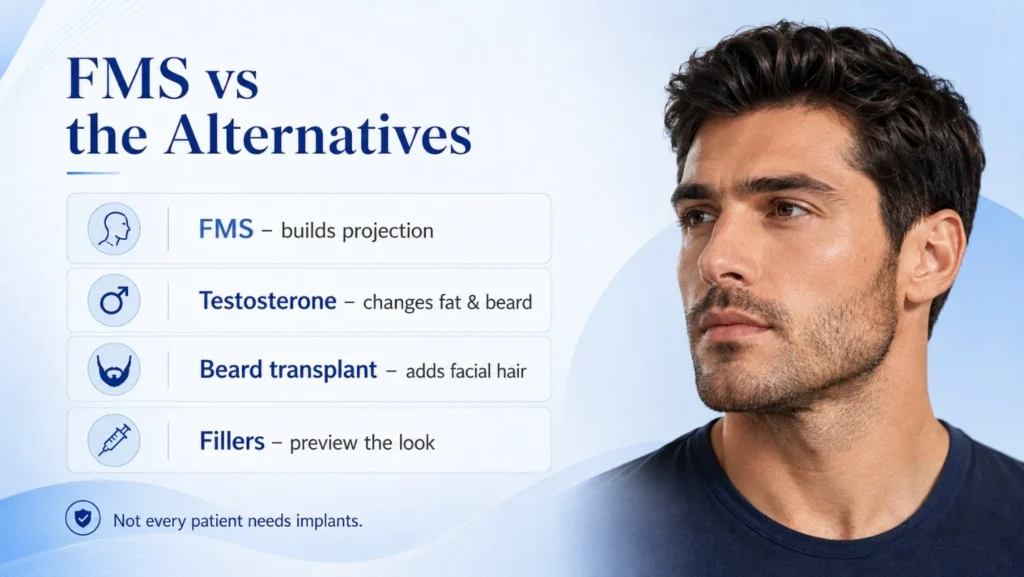
FMS vs the Alternatives
Option | What it can do | What it can’t do | Duration |
FMS (implants & grafts) | Build brow, jaw and chin projection | — | Permanent (revisable) |
Testosterone alone | Redistribute fat, grow beard, thicken skin, deepen voice | Cannot enlarge bone or brow ridge | Ongoing |
Create or fill facial hair permanently | No skeletal change | Permanent | |
Temporarily sharpen jaw and chin contour | Cannot match implant projection | 12–18 months | |
Weight training / body recomposition | Reduce facial fat, sharpen features | No structural change | While maintained |
Fillers deserve a specific mention. Jaw and chin filler is a genuinely useful way to preview the effect of an implant before committing — lower cost, reversible, and it tells you whether more projection actually suits your face. Several of our patients trial filler first and then decide. It is not, however, a long-term substitute: maintaining a masculinised jawline with filler indefinitely costs more than the implant would have.
Safety, Risks and Choosing a Surgeon
FMS is major surgery. General risks include bleeding, infection, adverse anaesthetic reaction and unfavourable scarring. The risks specific to this kind of surgery are worth naming clearly: implant infection, malposition, asymmetry or extrusion; temporary or, rarely, prolonged numbness of the chin and lower lip from nerve handling during jaw and chin work; and, with Adam’s apple augmentation, temporary voice weakness and — uncommonly — airway or voice complications, which is why that procedure warrants particular care.
Because most of the skeletal work is placed through the mouth against bone, oral hygiene and dental health matter more than patients expect. An untreated dental infection near a fresh implant is a genuine problem, which is why we check before operating.
Questions worth asking any FMS surgeon
- What is your training in craniofacial or maxillofacial surgery?
- How many facial implant cases have you personally performed?
- Will implants be off-the-shelf or custom, and why that choice for me?
- How long have you been on testosterone — and would you advise me to wait? (A surgeon who never says wait is worth questioning.)
- What would revision or implant removal cost if it were needed?

Why Dr. Arun Panda — Skeletal Surgery and Beard Transplantation Under One Roof
FMS asks for two capabilities that rarely sit together: craniofacial implant surgery, and hair transplantation. Dr. Arun Panda is a Cranio-Maxillofacial and fellowship-trained Facial Plastic and Cosmetic Surgeon, and the founder of Trinity Aesthetics Academy, where he trains other doctors in both aesthetic surgery and hair transplantation. For facial masculinization surgery in India, that pairing is genuinely uncommon — and it matters, because for many patients the beard is the highest-impact part of the plan.
- Jaw, chin and brow work is his core discipline. Mandibular angle, genioplasty and orbital-region surgery are cranio-maxillofacial territory.
- Beard transplantation performed and taught in-house. Not outsourced — see our beard hair transplant guide for the technique and graft numbers.
- Intraoral approaches for jaw and chin implants — routine ground, and no external scars.
- Willing to tell you to wait. If testosterone has more to give, you’ll be told to come back rather than sold a plan today.
- Filler trial before implants where useful — jaw and chin filler lets you preview projection reversibly before committing.
- Discretion and respect as standard. You’ll be addressed by your name and pronouns from the first contact.
For patients travelling to us Bodyskulpt Aesthetics is in Vashi, Navi Mumbai — close to Mumbai international airport and easily reached from across India. For out-of-town and international patients we schedule consultation, investigations and surgery efficiently, advise on length of stay (typically 2–3 weeks for major FMS), and arrange structured remote follow-up. Video consultations are available before you travel. |
Frequently Asked Questions
How much does facial masculinization surgery cost in India?
A combined FMS plan typically runs ₹2,50,000–₹6,00,000 depending on which procedures you need. Individually: beard transplant ₹80,000–₹2,00,000, jaw angle implants ₹1,00,000–₹2,00,000, chin augmentation ₹80,000–₹1,50,000, brow ridge augmentation ₹1,00,000–₹2,00,000, rhinoplasty ₹90,000–₹1,80,000, and Adam’s apple augmentation ₹80,000–₹1,50,000. Combining procedures in one sitting shares theatre and anaesthesia costs and is cheaper than staging.
Should I wait before having facial masculinization surgery?
Usually yes. Testosterone genuinely changes the face — cheek fat reduces, the lower face fills out, beard growth develops and skin thickens — and it continues doing so for years. Most surgeons advise at least 12–24 months on testosterone before deciding on facial surgery, because many people find they need less than expected or nothing at all. A surgeon who never advises waiting is worth questioning.
Which FMS procedure gives the biggest change?
For patchy facial hair, a beard transplant is frequently the highest-impact and best-value option — a full beard reframes the lower face and reads as unambiguously male in a way a small implant doesn’t. Among skeletal procedures, jaw angle and chin augmentation give the strongest change, followed by brow ridge augmentation. The nose has high harmony impact but less gender impact.
Is FMS reversible?
Partly, and more so than facial feminization surgery. FMS is mostly additive — implants and grafts — and an implant can in principle be removed or exchanged, unlike bone that has been permanently reduced. That said, removal is another operation with its own risks and the soft tissue does not always return exactly as before, so it shouldn’t be treated as a trial.
Will there be visible scars after FMS?
Mostly not. Jaw and chin implants are placed through incisions inside the mouth, leaving no facial scars. Brow and forehead augmentation uses a scalp or hairline incision — a scalp incision leaves nothing visible on the forehead but limits hairline change, while a hairline incision allows hairline adjustment at the cost of a potentially visible scar. Adam’s apple augmentation uses a small incision hidden in a neck crease or under the chin.
How long is recovery after facial masculinization surgery?
Marked swelling for the first week, presentable for most people around weeks 3–6, roughly 70–80% of swelling resolved by months 2–3, and the final result at 6–12 months. Soft diet and mouth rinses are needed after intraoral implants, and numbness of the chin and lower lip is common and settles over weeks to months.
Do I need voice surgery as well?
Usually not. Testosterone deepens the voice permanently in most trans men, which is a real asymmetry with trans women’s experience — voice feminisation often needs therapy or surgery, whereas voice masculinisation generally happens on hormones alone. If your voice hasn’t changed as you’d hoped, that’s worth discussing with a speech and language therapist first.
Can I try fillers before committing to implants?
Yes, and it’s often a sensible step. Jaw and chin filler previews the effect of added projection reversibly and at lower initial cost, which helps you decide whether an implant suits your face. It isn’t a long-term substitute though — maintaining the effect with filler indefinitely costs more than the implant would have.
Book an FMS Consultation
An honest plan — including being told to wait, if that’s the right advice. Book with Dr. Arun Panda at Bodyskulpt Aesthetics, Sector 9, Vashi, Navi Mumbai. You’ll get a detailed facial and beard-pattern assessment, an honest view on whether testosterone still has work to do, a sequenced plan ordered by impact rather than by price, and a clear itemised quote. Video consultations are available for patients across India and overseas. Explore beard hair transplant, chin augmentation, or book a consultation. Call / WhatsApp: 9152020907 / 9152020908 • drarunpanda.com • EMI available |
Authoritative references
For independent information, see the American Society of Plastic Surgeons on facial masculinization, Johns Hopkins Medicine and peer-reviewed literature on FMS.
Educational information only and not a substitute for an in-person surgical consultation. FMS is major surgery; suitability, results, costs and recovery vary between individuals. Facial masculinization surgery addresses facial features only; chest, body and genital gender-affirming surgeries are performed by other specialists.
Please reach out to us through the contact details below.
- Website: https://drarunpanda.com/
- Phone: +919152020907, +919152020908
- Address: Dr. Arun Panda, BodySkulpt Aesthetics, F1/A-4, Aditi Apartments, Sector 9, Vashi, Navi Mumbai – 400703
- Facebook: https://www.facebook.com/DrArunPanda
- Instagram: https://www.instagram.com/drarunpanda/
- Youtube: https://www.youtube.com/DrArunPanda
- LinkedIn: https://www.linkedin.com/in/drarunpanda
- Twitter: https://twitter.com/DrArunPanda1
- Email: facialaestheticsindia@gmail.com
- Google Directions: https://g.page/DrArunPanda?gm