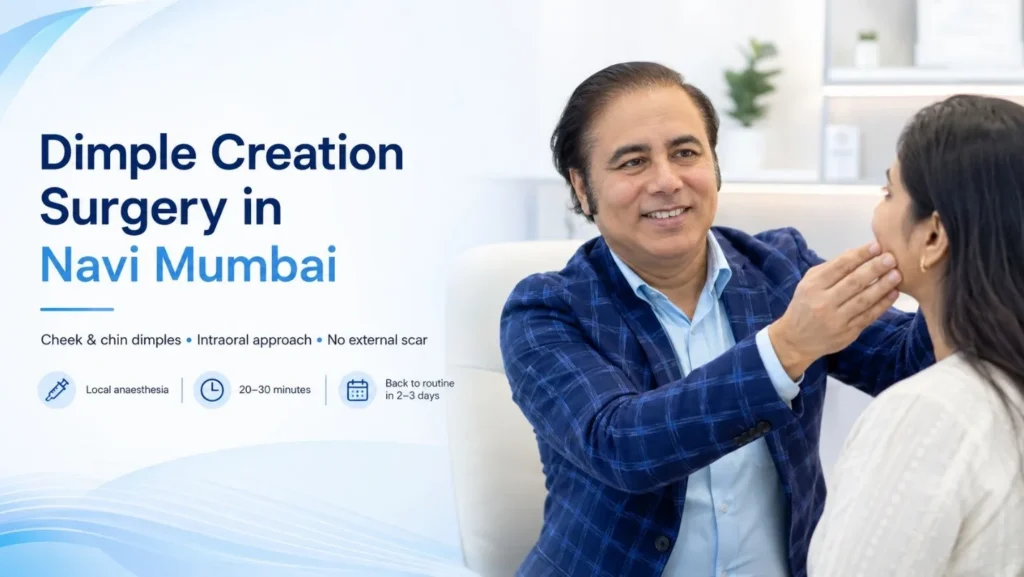
Dimple Creation Surgery in Navi Mumbai
How a Dimple Actually Works and How We Recreate It
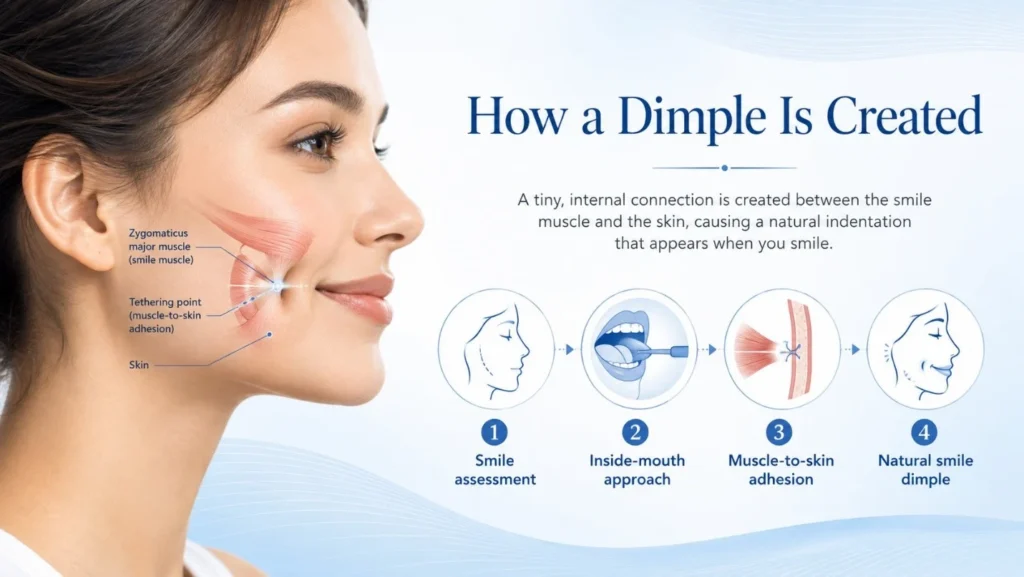
Natural dimples aren’t a skin feature; they’re a muscle variation. In roughly 20–30% of people, a facial muscle — usually a divided or shortened band of the zygomaticus major, with the buccinator playing a supporting role — attaches to the overlying skin. When you smile and that muscle contracts, it pulls the skin inward, and a dimple appears. It’s a tethering effect, not a dent.
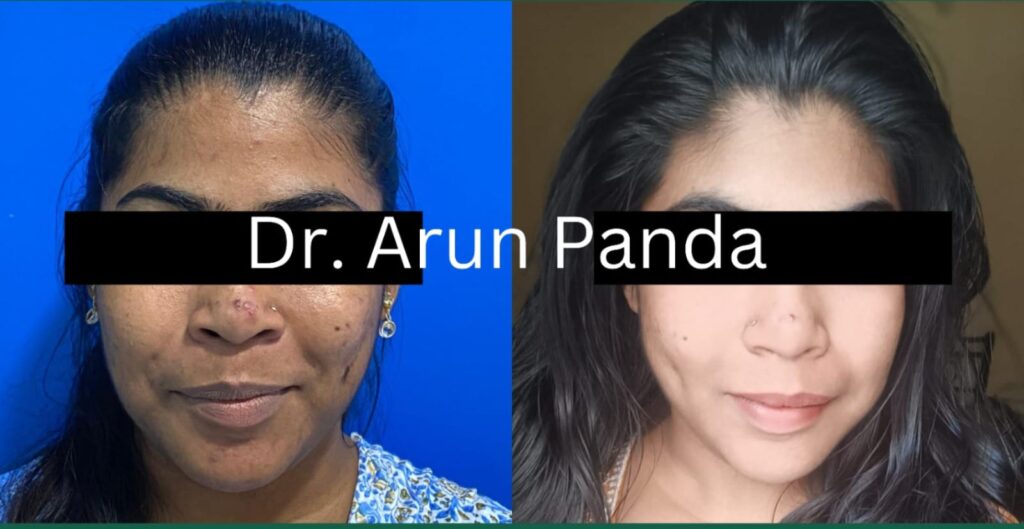
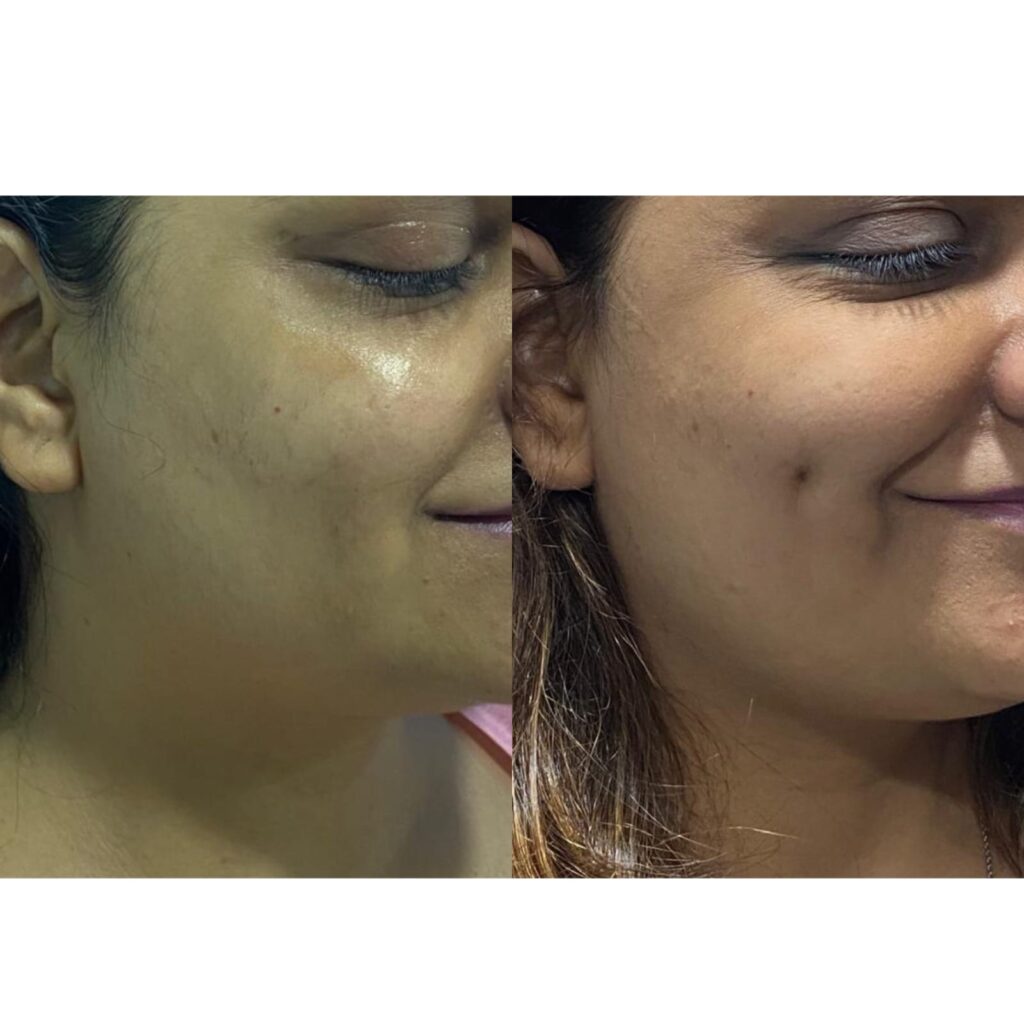
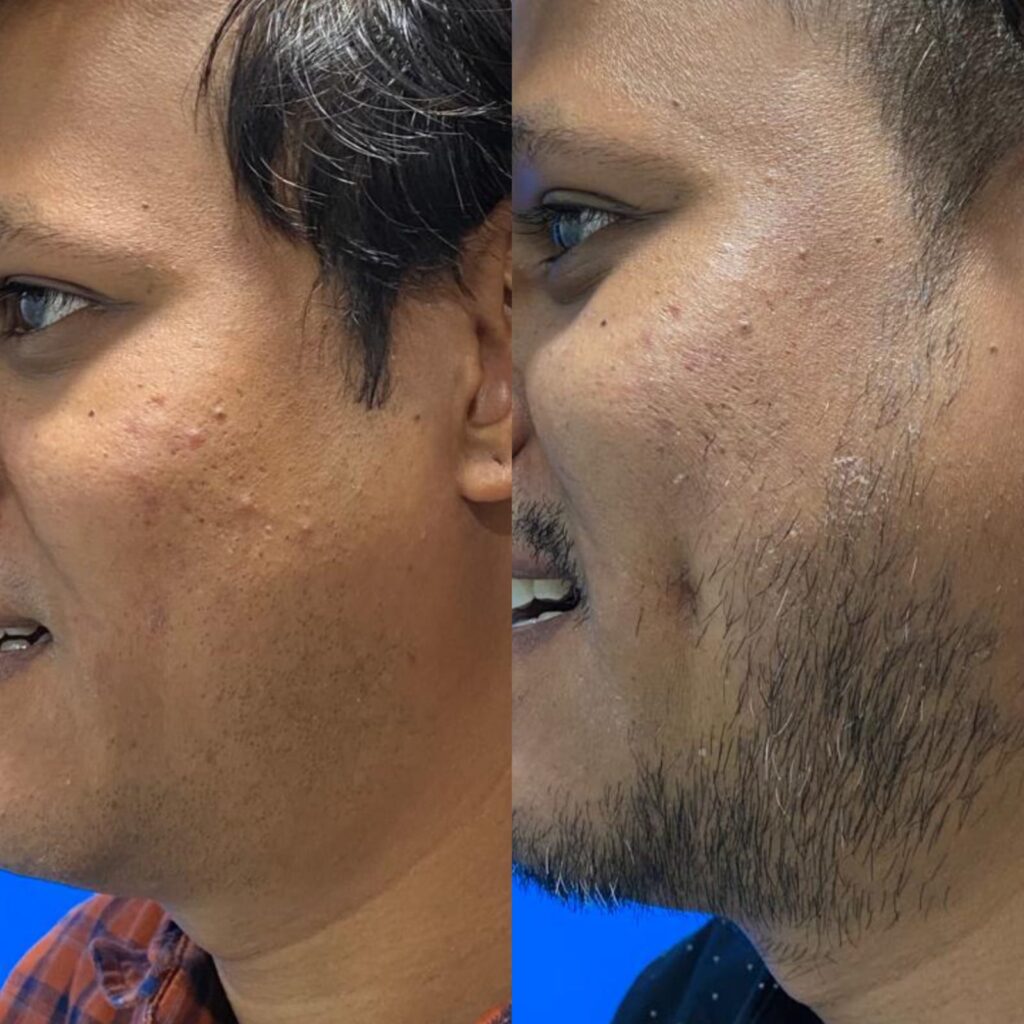
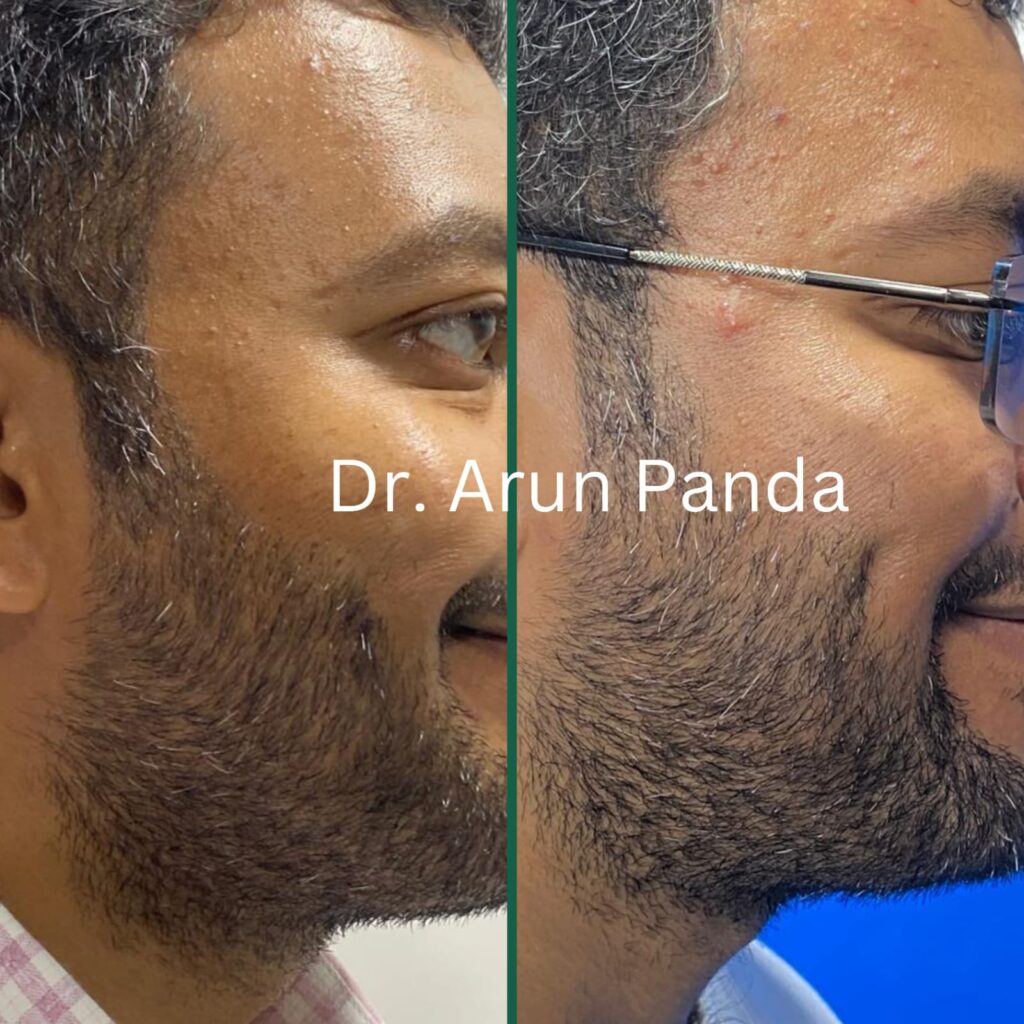
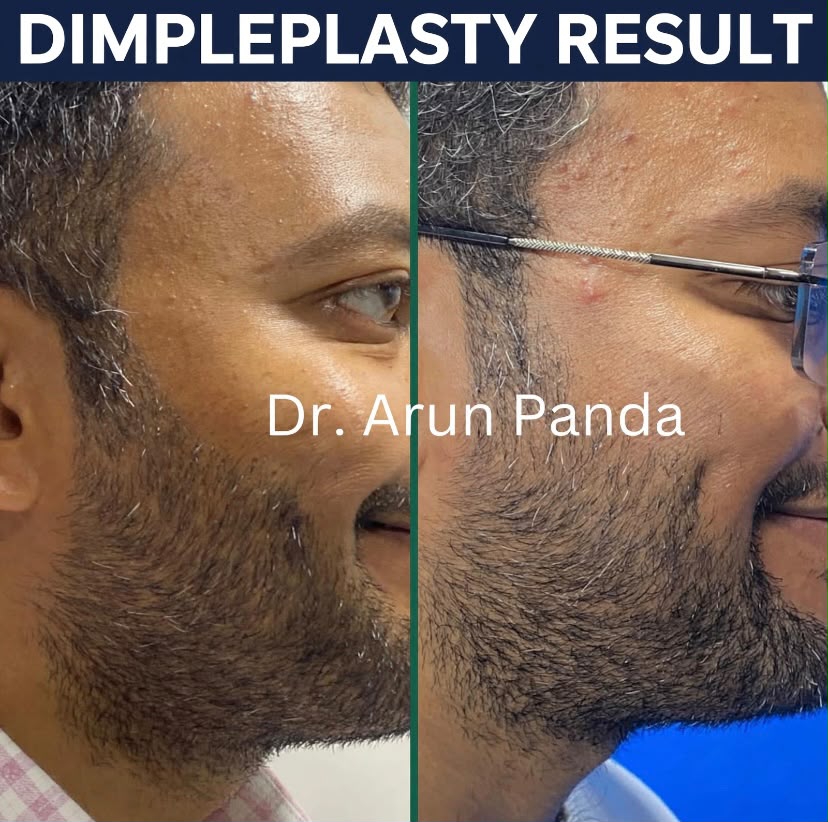
Dimpleplasty recreates that tether deliberately. Through a small incision on the inside of the cheek, a controlled adhesion is created between the muscle layer and the underside of the skin at a precisely chosen point. As it heals, a small area of scar tissue forms that holds the connection permanently — so when you smile, the skin draws in exactly as a natural dimple does. Nothing is done from the outside, so there is no visible scar on the face at all.
It’s a small operation — but a real one, performed millimetres from the buccal branch of the facial nerve and the parotid duct. Quick and low-risk is not the same as trivial, and it deserves a surgeon comfortable in that anatomy.
The Part Nobody Warns You About: the First Few Weeks
If there’s one thing to take from this page, it’s this. Straight after surgery, and for several weeks afterwards, your dimple will be permanently visible — present even when your face is completely relaxed. It often looks deeper, sharper and more obvious than the natural dimple you were imagining. Many patients quietly panic at around day seven, convinced it’s gone wrong.
It hasn’t. That static phase is the deliberate, expected consequence of the internal suture holding the adhesion while scar tissue forms. As the deep suture dissolves and the tissue matures, the resting dimple gradually releases — typically softening over 4–8 weeks, and settling into its final, natural, smile-only appearance by around 2–3 months.
When | How the dimple looks | ||
Days 0–7 | Clearly visible at rest, often deep-looking. Mild swelling adds to it. | ||
Weeks 2–4 | Still visible at rest, beginning to soften. The stage people worry most. | ||
Weeks 4–8 | Resting dimple fades noticeably; becoming smile-dominant. | ||
Months 2–3 | Final result — natural, appearing mainly when you smile. | ||
Plan around it Because of that static phase, don’t schedule dimpleplasty within about two months of a wedding, shoot or major event where you want to look entirely unchanged at rest. It’s not painful and it isn’t dangerous — it’s simply visible. Patients who are told this beforehand sail through it; patients who aren’t spend a month convinced something has failed. | |||
Two Techniques and Why the Choice Affects How Long It Lasts
Not all dimpleplasty is the same operation, and the difference matters for durability. Most clinics don’t mention there’s a choice at all:
Technique | How it works | Durability | Best for |
Suture-only | A stitch links cheek muscle to the underside of the skin; depth adjusted by knot tension | Good — but can soften or fade over time | Subtle dimples; patients wanting the most conservative option |
Coring / fenestration | A tiny core of inner-cheek tissue is removed and the skin fixed to the muscle | More durable — stronger, more reliable adhesion | Thicker cheeks; patients wanting a definite, lasting dimple |
Which is right for you depends on your cheek thickness, how prominent you want the dimple, and your tolerance for the small possibility of needing a revision. Thicker cheeks generally need the coring approach for the dimple to read at all; slimmer cheeks can achieve a natural result with sutures alone. We’ll explain which we’re recommending for you and why — rather than applying one method to everyone.
Placement Is the Whole Art
A dimple in the wrong place doesn’t look like a dimple — it looks like a dent. Position is planned from facial landmarks, classically near the intersection of a vertical line dropped from the outer corner of the eye and a horizontal line from the corner of the mouth, usually around 2–3 cm out from the mouth corner — then adjusted for your face and, crucially, your smile in motion.
- Too high or too far back — reads as a hollow or a scar, not a dimple.
- Too close to the mouth — looks like a crease rather than a dimple.
- Too deep — looks surgical and stays obvious at rest long-term.
- Asymmetric placement — the most common visible giveaway; both sides must be measured, not eyeballed.
We mark it, you approve it — while smiling The proposed position is marked and shown to you in a mirror, at rest and while smiling, before any anaesthetic is given. Natural dimples sit where they sit because of where a muscle attaches; a created one has to be placed where your smile will genuinely fold. That takes assessment of your smile dynamics, not just a measurement. |
Benefits of Dimple Creation Surgery
- No external scar. Everything happens inside the mouth — nothing visible on the face.
- Quick and minimally invasive. 20–30 minutes under local anaesthesia; you’re awake and home the same day.
- Fast return to routine. Most people are back to normal activity in 2–3 days.
- Position, depth and one-or-both are decided with you before surgery.
- Long-lasting. Once the adhesion matures, the dimple is generally permanent.
- Reversible if you change your mind. Unlike many facial procedures, dimpleplasty can usually be revised or reversed — a genuine advantage.
- Softens the face. A well-placed dimple warms a smile and adds character.
- Combines easily. Often planned alongside chin augmentation or buccal fat removal as part of overall facial contouring.
Areas Treated
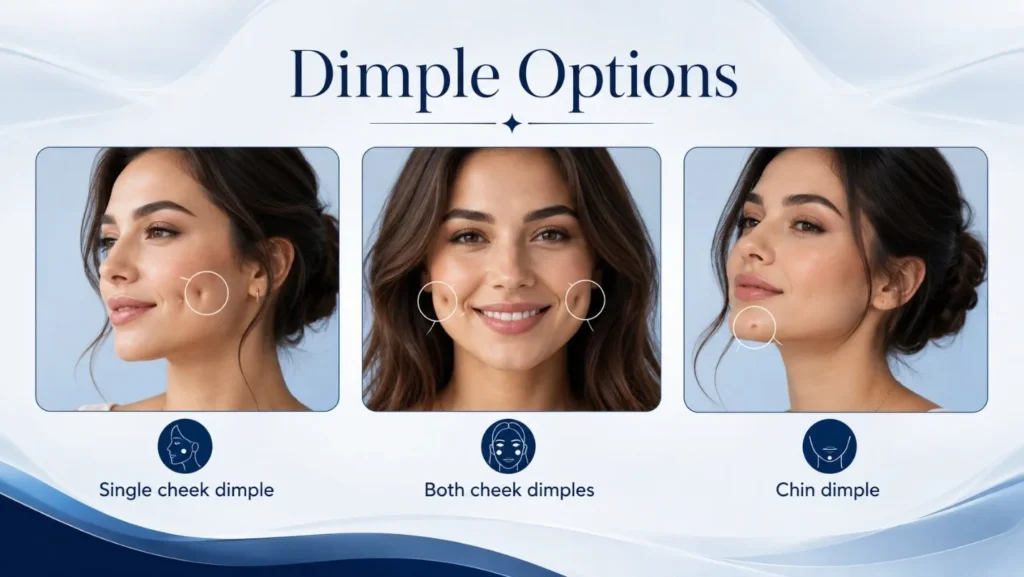
- Cheek dimples — bilateral (both cheeks): the most requested option.
- Cheek dimple — unilateral (one side): sometimes chosen deliberately, sometimes to match an existing natural dimple on the other side.
- Chin dimple (cleft chin) — a different operation using the mentalis muscle, creating a vertical chin cleft rather than a smile dimple.
- Dimple revision — correcting a dimple placed too deep, too high or asymmetrically elsewhere.
- Dimple reversal — releasing an unwanted created dimple.
Cheek dimple and chin dimple are not the same procedure A cheek dimple is a dynamic tether that appears when you smile, made in the buccinator/zygomaticus region. A chin dimple — a cleft chin — is a static feature created at the mentalis muscle and is visible all the time by design. Different muscle, different technique, different result. Pages that treat them as one procedure are a sign of copy written by marketers rather than surgeons. |
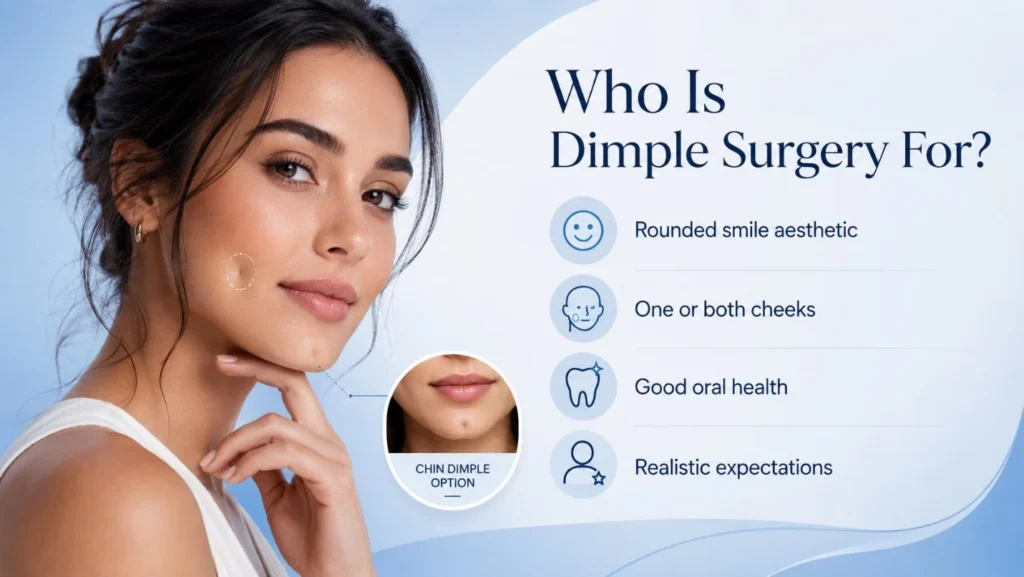
Who Is a Good Candidate?
Well suited
- Healthy adults who simply want dimples — no medical indication is needed; this is elective aesthetic surgery.
- Good oral health — healthy gums and no active dental infection.
- Realistic expectations — understanding the static phase and that the final dimple is subtle and smile-activated.
- Anyone wanting symmetry with one existing natural dimple.
Not suitable — or not yet
- Active oral infection or gum disease — treat first; the incision is inside the mouth.
- Very thick cheeks — the dimple may be shallow or unreliable; the coring technique helps, but expectations must be honest.
- Keloid tendency or abnormal scarring history — discussed carefully.
- Under 18, or unclear motivation — elective facial surgery deserves a settled, self-directed decision, not social pressure.
- Bleeding disorders or uncontrolled diabetes — medical clearance first.
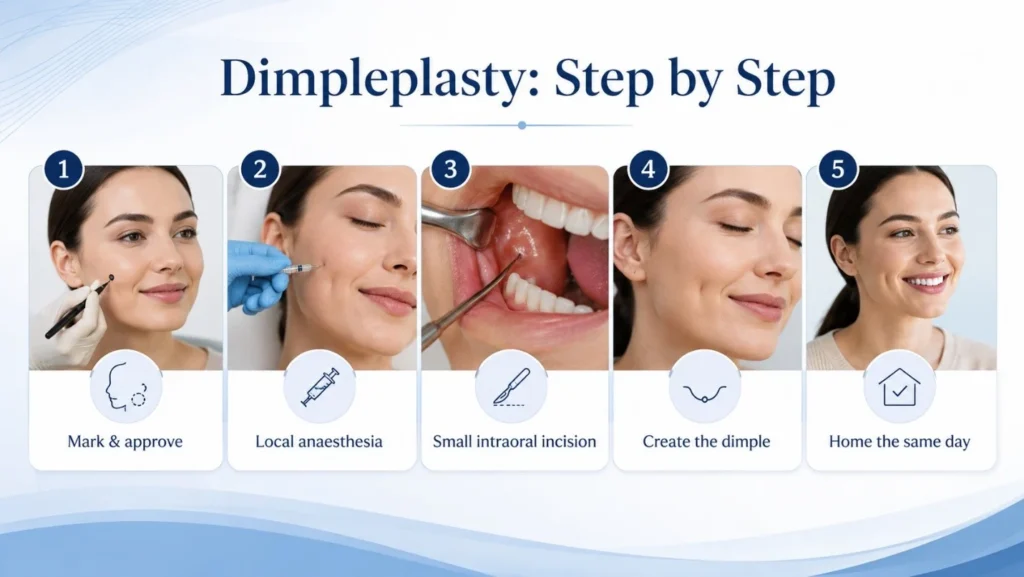
The Procedure, Step by Step
- Consultation & smile assessment. Your facial proportions and — importantly — how your face moves when you smile are assessed, and the technique chosen for your cheek thickness.
- Marking & your approval. The position is marked and reviewed with you in the mirror, at rest and smiling, before anything begins.
- Local anaesthesia. The inside of the cheek is numbed. The procedure is essentially painless; you’ll feel pressure only.
- Small intraoral incision. A few millimetres on the inner cheek at the planned point. Nothing on the outside.
- Creating the adhesion. Depending on technique, a small core of tissue is removed and/or an absorbable suture is placed linking the dermis to the muscle — with care around the buccal branch of the facial nerve and the parotid duct.
- Check, close & home. Both sides compared for symmetry and depth, closed with dissolvable sutures. Total: 20–30 minutes; you go home straight afterwards.
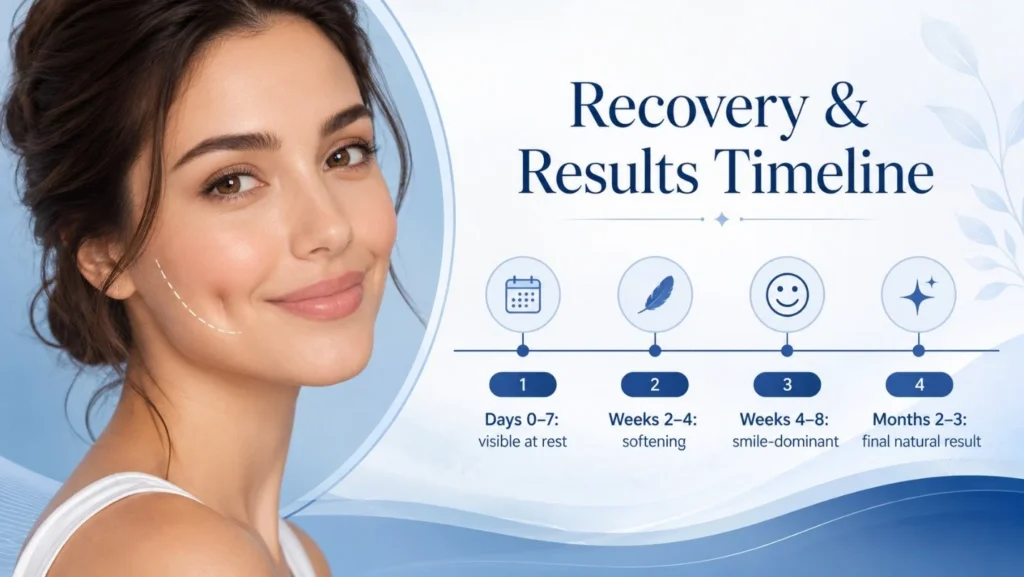
Downtime & Recovery
Timeframe | What to expect |
Day 0 | Mild swelling and tightness; the dimple is immediately visible. Soft, cool food. |
Days 1–3 | Swelling peaks then settles; most people resume normal routine and work. |
Days 4–7 | Comfort back to normal; intraoral stitches dissolving. Normal diet resumes. |
Weeks 2–8 | The static dimple gradually softens as the deep suture dissolves and tissue matures. |
Months 2–3 | Final, natural smile-activated dimple. |
Aftercare
- Antiseptic mouth rinses after every meal for the first week — oral hygiene protects the incision.
- Soft, lukewarm food for 2–3 days; avoid very hot, spicy or crunchy food.
- Don’t poke or press the dimple — and don’t test it repeatedly in the mirror; the adhesion needs to mature undisturbed.
- Avoid strenuous exercise for about a week.
- Attend the follow-up — and call if you notice increasing pain, swelling or discharge rather than steady improvement.
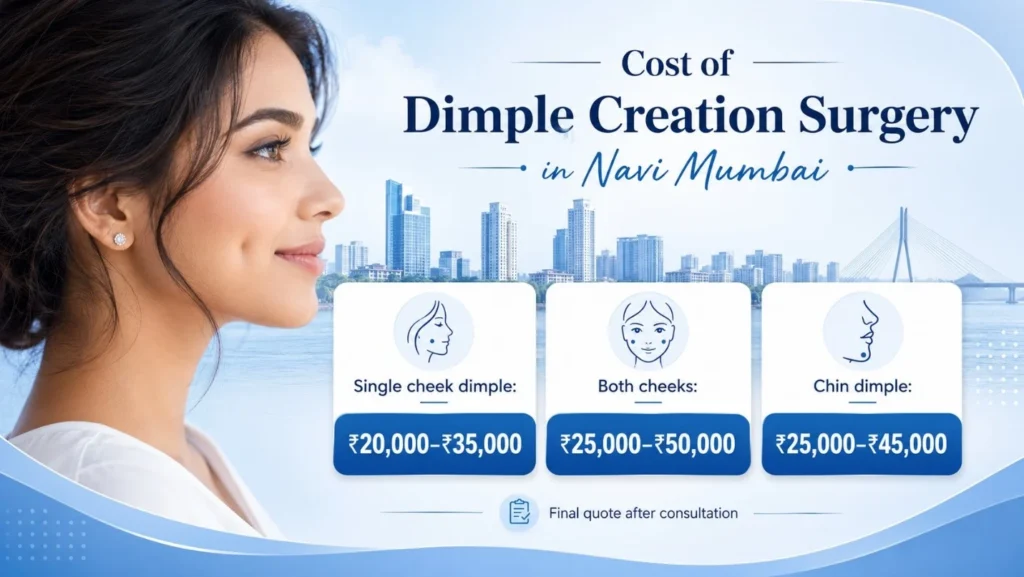
Cost of Dimple Creation Surgery in Navi Mumbai
Cost depends on whether you’re having one dimple or two, cheek or chin, and the technique used. Because the procedure is done under local anaesthesia as day care, there are no hospital or anaesthetist charges in most cases. These are honest indicative ranges for Navi Mumbai; your exact quote follows consultation. EMI options are available.
Procedure | Indicative cost |
| |
Single cheek dimple (unilateral) | ₹20,000 – ₹35,000 |
| |
Both cheek dimples (bilateral) | ₹25,000 – ₹50,000 |
| |
Chin dimple (cleft chin) | ₹25,000 – ₹45,000 |
| |
Dimple revision / reversal | Assessed case by case |
| |
Combined with chin augmentation or buccal fat removal | Quoted together — usually less than separately |
| |
| Why bilateral costs barely more than single — and what to actually compare The surgical steps — preparation, anaesthesia, marking, closure — are almost identical whether you do one side or two; only a few extra minutes are added. So a second dimple should not double your quote. What genuinely varies is the surgeon’s experience and judgement in placement, and whether the price includes follow-ups and any revision. This is permanently on your face every time you smile: compare the assessment you’re offered, not the discount. | ||
Results Timeline
When | What you’ll see |
Immediately | Dimple present straight away — deeper than final, plus swelling. |
Week 1 | Swelling settles; dimple still clearly visible at rest. |
Weeks 4–8 | Resting dimple softens progressively as the deep suture dissolves. |
Months 2–3 | Final natural result — visible mainly when smiling. |
Long term | Generally permanent. Suture-only dimples can soften over years; revision is straightforward if wanted. |
How Dimpleplasty Compares
| Dimpleplasty | Most facial surgery |
Duration | 20–30 minutes | 1–3 hours |
Anaesthesia | Local only | Often sedation or general |
External scar | None — intraoral | Usually some, however well hidden |
Back to routine | 2–3 days | 1–2 weeks |
Reversible | Usually yes | Rarely |
Final result | 2–3 months | 3–6 months |
Worth noting the contrast with buccal fat removal: that procedure is permanent and irreversible, so it demands far more deliberation. Dimpleplasty sits at the opposite end — small, quick and usually reversible — which makes it one of the lower-commitment ways to change a facial feature. That’s not a reason to be casual about it, but it is a genuine and reassuring difference.
Risks & Safety
Dimpleplasty is a low-risk procedure in trained hands, but it is still surgery inside the mouth in an anatomically busy region. Honest list:
- Asymmetry — the most common aesthetic issue; minimised by careful measurement and intraoperative comparison.
- Dimple fading or loosening — the adhesion can weaken, more commonly with suture-only technique; revision can restore it.
- A dimple that stays too deep at rest — usually from over-tightening; adjustable.
- Infection — uncommon, managed with rinses and antibiotics; good oral hygiene matters.
- Swelling, bruising or temporary numbness — expected and short-lived.
- Facial nerve or parotid duct injury — rare, and the specific reason this procedure belongs with a surgeon who knows the region.

Why Dr. Arun Panda a Maxillofacial Surgeon for an Intraoral Procedure
Dimpleplasty is marketed as a quick cosmetic add-on, which obscures what it actually is: intraoral surgery beside the buccal branch of the facial nerve and the parotid duct, where the aesthetic result depends entirely on millimetre-level placement judgement. Dr. Arun Panda is a Cranio-Maxillofacial and fellowship-trained Facial Plastic and Cosmetic Surgeon and founder of Trinity Aesthetics Academy, where he trains other doctors in aesthetic procedures. For a dimple creation surgeon in Navi Mumbai, that pairing — intraoral anatomy plus facial-aesthetic judgement — is exactly what this operation asks for.
- Intraoral surgery is everyday ground. Maxillofacial training means this approach and this anatomy are routine, not occasional.
- Placement judged on your smile in motion, marked and approved by you in a mirror before anaesthetic.
- Technique chosen for your anatomy — suture or coring, explained rather than defaulted.
- Honest expectation-setting about the static phase, so the recovery holds no surprises.
- Revision and reversal handled in-house if you ever change your mind, or if a dimple created elsewhere needs correcting.
- Full facial contouring context. Considered alongside chin augmentation, buccal fat removal or fillers where that serves the face better.
Frequently Asked Questions
How much does dimple creation surgery cost in Navi Mumbai?
Indicatively ₹20,000–₹35,000 for a single cheek dimple and ₹25,000–₹50,000 for both cheeks. A chin dimple (cleft chin) runs ₹25,000–₹45,000. Bilateral costs only modestly more than unilateral because the preparation, anaesthesia and closure steps are nearly identical. Ask whether follow-ups and any revision are included. EMI options are available.
Is dimple creation surgery permanent?
Generally yes — once the internal adhesion matures into scar tissue, the dimple is lasting. That said, suture-only dimples can soften or fade over time, while coring/fixation techniques tend to be more durable. If a dimple does loosen, revision is straightforward.
Why is my dimple visible even when I’m not smiling?
This is normal and expected for the first few weeks. The internal suture holds the adhesion while scar tissue forms, which makes the dimple visible at rest — often looking deeper than you anticipated. It softens progressively over roughly 4–8 weeks as the suture dissolves, settling into a natural smile-only dimple by around 2–3 months.
Does dimple creation surgery leave a scar?
Not on your face. The entire procedure is performed through a small incision inside the cheek, closed with dissolvable stitches. There is no external incision and nothing visible from the outside.
Is dimpleplasty reversible?
Usually, yes — which is one of its genuine advantages over most facial procedures. If you decide you no longer want the dimple, the adhesion can generally be released surgically. Reversal isn’t guaranteed to leave things exactly as they were, so it shouldn’t be treated as a free trial, but the option exists.
Does it hurt, and how long is recovery?
The procedure is essentially painless under local anaesthesia — you’ll feel pressure rather than pain. Afterwards expect mild soreness and swelling for a couple of days, a soft diet for 2–3 days, and antiseptic mouth rinses for a week. Most people are back to normal routine within 2–3 days.
Can I choose where my dimples go and how deep they are?
Yes — within what will look natural on your face. Position, depth and whether you want one or both are planned with you and marked before surgery, and you approve them in a mirror at rest and while smiling. Placement is the single biggest factor in whether a created dimple reads as natural or as a dent.
What is the difference between a cheek dimple and a chin dimple?
They’re different procedures. A cheek dimple is a dynamic tether created in the buccinator/zygomaticus region that appears when you smile. A chin dimple — a cleft chin — is created at the mentalis muscle and is a static feature visible all the time by design. Different muscle, different technique, different result.
Will a dimple work if I have chubby cheeks?
Often yes, but the result can be shallower and less reliable, because thicker soft tissue resists the tethering effect. In fuller cheeks the coring technique is usually preferred as it creates a stronger adhesion. Sometimes buccal fat removal is discussed alongside — but only if there’s a genuine indication for it, not simply to make a dimple show.
Book a Dimple Consultation
See your dimple marked before you decide. Book with Dr. Arun Panda at Bodyskulpt Aesthetics, Sector 9, Vashi, Navi Mumbai. You’ll have your smile assessed in motion, see the proposed position marked and reviewed in a mirror, get the technique and its durability explained, hear exactly what the first few weeks will look like, and receive a clear itemised quote. Explore chin augmentation, buccal fat removal, or book a consultation. Call / WhatsApp: 9152020907 / 9152020908 • drarunpanda.com • EMI available |
Authoritative references
For independent information, see the American Society of Plastic Surgeons, NCBI StatPearls on facial anatomy and peer-reviewed literature on dimpleplasty.
Educational information only and not a substitute for an in-person surgical consultation. Dimple creation is elective aesthetic surgery; results, durability and recovery vary between individuals
Please reach out to us through the contact details below.
- Website: https://drarunpanda.com/
- Phone: +919152020907, +919152020908
- Address: Dr. Arun Panda, BodySkulpt Aesthetics, F1/A-4, Aditi Apartments, Sector 9, Vashi, Navi Mumbai – 400703
- Facebook: https://www.facebook.com/DrArunPanda
- Instagram: https://www.instagram.com/drarunpanda/
- Youtube: https://www.youtube.com/DrArunPanda
- LinkedIn: https://www.linkedin.com/in/drarunpanda
- Twitter: https://twitter.com/DrArunPanda1
- Email: facialaestheticsindia@gmail.com
- Google Directions: https://g.page/DrArunPanda?gm